According to www.microsoft.com, Microsoft has deployed more than 25 AI agents and applications across its global supply chains — spanning over 70 Azure regions, 400 datacenters, and a 600,000 km fiber network — as part of its transition to an autonomous, agentic supply chain.
From Excel to autonomous agents
Microsoft’s internal supply chains — supporting Azure infrastructure, Windows and Devices (including Surface and Xbox hardware), and cloud services — have undergone a decade-long transformation. In 2018, the company consolidated more than 30 legacy systems into a unified supply chain data lake on Azure, enabling predictive analytics. By 2022, it began experimenting with generative AI; today, it operates a scalable AI platform hosting fully autonomous agents. The goal is to deploy over 100 agents by the end of 2026 and equip every employee with AI copilots for simulation, insight generation, and action recommendation.
Real-world agent use cases
- The Demand Planning Agent drives AI-based demand-simulations for non-IT rack components — improving forecast accuracy and reducing manual reconciliation.
- The Multi-Agent DC Spare-Part Space Solver uses computer-vision-driven monitoring and multi-agent reasoning to forecast spare-part storage needs and proactively mitigate space or stockout risks.
- The CargoPilot Agent continuously analyzes transport modes, routes, cost structures, carbon impact, and cycle times — delivering optimized shipment recommendations that balance speed, sustainability, and efficiency.
Simulations and physical AI: Bridging digital and real world
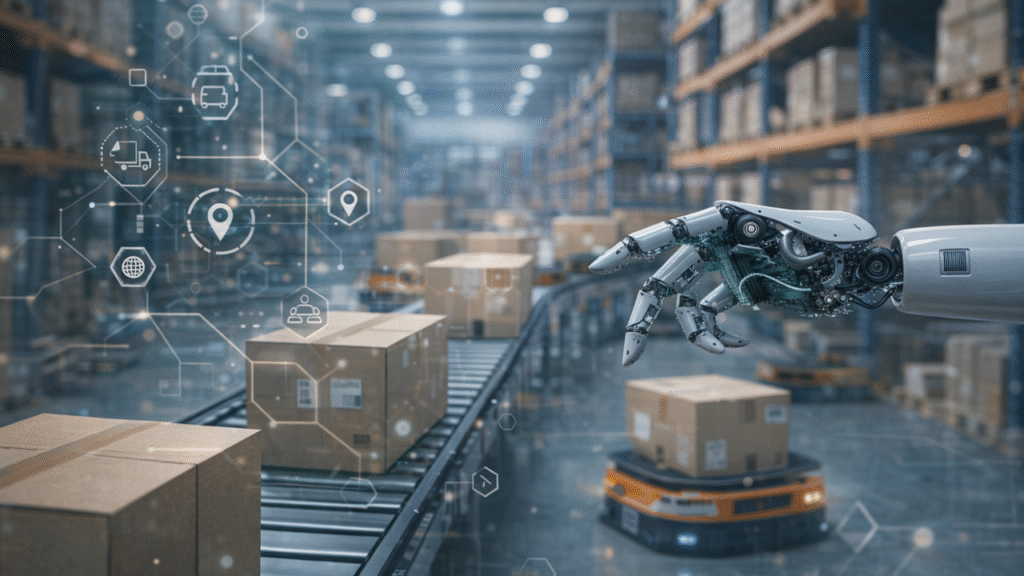
Microsoft identifies three converging innovation pillars: digital twins and simulations (virtual replicas of warehouses, factories, and transport networks); physical AI and robotics (autonomous material handling, inventory counting, and quality inspection); and edge-to-cloud intelligence (AI models deployed in warehouses, on trucks, and at ports, coordinated centrally via cloud). These are already operational: partners like Capgemini are building agentic end-to-end offerings using Microsoft IQ technology for release at Hannover Messe in April 2026. Logistics firms are piloting autonomous forklifts and robotic picking systems integrated with Microsoft’s supply chain platforms.
Supply Chain 2.0: Autonomous, adaptive, sustainable
Microsoft envisions supply chains that are autonomous (self-optimizing, disruption-responsive without human intervention), adaptive (reconfigurable to market shifts, customer demands, and regulatory changes), and sustainable (optimized for carbon footprint, resource efficiency, and circular economy principles). This convergence of AI agents, simulations, and physical AI marks a paradigm shift from reactive, manual operations to proactive, intelligent ecosystems.
“The future is not about replacing humans with machines, but about augmenting human decision-making with AI-powered insights and automation.” — Microsoft, “Supply Chain 2.0: How Microsoft is powering simulations, AI agents, and physical AI”
For global supply chain professionals, this signals an inflection point: AI agents are no longer prototypes but production tools driving measurable improvements in forecasting, spatial optimization, and multimodal logistics. Integration with edge devices, robotics, and digital twins means planning and execution layers are converging — requiring updated skill sets in data orchestration, system interoperability (e.g., Model Context Protocol), and cross-domain validation of AI outputs. As Microsoft scales to 100+ agents by 2026, practitioners must prioritize secure, auditable agent workflows and invest in foundational data infrastructure — because agent efficacy remains bounded by data quality, system connectivity, and domain-specific guardrails.
Source: www.microsoft.com
Compiled from international media by the SCI.AI editorial team.