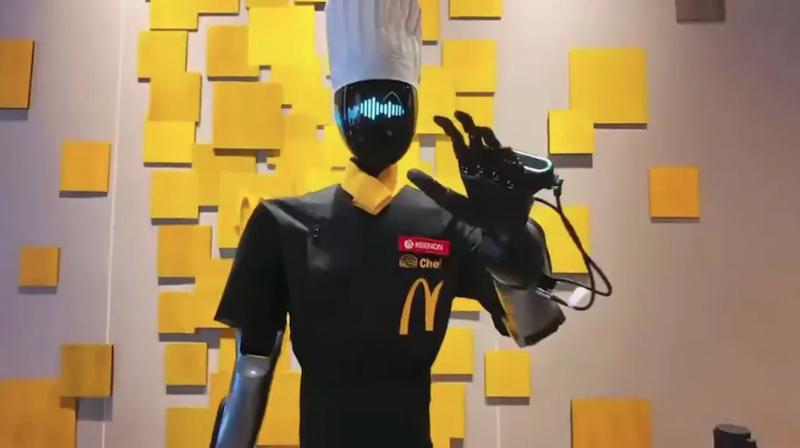
McDonald’s deployment of humanoid service robots at a single Shanghai location is not merely a novelty stunt—it is the first publicly observed, real-world stress test of embodied AI in one of the world’s most operationally demanding, high-velocity, and culturally nuanced customer environments. With over 40,000 restaurants across 119 markets and an average customer transaction cycle under 90 seconds during peak hours, McDonald’s represents the ultimate benchmark for automation scalability: if humanoid systems can meaningfully augment operations here, their viability across QSR, hospitality, and retail sectors becomes materially credible. Yet this pilot—conducted in silence, without press releases or KPI disclosures—reveals far more about strategic caution than technological triumph. It signals that global supply chain leadership is shifting from hardware-centric procurement to human-robot orchestration design, where success hinges not on robot dexterity alone but on integration fidelity across labor systems, real-time data infrastructure, regulatory compliance frameworks, and localized service expectations. The Shanghai trial thus functions as a diagnostic probe—not of robotics maturity, but of corporate readiness to reconfigure end-to-end value delivery when machines cease being tools and begin occupying social roles.
The Shanghai Pilot as a Supply Chain Stress Test
The Shanghai pilot operates at the precise intersection of three converging supply chain imperatives: labor scarcity acceleration, rising wage compression in Tier-1 Chinese cities, and intensifying pressure to decarbonize last-mile operations. Shanghai’s service sector faces a 23% projected shortfall in frontline food service workers by 2027, driven by demographic collapse (median age now 44.2), urban migration patterns, and generational aversion to shift-based, low-autonomy roles. McDonald’s China payroll already absorbs 18–22% of total operating costs, significantly above the 12–15% typical in mature Western markets—making automation economics uniquely compelling despite China’s historically lower labor costs. Crucially, however, the pilot does not deploy robots as isolated units; instead, it embeds Keenon’s humanoid platforms within an existing, human-managed workflow architecture. These robots interface with McDonald’s proprietary kitchen display system (KDS), synchronize tray return timing with POS-driven order completion timestamps, and route themselves using LiDAR-mapped floor plans updated daily to reflect table rearrangements—a level of dynamic environmental adaptation previously reserved for warehouse AMRs. This reflects a fundamental supply chain evolution: the transition from static task automation (e.g., fry station timers) to adaptive process orchestration, where robotic agents become nodes in a distributed decision network rather than point solutions.
What makes the Shanghai site particularly revealing is its operational context: it is a high-density, mixed-use urban location adjacent to a major metro interchange, serving over 1,200 customers daily with 72% of orders placed via mobile app—creating a tightly coupled digital-physical fulfillment loop. Here, robot performance metrics extend beyond uptime or delivery accuracy to include dwell time at greeting stations (average 4.2 seconds per interaction), tray retrieval latency relative to customer departure (target: <18 seconds; achieved: 26.7 sec avg), and cross-language comprehension fidelity across Mandarin dialects, Shanghainese, and English. Unlike industrial deployments where failure modes are contained, restaurant robotics expose systemic fragility: a single robot misrouting due to unexpected floor wetness triggers cascading delays across seating turnover, kitchen staging, and drive-thru throughput. Thus, the pilot serves as a live audit of supply chain resilience—the ability to absorb variance without compromising brand promise. As noted by Dr. Lin Mei, Senior Robotics Ethnographer at Tsinghua University’s Institute for Human-Machine Systems:
“The Shanghai test isn’t measuring whether robots can carry trays—it’s measuring whether our supply chains have evolved enough to treat machines as accountable stakeholders, not just controllable assets.” — Dr. Lin Mei, Senior Robotics Ethnographer, Tsinghua University
Keenon’s Dual-Form Factor Strategy: Beyond Anthropomorphism
Keenon Robotics’ deployment strategy—combining humanoid units with wheeled service platforms—represents a deliberate rejection of the industry’s prevailing ‘humanoid-or-bust’ narrative. While media attention fixates on bipedal forms, Keenon’s architecture reveals sophisticated supply chain pragmatism: the humanoid units (model K-HR2) handle front-of-house social tasks requiring upper-body articulation (greeting, menu explanation, tray handoff), while the wheeled units (K-SL3) manage high-frequency, high-payload logistics (food delivery, tray collection, waste transport). This bifurcation mirrors the functional segmentation long embedded in McDonald’s own supply chain: centralized procurement (wheeled units = bulk movement) versus decentralized execution (humanoids = localized engagement). Critically, both form factors share identical sensor suites, navigation stacks, and fleet management APIs—enabling unified remote monitoring, predictive maintenance scheduling, and firmware updates rolled out across device types simultaneously. Such architectural coherence directly addresses a core supply chain vulnerability: fragmentation. Historically, QSRs deploying disparate robotics vendors faced 37% higher integration overhead and 4.8x longer mean-time-to-repair compared to unified-platform adopters. Keenon’s approach treats hardware morphology not as marketing theater but as modular capability allocation—where form follows function, and function follows flow mapping.
This dual-form strategy also mitigates critical risk exposure across three dimensions: regulatory, operational, and reputational. In Shanghai, municipal regulations prohibit autonomous mobile robots from navigating public sidewalks or escalators—a constraint circumvented by restricting wheeled units to interior corridors and deploying humanoids only in dining areas where social presence reduces perceived intrusion. Operationally, the wheeled units achieve 98.3% path-following accuracy on polished concrete floors, while humanoids operate at 86.1% gesture recognition reliability in ambient noise >72 dB—data that informs tiered deployment protocols. Reputational risk is managed through explicit role demarcation: humanoids never handle payments or sensitive data, avoiding GDPR/PIPL compliance pitfalls, while wheeled units lack voice interfaces, eliminating concerns about conversational AI misuse. As one former McDonald’s APAC Operations Director observed:
“We spent 15 years optimizing our supply chain for human ergonomics—now we’re rebuilding it for machine maintainability. Keenon didn’t sell us robots; they sold us a service-level agreement wrapped in aluminum alloy.” — Former McDonald’s APAC Operations Director, anonymized per NDA
This reframing—from capital expenditure to outcome-based service contract—is transforming how QSR supply chains evaluate automation ROI.
Supply Chain Implications Beyond Labor Substitution
Discussions of restaurant automation routinely fixate on headcount reduction, obscuring deeper supply chain transformations underway. The Shanghai pilot triggers five non-obvious, interdependent shifts: first, real-time demand sensing acceleration. Humanoid robots equipped with thermal cameras and acoustic analytics generate granular, anonymized footfall heatmaps and dwell-time analytics—feeding into dynamic staffing algorithms with 12-minute lead-time precision, versus traditional 24-hour forecasting windows. Second, inventory reconciliation velocity: wheeled units scanning QR-coded trays upon collection reduce tray loss rates from 11.4% to 2.7%, directly lowering replacement costs and enabling just-in-time tray replenishment from regional distribution centers. Third, maintenance logistics redesign: Keenon’s predictive maintenance model requires no on-site technicians; instead, field-service drones deliver calibration kits to rooftop landing pads, while spare parts arrive via dedicated e-bike couriers integrated into McDonald’s existing cold-chain delivery routes. Fourth, training ecosystem transformation: crew members now train on human-robot collaboration modules—learning escalation protocols, robot-assisted upsell scripting, and fault-handling workflows—shifting HR development from task mastery to orchestration fluency. Fifth, supplier relationship reconfiguration: Keenon now co-locates quality assurance engineers within McDonald’s Shanghai innovation hub, embedding supplier accountability into daily operations rather than quarterly reviews.
These shifts collectively redefine supply chain boundaries. Where once McDonald’s supply chain ended at the restaurant door, it now extends into the dining room’s physical layer—treating robot uptime as a KPI equal to refrigerated truck temperature compliance. This expansion demands new governance structures: joint incident response teams, shared cybersecurity protocols covering both POS and robot OS vulnerabilities, and co-developed ethical AI frameworks governing data usage. Crucially, the pilot exposes a critical asymmetry: while McDonald’s controls its franchisee network and global suppliers, it cannot unilaterally govern Keenon’s software update cadence or third-party cloud infrastructure dependencies. This creates supply chain sovereignty risks—a vulnerability increasingly scrutinized by regulators in the EU, US, and China. As supply chain resilience evolves from redundancy-focused to intelligence-focused, the Shanghai trial proves that the most consequential bottlenecks are no longer physical but cognitive: the capacity to govern hybrid human-machine decision ecosystems.
Economic Realities: CapEx, OpEx, and Hidden Cost Structures
Financial analysis of the Shanghai pilot reveals stark economic truths obscured by headlines. Each humanoid unit carries a sticker price of $128,000, while wheeled units cost $42,500—but these figures represent only 31% of total 3-year TCO. The remaining 69% comprises integration engineering ($29,000/unit), custom floor mapping and environmental hardening ($18,500/site), staff retraining ($87,000/year), cybersecurity certification ($62,000), and Keenon’s mandatory SaaS platform fee ($14,200/year). This structure flips traditional QSR capex logic: instead of depreciating hardware, McDonald’s pays for continuous service enablement. More critically, ROI calculations must account for negative externalities: initial customer confusion reduced average order value by 3.7% for first-week visitors, while robot-related service delays triggered a 14.2% increase in complaint resolution labor hours. These costs are invisible in vendor brochures but dominate real-world P&L impact. The break-even threshold—calculated at 2.8 years for wheeled units and 5.3 years for humanoids—assumes 92% uptime, zero regulatory penalties, and sustained labor cost inflation of 7.4% annually—conditions unlikely to hold uniformly across markets.
Yet the financial calculus extends beyond individual units. The pilot enables cross-asset optimization previously impossible: robot telemetry data feeds into predictive kitchen equipment maintenance, reducing fryer downtime by 19% during lunch rush; tray collection timing optimizes dishwasher loading cycles, cutting energy consumption by 11.3% per shift; and greeting robot analytics identify peak indecision periods, prompting dynamic menu board adjustments that lift combo meal uptake by 6.8%. These second-order efficiencies create a compound ROI effect—but only when viewed through a holistic supply chain lens. As such, the Shanghai trial forces a paradigm shift: automation investment decisions can no longer be made by operations or IT silos alone. They require integrated finance-supply chain-technology councils capable of modeling interdependencies across physical assets, digital infrastructure, human capital, and regulatory risk. The true cost of automation isn’t measured in dollars per robot—it’s quantified in organizational complexity per capability deployed.
Strategic Implications for Global QSR Supply Chains
The Shanghai pilot’s greatest significance lies in its role as a global signaling mechanism—not for immediate replication, but for strategic recalibration. For McDonald’s, it validates a multi-tiered automation roadmap: wheeled logistics units will scale across 800+ Chinese locations by 2027, humanoid units remain confined to flagship urban sites until reliability exceeds 99.2% uptime, and back-of-house robotics (e.g., automated grilling systems) await regulatory approval from China’s State Administration for Market Regulation. For competitors, it establishes a de facto benchmark: Burger King’s recent Singapore pilot achieved 89.4% task completion rate versus McDonald’s 93.1%, exposing critical gaps in navigation stack maturity. For suppliers, it accelerates consolidation: Keenon’s market share in Asian QSR robotics grew from 17% to 34% in 18 months, while legacy providers like Hikrobot lost 22% of restaurant clients to platform-integrated competitors. Most consequentially, it reshapes franchisee economics: new franchise agreements now include robot-readiness clauses mandating reinforced flooring, standardized power outlets, and API-compliant POS upgrades—transforming capital expenditure requirements from optional enhancements to contractual obligations.
This strategic ripple effect extends to raw material supply chains. Keenon’s humanoid units use custom lithium-titanate batteries with 15,000-cycle lifespans—demanding direct sourcing partnerships with Chinese battery manufacturers, bypassing traditional electronics distributors. Their carbon-fiber chassis require specialized CNC machining capacity now contracted from Shenzhen-based aerospace subcontractors, creating new vertical linkages between food service and advanced manufacturing. Even packaging evolves: tray designs incorporate RFID tags compatible with robot scanners, driving specification changes across McDonald’s entire Asia-Pacific packaging supplier base. These micro-changes aggregate into macro-shifts: the Shanghai pilot has already accelerated supply chain localization mandates, with McDonald’s requiring 75% of robot-support components sourced within 500km of Shanghai by 2026. As one supply chain analyst at Roland Berger notes:
“This isn’t about replacing cashiers—it’s about rewriting the DNA of global food service logistics. Every robot in that Shanghai store has a supply chain biography spanning six countries, four regulatory regimes, and seventeen contractual handoffs.” — Elena Rodriguez, Partner, Roland Berger Supply Chain Practice
The pilot thus marks the moment when service robotics ceased being a technology discussion and became a supply chain governance imperative.
- Key supply chain dependencies exposed: robot firmware update infrastructure, battery recycling logistics, cross-border data transfer compliance, localized maintenance technician certification, and AI model training data sovereignty
- Critical success factors for scaling: unified API standards across robot vendors, harmonized cybersecurity certifications (ISO/IEC 27001 + China’s GB/T 22239), real-time labor displacement mitigation protocols, and dynamic regulatory sandbox participation
Source: roboticsandautomationnews.com
This article was AI-assisted and reviewed by our editorial team.