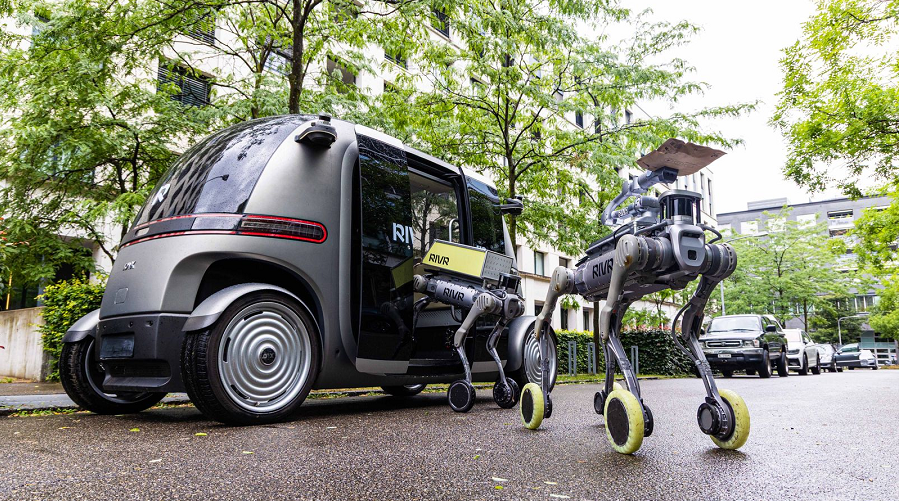
According to siliconangle.com, Amazon.com Inc. has acquired Rivr Technologies AG, a Swiss developer of autonomous last-mile delivery robots. The deal closed earlier this week, as first reported by CNBC on March 20, 2026; financial terms were not disclosed.
Rivr Two Robot Capabilities
Rivr’s flagship product is the Rivr Two, a four-legged robot that rolls on wheels and is purpose-built for last-mile delivery—the final leg between logistics hubs (e.g., warehouses or delivery vans) and end customers. Key technical specifications include:
- Carrying capacity of more than 60 pounds in an internal compartment
- Top speed of 8.7 miles per hour—approximately twice walking pace
- Autonomous navigation features: stops at red lights, opens gates, and climbs stairs
- Safety systems: high-visibility lighting, instant obstacle-triggered stopping, and a physical deactivation button
Deployment Models & Amazon’s Prioritization
The Rivr Two supports multiple operational models. Retailers can deploy it for direct store-to-customer deliveries, while logistics providers can integrate it into existing van fleets. In the latter scenario, drivers and robots split tasks at delivery stops—enabling parallelized drop-offs and improving route efficiency. Amazon plans to prioritize this van-integrated use case, aligning with its reliance on a vast network of third-party delivery contractors.
In an internal memo shared with logistics partners, Amazon stated:
“We are in the early stages of this journey, and as we progress, we will engage you and our teams to help us field test this technology, gathering real-world insights and incorporating your feedback into how we scale this technology in the future.”
AI Software & Broader Supply Chain Applications
Beyond hardware, Rivr’s AI software stack represents a strategic asset. Its training framework combines supervised and unsupervised learning methods—using labeled datasets alongside unlabeled data—to develop navigation and decision-making models. Rivr claims this approach enables rapid adaptation: during one internal project, its software was ported to a new robot form factor in just one week.
This flexibility may extend across Amazon’s operations. The company operates more than 1 million robots in its fulfillment centers. Rivr’s AI could enhance perception, path planning, or coordination capabilities in those environments. The acquisition also complements Amazon’s $1.2 billion 2020 acquisition of Zoox Inc., a self-driving vehicle startup currently testing autonomous SUVs in multiple U.S. cities. Combined, Zoox’s autonomous vans and Rivr’s sidewalk-capable robots could enable end-to-end autonomous delivery workflows—from regional hubs to front doors.
Industry Context for Supply Chain Professionals
This move follows broader industry momentum toward automation in final-mile logistics. In 2023, Nuro deployed its R2 robot commercially with Kroger and FedEx; in 2024, Amazon launched Scout trials in Washington state before pausing the program. Meanwhile, Locus Robotics and Berkshire Grey have scaled AMRs in warehouses, and Ocado’s grid-based robotic fulfillment systems now serve retailers globally—including Morrisons and Kroger. Rivr’s stair-climbing and gate-opening functionality differentiates it from many wheeled competitors constrained to flat, gated, or curb-accessible environments—a practical advantage in dense urban and suburban residential areas where over 70% of U.S. e-commerce deliveries occur (U.S. Census Bureau, 2025 E-Commerce Report). For supply chain professionals, integration readiness—especially around fleet interoperability, driver training, regulatory compliance (e.g., local sidewalk robotics ordinances), and real-time fleet telemetry—will be critical in pilot phases. Early engagement with Amazon’s field-testing initiative offers a tangible pathway to influence deployment standards and service-level agreements for autonomous last-mile support.
Source: siliconangle.com
Compiled from international media by the SCI.AI editorial team.