PACT Collaborates with Utility Companies to Accelerate Zero-Emission Vehicle Infrastructure Development
==========================================================
Promoting Strategies and Best Practices for Zero-Emission Freight Corridors

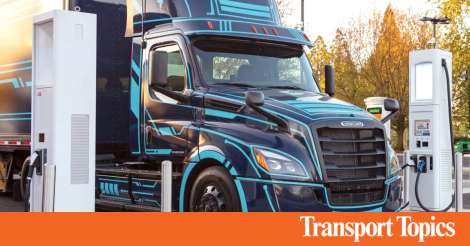
A Freightliner eCascadia is charging. (Daimler Truck North America)
Powering America’s Commercial Transportation (PACT) and the Edison Electric Institute signed a memorandum of understanding on October 17 to help advance the普及所需的基础设施。
The Edison Electric Institute, an association representing investor-owned electric utilities, and PACT, a lobbying coalition led by truck manufacturers, plan to collaborate to accelerate grid readiness for medium- and heavy-duty truck electrification. Their partnership also supports the Biden administration’s National Zero-Emission Freight Corridors strategy.
Partners also plan to develop best practices for estimating when and where truck charging loads will occur, processes for utilities to support timely power supply, and policies by state and local governments to reduce planning costs and time.
“PACT’s collaboration with the Edison Electric Institute is a critical and necessary step toward unlocking the future benefits of zero-emission commercial vehicles,” said Aravind Kailas, Volvo Group’s North American Advanced Technology Policy Director.
When PACT was established in January, Volvo joined as one of the founding members alongside Daimler Truck North America and Navistar Inc. (now known as International Motors). These three companies account for five out of the top seven brands in Class 8 heavy-duty truck sales in the U.S.
Daimler Truck is the parent company of Freightliner and Western Star, while Volvo Group owns Volvo Trucks and Mack Trucks. International Motors is the parent company of International Trucks.
“Close collaboration between medium- and heavy-duty vehicle manufacturers, truck fleets, charging infrastructure developers, and electric utilities is critical for an affordable energy transition in the trucking industry,” Kailas said.
By May, membership in the alliance had grown to 24 companies, including some of North America’s largest carriers such as Amazon.com Inc. and J.B. Hunt Transport Services.
This memorandum of understanding signals to the freight market that utilities are allies, Kailas told TT in an interview. “We can present a united front,” he said.
Membership has tripled since PACT’s inception, strengthening a consistent message, Kailas noted. He added that more companies are ready to join as the momentum builds and potential partners become increasingly likely to align with them.
Collaboration with the Department of Energy and the Department of Transportation is expanding, with PACT being asked for feedback on the National Zero-Emission Freight Corridors program, he said.
“Medium- and heavy-duty truck fleets represent a new customer base for U.S. electric utilities, and we are proud to partner with PACT to ensure their seamless integration into the energy grid in an economically viable manner,” said Phil Dion, Senior Vice President of Customer Solutions at the Edison Electric Institute.
“Through collaboration, we believe our two industries can accelerate the adoption of EVs in commercial sectors and prepare the energy grid for future transportation network needs,” he added.
Executives from truck manufacturers are disappointed with the pace of adoption and infrastructure development for electric battery trucks.
Meanwhile, executives like Robert Sanchez, CEO of Ryder System Inc., and Shelley Simpson, CEO of J.B. Hunt, have a clear assessment of the scale of challenges facing alternative fuel trucks.
—
Source: Transport Topics