According to www.microsoft.com, Microsoft has deployed more than 25 AI agents and applications across its global supply chains — spanning over 70 Azure regions, 400 datacenters, and a fiber network exceeding 600,000 km — as part of its transition to an autonomous, agentic supply chain.
From Excel to Agentic Operations
Microsoft’s internal supply chain transformation began in 2018 with the consolidation of more than 30 legacy systems into a unified supply chain data lake on Azure. This enabled predictive analytics and laid the groundwork for cognitive capabilities. In 2022, the company began experimenting with generative AI and subsequently built an AI platform to operationalize agents at scale. Today, three flagship agents demonstrate tangible impact:
- Demand Planning Agent: Drives AI-based demand simulations for non-IT rack components, improving forecast accuracy and reducing manual reconciliation.
- Multi-Agent DC Spare-Part Space Solver: Uses computer-vision-driven monitoring and multi-agent reasoning to forecast spare-part storage needs and proactively mitigate space or stockout risks.
- CargoPilot Agent: Continuously analyzes transport modes, routes, cost structures, carbon impact, and cycle times to deliver optimized shipment recommendations balancing speed, sustainability, and efficiency.
The company aims to operate over 100 agents by the end of 2026 and equip every employee with agentic support. Early results show AI in logistics is saving Microsoft teams hundreds of hours each month.
Simulations and Digital Twins
Microsoft emphasizes that supply chain resilience now hinges on pre-emptive simulation. Discrete event-based simulations (DES) — powered by Azure Machine Learning and new machine learning models in Microsoft Fabric with Power BI semantic models — allow organizations to test demand patterns, shortages, and disruptions in risk-free virtual environments. Partners such as paiqo (with prognotix), Cosmo Tech, and InstaDeep offer AI-powered forecasting, risk management, and last-mile optimization platforms on Azure.
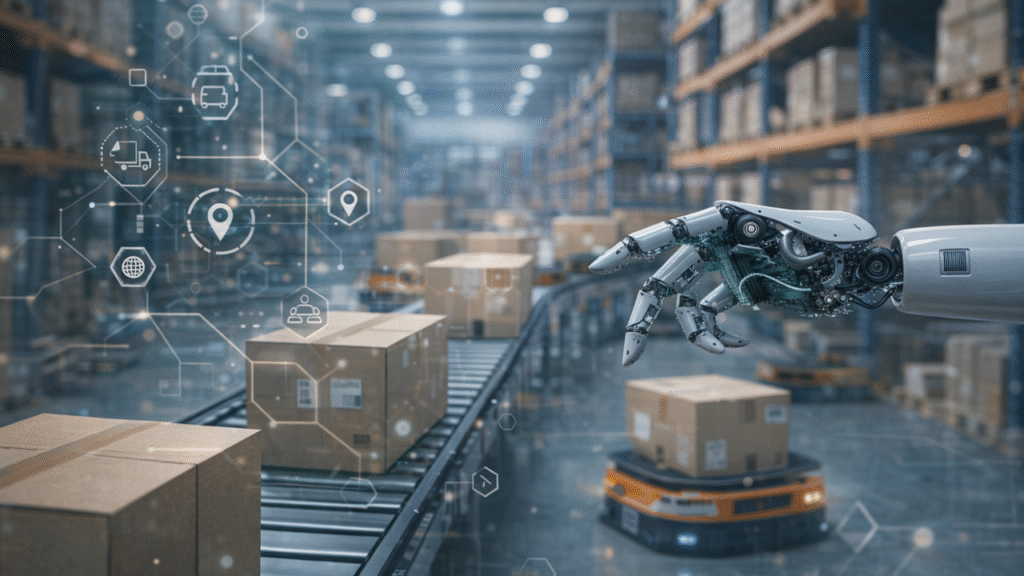
The next evolution integrates 3D physical simulations with DES to build comprehensive digital twins of warehouses, distribution centers, production lines, and logistics networks. These twins model both asset behavior and operational flow. With NVIDIA, Microsoft provides access to NVIDIA Omniverse™, NVIDIA Isaac Sim™, and NVIDIA Omniverse Kit App Streaming — enabling developers to simulate and test workflows before real-world deployment.
Physical AI and Embodied Intelligence
Advances in robotics and embodied intelligence — including frameworks like NVIDIA Cosmos and the OSMO edge-to-cloud compute framework on Azure — are expanding automation across warehouses, distribution centers, and transportation. These technologies empower humanoid robots and machines to act more effectively in physical environments — a foundational shift toward ‘physical AI’ in logistics operations.
Source: www.microsoft.com
Compiled from international media by the SCI.AI editorial team.