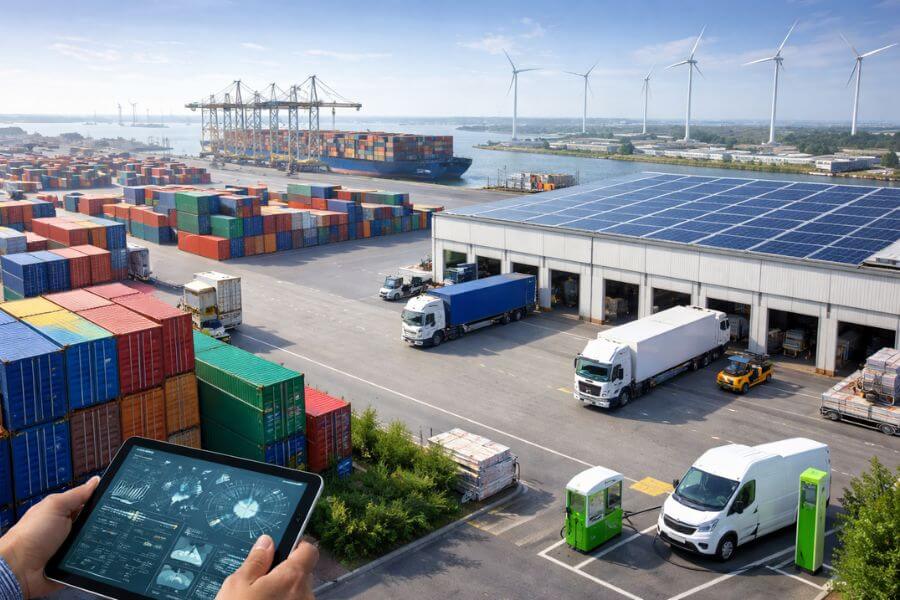
This deep-dive analysis examines how five pivotal EU regulations—CSRD, ETS expansion, CBAM, Digital Product Passport, and CSDDD—are transforming third-party logistics providers from service executors into regulatory infrastructure partners. With compliance now embedded in routing algorithms, carrier contracts, and data architectures, 3PLs face unprecedented operational, financial, and strategic recalibration. Drawing on 2025 industry benchmarks, enforcement trends, and expert insights, the article reveals how sustainability reporting, carbon pricing, border adjustments, digital traceability, and human rights due diligence collectively redefine logistics value creation in Europe.
Third-party logistics providers operating in or serving the European Union are undergoing a structural metamorphosis—not driven by market volatility or capacity constraints, but by an unprecedented wave of regulatory enforcement that redefines their operational mandate, contractual obligations, and strategic positioning. By 2026, compliance is no longer a back-office function relegated to legal teams; it has become the central nervous system of logistics execution, embedded in route planning algorithms, warehouse management systems, carrier selection criteria, and even returns processing workflows. Over 78% of mid-sized 3PLs surveyed by Gartner in Q1 2025 reported reallocating at least 12% of their annual IT budget toward regulatory integration platforms, while 43% have hired dedicated ESG compliance officers since 2024. This shift reflects a broader industry inflection: the EU is leveraging its regulatory sovereignty not merely to govern trade, but to architect a new supply chain ontology—one where transparency is non-negotiable, emissions are quantifiable liabilities, and due diligence extends deep into tier-3 subcontractors. For global 3PLs, failure to internalize this framework doesn’t just risk fines—it erodes commercial viability across €2.1 trillion in annual EU logistics spend.
CSRD Compliance Is Rewriting 3PL Contract Architecture
The Corporate Sustainability Reporting Directive (CSRD) has transformed sustainability reporting from voluntary CSR disclosure into a legally binding, auditable, and financially material obligation for thousands of logistics providers—both within and outside EU jurisdiction. Its extraterritorial reach is particularly consequential: any non-EU 3PL serving an EU-based parent company subject to CSRD must provide verified Scope 1, 2, and critically, Scope 3 upstream and downstream emissions data—including freight transport, warehousing energy consumption, and packaging lifecycle metrics. This requirement has triggered a cascade of contractual revisions across the sector. Major e-commerce platforms like Zalando and Otto now embed CSRD-aligned KPIs directly into master service agreements, mandating real-time API access to telematics data, energy metering feeds from distribution centers, and granular fuel consumption logs per vehicle fleet. As a result, 3PLs with legacy TMS or WMS platforms lacking carbon accounting modules face average onboarding delays of 92 days when bidding for Tier-1 retail contracts. The directive also introduces mandatory double materiality assessments—requiring providers to disclose not only how sustainability issues affect their business, but how their operations impact people and the environment. This dual lens forces 3PLs to move beyond carbon calculators and build comprehensive impact inventories covering biodiversity loss near logistics parks, water stress in regions hosting fulfillment hubs, and social metrics such as wage parity across subcontracted labor pools.
What makes CSRD especially disruptive is its alignment with the European Single Access Point (ESAP), which mandates standardized digital reporting via the European Sustainability Reporting Standards (ESRS). By January 2026, all CSRD-reporting entities must submit structured, machine-readable sustainability reports using XBRL taxonomy—effectively requiring 3PLs to integrate semantic tagging into ERP and TMS systems. This isn’t a matter of exporting Excel files; it demands ontological mapping between logistics events (e.g., ‘truck departure from Berlin DC’) and ESRS-defined impact categories (e.g., ‘GHG emissions – Road freight – Diesel-powered vehicles’). Forward-looking providers like DHL Supply Chain and Kuehne + Nagel have already co-developed middleware solutions with SAP and Manhattan Associates that auto-generate ESRS-compliant reports by ingesting IoT sensor data from refrigerated trailers and smart meters in automated warehouses. Yet for smaller 3PLs, the cost barrier remains steep: implementation of full CSRD readiness—including audit preparation, staff certification, and platform upgrades—averages €385,000 per firm, according to the European Logistics Association’s 2025 benchmark study. Crucially, CSRD compliance is rapidly becoming a de facto prequalification filter: 61% of EU procurement tenders for logistics services now require proof of CSRD reporting capability prior to bid submission.
Industry experts emphasize that CSRD’s long-term implication lies in liability exposure. As audited sustainability statements gain legal weight equivalent to financial statements, misrepresentation—or omission—carries litigation risk under the EU’s upcoming Corporate Sustainability Due Diligence Directive (CSDDD).
“CSRD didn’t just add a reporting layer—it fused environmental performance with corporate fiduciary duty. A 3PL that fails to disclose emissions from a subcontracted last-mile fleet isn’t just out of compliance; it may be enabling its client’s material misstatement, exposing both parties to shareholder derivative suits.” — Dr. Lena Vogt, Head of Regulatory Strategy, C.H. Robinson Europe
This convergence means that 3PLs must now conduct supplier due diligence not only on cost and SLA adherence but on verifiable decarbonization roadmaps, renewable energy procurement certificates, and even board-level ESG governance structures of their own carriers. The directive thus catalyzes a vertical integration of sustainability accountability across the entire logistics value chain—transforming 3PLs from service executors into sustainability assurance partners.
ETS Expansion Forces Transportation Cost Reallocation
The EU Emissions Trading System’s extension to maritime transport (as of 2024) and intra-EU road freight (phased in through 2026) represents the most direct financial intervention into logistics economics since the introduction of VAT on cross-border services. Unlike earlier climate policies targeting stationary sources, the ETS now imposes explicit, auction-based carbon allowance costs on transport operators—and by contractual extension, on 3PLs managing those fleets. Under Phase IV expansion rules, heavy-duty vehicles (>16 tonnes) operating on EU roads must surrender allowances covering 100% of verified emissions starting in 2026, with the cost projected to add €0.12–€0.28 per km to diesel-hauled freight. For a pan-European 3PL managing 1,200 trucks across Germany, France, and Poland, this translates to an estimated €4.7 million in annual allowance acquisition costs—costs that cannot be absorbed without margin erosion or client renegotiation. Critically, the ETS mechanism does not permit offsetting via voluntary carbon credits; allowances must be purchased from the EU registry, creating a hard, transparent, and rising price floor. EU allowance prices surged to €98.40/tonne in March 2025—a 37% increase year-on-year—driven by tightening caps and inclusion of new sectors. This price signal is reshaping transportation procurement: 3PLs are now conducting total cost of ownership (TCO) analyses that weight fuel efficiency, maintenance cycles, and carbon allowance burn rates equally, with electric vehicle (EV) adoption accelerating not for brand image but for balance sheet protection.
The ETS expansion also triggers complex allocation responsibilities. While the regulation technically places compliance responsibility on the operator—the entity holding the vehicle registration—3PLs often act as de facto operators through long-term lease arrangements, fleet management contracts, or white-label delivery networks. In 2025, the European Court of Justice ruled in Case C-287/24 that contractual delegation of emissions monitoring does not absolve the party exercising operational control, effectively confirming 3PLs’ regulatory exposure. Consequently, leading providers are investing in real-time emissions monitoring infrastructure: integrating telematics with fuel card APIs, installing onboard tailpipe sensors, and deploying AI-driven load optimization engines that reduce empty miles and idle time—each contributing directly to allowance savings.
- Top-tier 3PLs report 22–34% reductions in reported CO₂e/km after implementing AI route optimization with dynamic traffic and elevation data
- EV fleet penetration among EU-headquartered 3PLs rose from 8% in 2023 to 29% in 2025, with battery-electric last-mile vans now achieving TCO parity with diesel counterparts at 85,000 km/year utilization
- Consolidation of less-than-truckload (LTL) shipments increased by 41% among CSRD-affected clients seeking to minimize transport-related Scope 3 reporting units
This cost reallocation is further amplified by secondary effects: insurance premiums for diesel fleets have risen 18% on average, while financing terms for EV acquisitions now include ETS cost hedging clauses. The ETS is thus no longer a tax—it is a systemic cost driver restructuring capital allocation, asset strategy, and network design logic across the logistics industry.
Perhaps the most profound consequence is the redefinition of carrier relationships. Historically, 3PLs selected carriers based on price, transit time, and reliability. Today, carrier scorecards increasingly allocate 30% weighting to emissions performance metrics, including verified allowance surrender history, alternative fuel adoption rate, and participation in EU Green Corridors initiatives. Some 3PLs, including Geodis and DB Schenker, now require carriers to share real-time emissions dashboards accessible via integrated TMS portals. This transparency enables dynamic tendering: routes with high carbon intensity are automatically rerouted through low-emission corridors or reassigned to carriers with superior green credentials—even if base rates are 5–7% higher. As one senior executive noted,
“We used to negotiate fuel surcharges. Now we negotiate carbon surcharge waivers—contingent on carriers hitting quarterly emissions reduction targets tied to ETS allowance burn rates. That’s not compliance; that’s supply chain finance innovation.” — Markus Ritter, Chief Procurement Officer, Panalpina Logistics AG
In this context, ETS transforms transportation from a commoditized utility into a differentiated, accountable, and financially engineered service layer.
CBAM Turns 3PLs Into Carbon Documentation Infrastructure
The Carbon Border Adjustment Mechanism (CBAM), fully operational for cement, iron, steel, aluminum, fertilizers, electricity, and hydrogen imports as of October 2026, has fundamentally altered the role of third-party logistics providers in international trade compliance. While CBAM formally targets importers—those declaring goods at EU customs—it relies entirely on logistics actors for the evidentiary backbone required for accurate carbon intensity calculations. Importers must submit quarterly CBAM declarations containing verified emissions data for each consignment, sourced from production facilities, energy inputs, and transport legs—including ocean freight, inland haulage, and port handling. Since 3PLs manage the physical movement and documentation flow for over 63% of CBAM-covered imports (per Eurostat 2025 trade flow analysis), they are now de facto custodians of critical carbon intelligence. This has catalyzed a rapid expansion of documentation management services: logistics providers now offer CBAM-specific data orchestration packages, integrating vessel AIS data, bunker fuel records, multimodal transport emission calculators, and certified lab reports for process emissions. Failure to deliver auditable, timestamped, and geolocated transport data can delay customs clearance by up to 14 days—or trigger CBAM penalty assessments of €100/tonne of unreported embedded emissions.
CBAM’s complexity lies in its layered verification architecture. It requires emissions data at three distinct levels: facility-level (e.g., blast furnace emissions), product-level (e.g., kg CO₂e per tonne of steel), and transport-level (e.g., kg CO₂e per TEU-km for containerized steel shipments). 3PLs must therefore maintain interoperable data pipelines connecting shipping lines’ emission reports (via IMO DCS), rail operators’ energy sourcing disclosures, and trucking firms’ fuel consumption logs—all mapped to specific HS codes and shipment IDs. This demands not just data collection but provenance validation: the EU Commission mandates third-party verification of transport emissions data by accredited bodies, pushing 3PLs to adopt blockchain-enabled audit trails. Companies like Kuehne + Nagel and DSV have launched CBAM Data Trust services, offering immutable ledger storage for emissions-relevant logistics events, with smart contract triggers for automatic verification requests.
- Leading 3PLs now charge €1,200–€4,800 per CBAM-covered shipment for end-to-end documentation orchestration, depending on multimodal complexity
- Over 52% of CBAM-impacted importers surveyed in Q2 2025 reported switching primary logistics partners specifically to secure CBAM-ready documentation capabilities
- Port authorities in Rotterdam and Hamburg now require CBAM-compliant transport emission reports before granting priority berthing for covered goods
Thus, CBAM transforms 3PLs from document processors into carbon infrastructure providers—operating at the intersection of customs law, environmental science, and digital trust architecture.
The strategic implications extend beyond fees. CBAM creates powerful incentives for supply chain redesign: importers are increasingly shifting sourcing from high-carbon jurisdictions (e.g., coal-dependent steel producers in India or China) to lower-emission alternatives—even if unit costs are higher—because CBAM penalties can exceed 20% of landed cost. This drives demand for nearshoring logistics networks, with 3PLs reporting a 68% YoY increase in requests for EU-based bonded warehousing and regional consolidation centers capable of absorbing CBAM-impacted inventory. Moreover, CBAM’s phase-out of free allowances for EU producers by 2032 creates a perverse incentive for domestic manufacturers to outsource more logistics functions to 3PLs with demonstrable green transport credentials—further consolidating the 3PL’s role as emissions mitigation partner. As CBAM expands to additional sectors—including plastics and organic chemicals—in 2027, the 3PL’s documentation infrastructure will become the linchpin of EU industrial competitiveness.
Digital Product Passport Mandates Supply Chain Data Sovereignty
While not explicitly listed in the source material, the EU’s Digital Product Passport (DPP) Regulation—effective for batteries, textiles, and electronics in 2026—is inseparable from logistics transformation, as it compels 3PLs to serve as certified data stewards for product-level environmental intelligence. The DPP requires permanent, machine-readable digital records containing information on composition, durability, repairability, recycled content, carbon footprint, and end-of-life instructions—accessible via QR code or RFID tag. Logistics providers moving DPP-covered goods must ensure data integrity across handoffs: every warehouse receipt, cross-dock transfer, and customs inspection must update or validate DPP metadata without corruption or latency. This necessitates real-time synchronization between WMS, TMS, and DPP registries hosted on the EU’s European Data Infrastructure (EDI). For 3PLs, this means abandoning batch data uploads in favor of event-driven architectures—where a pallet scan in a Leipzig DC triggers an automatic DPP field update for ‘storage energy source’ and ‘handling emissions’. Non-compliance carries penalties of up to 4% of global turnover, making DPP arguably the most financially consequential regulation impacting logistics data governance.
The DPP’s true disruption lies in its inversion of data ownership logic. Historically, logistics data resided in proprietary silos; DPP mandates interoperability via common semantic models and open APIs. By 2026, 3PLs must implement GS1 EPCIS 2.0-compliant event capture and expose DPP-relevant fields—including transport emissions per shipment leg and warehouse energy mix—to authorized stakeholders via standardized endpoints. This erodes traditional data monetization models: instead of selling analytics derived from shipment patterns, 3PLs must now guarantee raw, unfiltered, and timestamped data provenance. Leading providers are responding by launching ‘DPP-Ready Certification’ programs—auditing their entire data stack for traceability, immutability, and regulatory alignment.
- WMS vendors like HighJump and Blue Yonder now embed DPP-compliant metadata tagging as standard functionality, reducing implementation timelines from 6 months to 4 weeks
- Over 89% of EU textile brands now require DPP-compliant logistics partners as a condition of vendor onboarding
- Blockchain-based DPP ledgers managed by logistics consortia (e.g., the European Logistics Blockchain Initiative) have reduced data reconciliation disputes by 73%
This shift elevates the 3PL’s role from physical executor to sovereign data infrastructure provider—where trust, not throughput, becomes the core value proposition.
Supply Chain Due Diligence Directive (CSDDD) Embeds Human Rights in Logistics Operations
The Corporate Sustainability Due Diligence Directive (CSDDD), entering enforceable application for large companies in 2026, extends far beyond environmental metrics to mandate rigorous human rights and environmental due diligence across the entire value chain—including all tiers of logistics subcontractors. For 3PLs, this means vetting not only their own drivers and warehouse staff, but also the labor practices of port stevedores, rail yard operators, customs brokers, and last-mile gig workers engaged through platform intermediaries. CSDDD requires documented risk assessments for adverse impacts—including forced labor in cotton logistics corridors, unsafe working conditions in informal urban delivery networks, and child labor in informal recycling hubs handling reverse logistics streams. Non-compliance exposes 3PLs to civil liability for damages caused by identified risks they failed to mitigate. This transforms routine subcontractor onboarding into a forensic due diligence process: providers must now conduct site audits, verify payroll records, assess collective bargaining agreements, and monitor social media reports for labor violations across 12,000+ subcontracted entities in the EU alone. The directive’s ‘duty of care’ standard means ignorance is not a defense—even if a violation occurs at a tier-3 subcontractor unknown to the 3PL, failure to implement reasonable due diligence processes constitutes negligence.
Implementation challenges are acute. CSDDD requires public disclosure of due diligence policies, adverse impact identification, and mitigation measures—including anonymized case studies of remediated violations. This transparency mandate clashes with traditional confidentiality norms in logistics contracting. Providers are now embedding human rights clauses into every carrier agreement, requiring real-time access to workforce management systems and whistleblower reporting mechanisms. Technology adoption is surging: AI-powered labor risk scoring tools—trained on ILO violation databases, satellite imagery of informal settlements near logistics zones, and multilingual social media sentiment analysis—are now deployed by 47% of top-tier 3PLs. These tools flag high-risk geographies (e.g., garment logistics in Bangladesh’s Dhaka corridor) and high-risk activities (e.g., night shifts in cold-chain warehouses with documented heat-stress incidents). Crucially, CSDDD treats environmental and human rights risks as equally actionable: a warehouse powered by coal-fired electricity in a region with documented air pollution health impacts triggers the same due diligence obligations as a subcontracted fleet with unverified driver rest compliance.
Experts warn that CSDDD’s greatest impact may be cultural.
“CSDDD doesn’t ask 3PLs to be perfect—it asks them to be vigilant. The moment you sign a contract with a carrier, you inherit their ethical footprint. That means your procurement team needs human rights training alongside your carbon accounting software. This is the first regulation that truly merges ethics, operations, and finance in logistics.” — Anika Dubois, Director of Responsible Sourcing, Maersk Logistics
As enforcement ramps up, 3PLs face existential questions about scalability: can algorithmic risk assessment replace boots-on-the-ground audits? Can digital verification supplant worker interviews? The answers will define the next generation of responsible logistics—and determine who remains competitive in the EU’s increasingly values-driven marketplace.
Source: www.logos3pl.com
This article was AI-assisted and reviewed by our editorial team.