Page Siplon begins work at the American Transportation Research Institute in November and will officially take over as president and chief operating officer in February of next year.
Leadership transition and strategic continuity
Siplon will succeed Rebecca Brewster, ATRI’s current president and COO, who is retiring after spending more than 30 years shaping ATRI’s work. He served as CEO of Georgia-based TeamOne Logistics, a logistics service provider, for more than a decade — not far from ATRI’s regional office in Atlanta. His background in logistics, driver retention and safety aligns directly with ATRI’s research on truck parking, detention reduction and freight bottlenecks.
Siplon’s work at TeamOne Logistics focused on truck driver retention and safety as well as the operational challenges carriers face — issues that have been central to ATRI’s research over the years. ’s announcement, the organization uses truck GPS data to identify key trucking bottlenecks across the country and addresses industry priorities including expanding truck parking and reducing detention times.
Brewster said she has known Siplon for years through his work as executive director of the Georgia Center of Innovation for Logistics and is excited to have him join ATRI. “Page’s leadership will be vital to carrying ATRI’s research mission forward at a time when trucking faces increasingly complex decisions,” she said.
Futureproofing trucking amid AI, automation and cost pressures
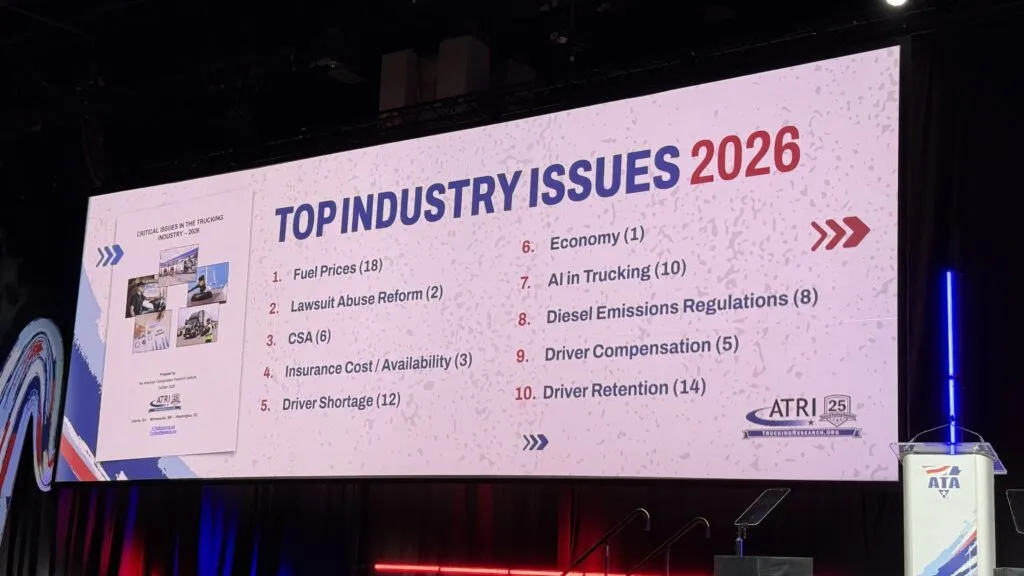
Siplon said he plans to expand industry partnerships and help trucking address future challenges including AI, self-driving trucks and fuel costs. He wants ATRI to help trucking become more profitable, efficient and safe while anticipating the questions the industry will face as it evolves. “ATRI has been well-positioned and has been answering those questions, and I want to double down on that,” Siplon said. “How do we futureproof the industry, whether it’s AI or self-driving trucks or whatever the case may be or just how do we manage fuel costs?”
He also served in the Air Force and Marine Corps, where he worked in technician roles supporting military operations. “Working with the military and working as a team — logistics, trucking, transportation, whatever capital word you wanna call it — it’s all collaborative, right?” he said. “And it needs to have partnerships because trucking doesn’t operate in a vacuum and transportation doesn’t operate on its own.”
“Trucking is more than just steering a wheel and pushing a pedal, right? It impacts our economy,” he told Transport Topics. “I think there’s opportunities for economic developers and truckers, who traditionally don’t get together in the same room and talk about issues.”
Public-sector engagement and cross-sector collaboration
Beyond his work at TeamOne Logistics, Siplon worked on logistics and innovation initiatives for the Georgia state government and founded the Georgia Logistics Summit, which is attended by shippers, manufacturers and transportation leaders. He has also served as vice chairman of the Department of Commerce’s advisory committee on supply chain competitiveness.
Related: Fuel prices rank as trucking’s most pressing concern. PCS Software CEO Mark Hill discusses the advance of AI in the trucking industry on RoadSigns.ttnews.com.
“In the years ahead, credible independent research will be essential to helping our industry navigate change, improve safety and make informed decisions.” — Rebecca Brewster, outgoing president and COO of the American Transportation Research Institute
Source: Transport Topics
Compiled from international media by the SCI.AI editorial team.