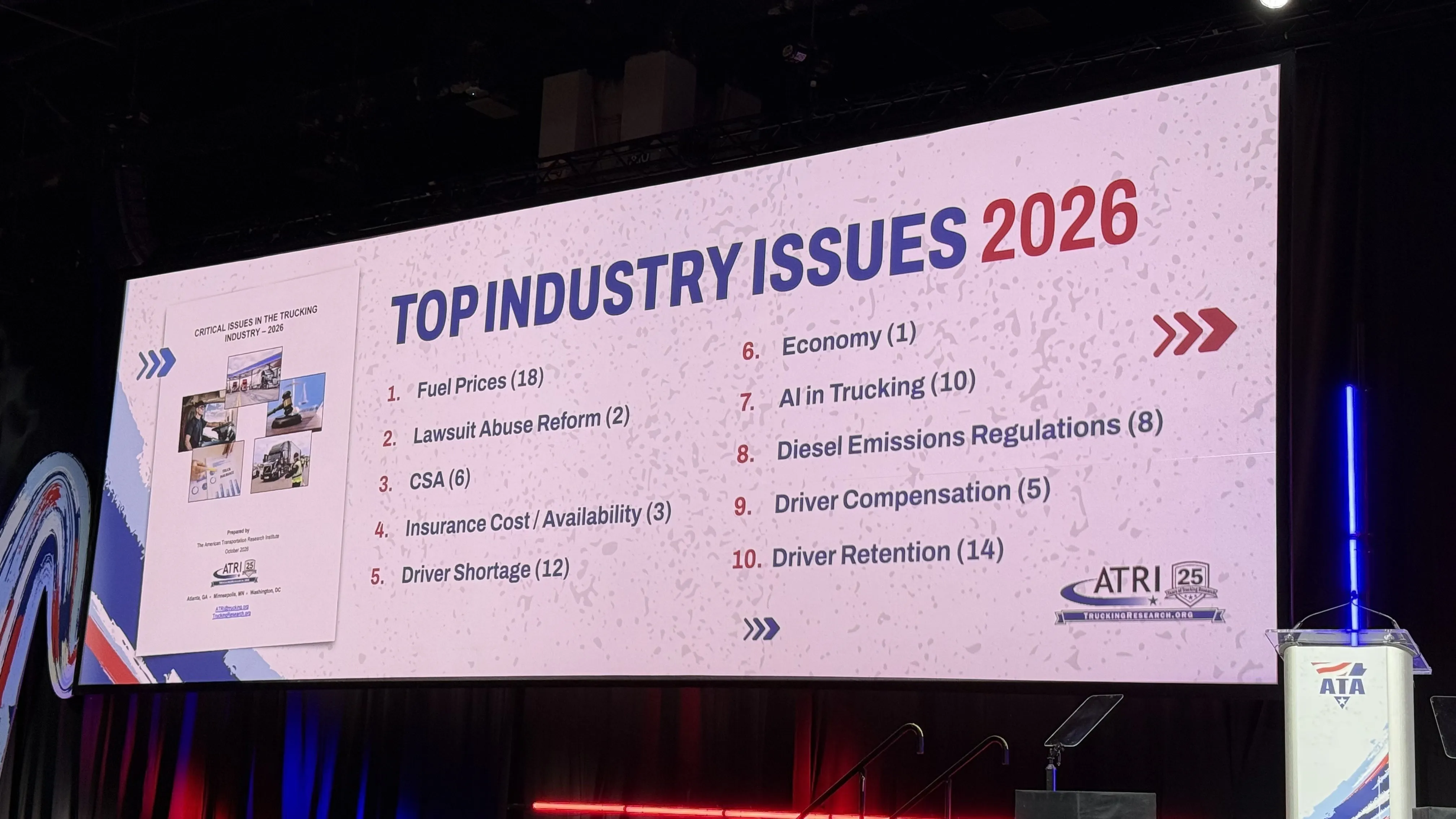
Fuel prices have surged to the top concern for the U.S. trucking industry in ATRI’s 2026 top 10 survey — the fourth time in 22 years and the first since 2023. Diesel hit a record $6.529/gallon on September 22, 2026. CSA scores rose to #3 overall amid heightened liability fears following the Montgomery v. Caribe SCOTUS ruling. Drivers ranked fuel #1 and parking #2; carriers ranked fuel #2 and lawsuit abuse #1. State-level caps on punitive damages and anti-phantom-medical-damages laws in Florida and Georgia emerged as top reform priorities.
This year’s study of the top issues facing trucking undertaken by the American Transportation Research Institute (ATRI) had a number one concern that didn’t even crack the top 10 in the prior two years: fuel prices. That issue was number one in the responses submitted by drivers and number two for carriers, finishing in the top slot overall.
Fuel Prices Return to #1 After Two-Year Absence
The carriers’ rating is particularly notable, because it undercuts the idea that fuel surcharges are able to effectively move the cost of fuel on to the shiplittle impact on the carrier, or that higher prices and the fuel surcharges that come with are a positive for carriers. The results in the survey suggest otherwise, at least to some degree. Although fuel prices didn’t make the list the last two years, ATRI, the research arm of the American Trucking Associations (ATA), said 2026 was the fourth time in the 22 years of its top 10 survey that fuel prices were the number one overall concern.
ATRI revealed its top 10 list Sunday at the ATA’s annual Management Conference & Exhibition meeting in Charlotte. Prior to appearing again on the ATRI list of “critical concerns in the trucking industry,” fuel prices were most recently number 3 on the list for drivers in 2023, when diesel at that point had set an all-time record for prices. It was number five on the list that year for carriers. But the issue was nowhere to be found in 2024 and 2025.
The highest average weekly retail diesel price reported by the Energy Information Administration in 2022 was $5.341/g on October 24. While the price was down in 2023, it remained above $4/gallon until May and then climbed back above $5 for most of August into November. The highest EIA weekly level this year was $6.529 on September 22, which also was the highest in the data series’ history. The AAA’s daily average fuel price hit a record in September as well.
CSA Scores Rise to #3 Amid Post-Montgomery Liability Concerns
The case of Montgomery vs. Caribe Transport II could be seen in the high rankings for several categories. For example, motor carrier Compliance Safety Accountability (CSA) scores were fourth in 2025 and fifth this year for motor carriers, third overall. One observation made by brokers is that in the post-Montgomery world where they are more likely to be held liable in a crash, what constitutes a best practice that in any subsequent litigation they can cite as having proved they did adequate due diligence in hiring a carrier?
For example, the nuclear verdict in Lipe vs. Lupus Superior involved a motor carrier with a Satisfactory rating from the Federal Motor Carrier Safety Administration. FMCSA officials have said they do not view their scores as a ratings tool. “Compliance Safety Accountability – FMCSA’s safety measurement system – has been a top 10 issue for 16 of the 17 years since CSA debuted on the list as the #2 overall concern in 2010,” the ATRI report said. “This year, driven in large part by the SCOTUS ruling, CSA is back up to the industry’s #3 overall concern, its highest ranking since 2015.”
While the respondents want FMCSA to address “enforcement disparities” and “geographic variations” in its work, there seemed to be little question that the industry believes CSA scores will help them in a lawsuit. “Based on the (Montgomery) ruling, brokers will need documented evidence that they hired the safest carriers to avoid negligent hiring claims, and carrier CSA scores are one such form of documentation,” the ATRI report on its survey said.
Driver-Carrier Divide Persists Across Key Issues
While the two sides of the trucking industry, driver and carrier, may agree on the impact of fuel prices, the divide that shows up regularly in this annual survey by ATRI was present for other issues. For example, truck parking, even after various efforts to improve its availability, showed up as number 2 on the list of drivers. For carriers, it wasn’t even in the top 10.
Lawsuit abuse was number two overall for the second consecutive year. It was number one for carriers. It didn’t show up in the top 10 for drivers. Driver shortage was number 3 for carriers, and not on the top 10 list for drivers. Broker issues: number 8 for drivers, not on the carriers list. Detention/delay at customer facilities was number 7 for drivers and didn’t make the top 10 cut for carriers.
Driver compensation between 2023 and 2026 for drivers was first, second, first and third. It popped up as number nine this year on the carriers’ list, but that is the first time in the last four years it has been in the top 10.
Solutions Focus on Lawsuit Reform and Insurance Frameworks
The ATRI survey also seeks input on solutions to the issues raised by the respondents. At the top of the list for lawsuit reform were state-level reforms “to cap non-economic and/or punitive damages paid to plaintiffs in truck-involved crashes.” Another target strategy for fighting lawsuit abuse, survey, would be to push for what are described as “phantom” medical damages.
ATRI described them as payouts that are ordered “by claiming the original billed total for medical care rather than the amount actually paid for medical care. These inflated costs increase verdict and settlement amounts, and several states – including Florida and Georgia – have passed legislation to rein in plaintiff claims for phantom medical damages.” Another target for fixing the issue, ATRI respondents, would be fighting third party litigation funding, where an outside attorney or group of attorneys provides upfront funding to power a lawsuit.
Insurance cost/availability was fourth on the overall list. Commentary on that brought up Montgomery as well. “The impacts of the SCOTUS ruling in Montgomery v. Caribe are just now starting to be realized but one thing is certain: insurance rates are likely to increase for motor carriers and brokers,” ATRI said. The top recommendation for dealing with that issue, would be to develop a “framework” that could possibly lead insurance companies to reduce premiums “when drivers and carriers adopt proven safety technologies.”
Source: FreightWaves
Compiled from international media by the SCI.AI editorial team.