
‘Tis the season for the annual capacity purge

Craig Fuller, CEO at FreightWaves · Thursday, November 27, 2025
As truckers celebrate the Thanksgiving holidays, the U.S. trucking industry stands on the brink of another tradition: the annual capacity purge.
The annual capacity purge happens between Thanksgiving and Valentine’s Day, each year and involves a significant increase in motor carriers leaving the industry compared to other times in the year.
This seasonal trend, clearly captured in SONAR’s Carrier Detail Net Changes in Trucking Authorities (CDNCA) data, shows a consistent surge in net authority losses during this period—outpacing new entrants even in the best economic years. The trucking industry has been an economic backwater for a couple of years and many carrier balance sheets are underwater by the damage done during the Great Freight Recession, the longest economic downturn in trucking history.
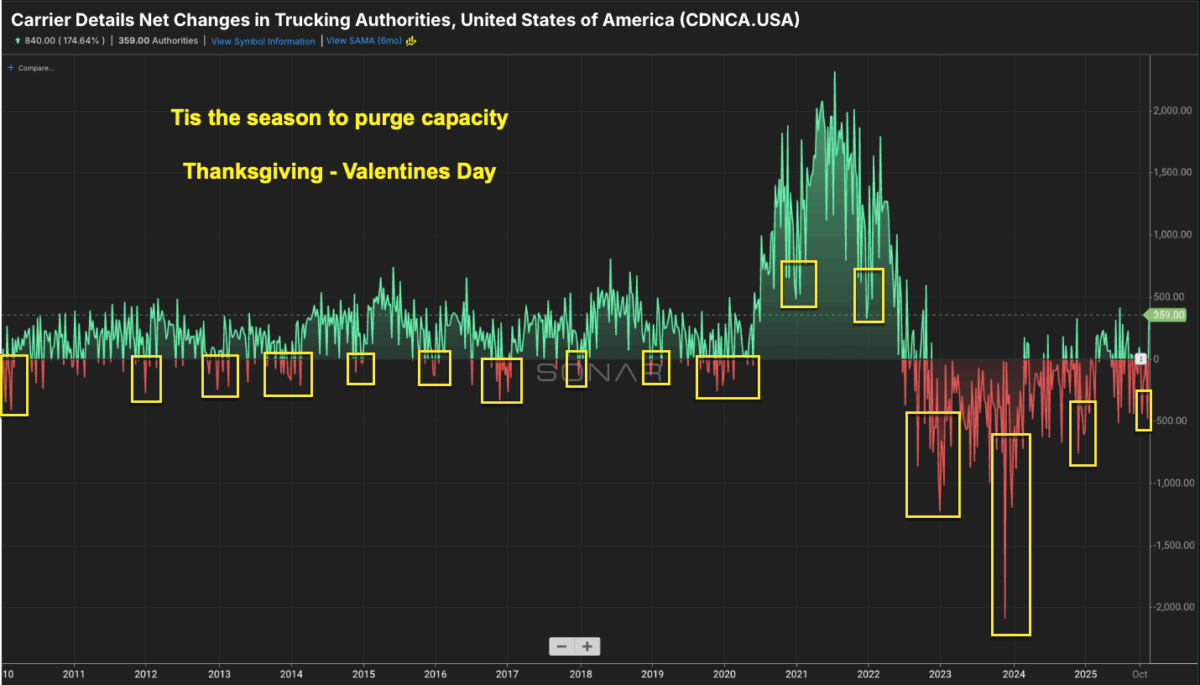
This year’s contraction could be more severe than usual.
'Tis the season for capacity churn. Drivers go home for the holidays and don't return. This year we could see a sharp increase, as foreign-born drivers leave the US and don't return to America, much less trucking. pic.twitter.com/Gj92VRtNSD
— Craig Fuller 🛩🚛🚂⚓️ (@FreightAlley) November 27, 2025
A Seasonal Pattern Rooted in Data
SONAR’s CDNCA data, which tracks the weekly net change in motor carrier of property trucking authorities by subtracting revocations from granted authorities, highlights a pronounced dip in net capacity from late November to mid-February. This timeframe sees a marked increase in carriers exiting the industry—voluntarily or involuntarily—while new operator startups tend to slow down. Even in strong years like 2018 or 2021, the Thanksgiving-to-Valentine’s window stands out as a period of net attrition.
As I noted in my recent X post:
“Tis the season to purge capacity. The trucking industry typically experiences a purge of net capacity from Thanksgiving – Valentine’s Day. Even in the good years, fewer new carriers were started during this period.”
Sign up free to read the full article
Create a free account to unlock full access to all articles.
Sign Up FreeAlready have an account? Sign in