
The Container That Learned to Swing
A Comparison of Musical and Logistical Sequencing Problems

Knut AlickeJul 10, 2026
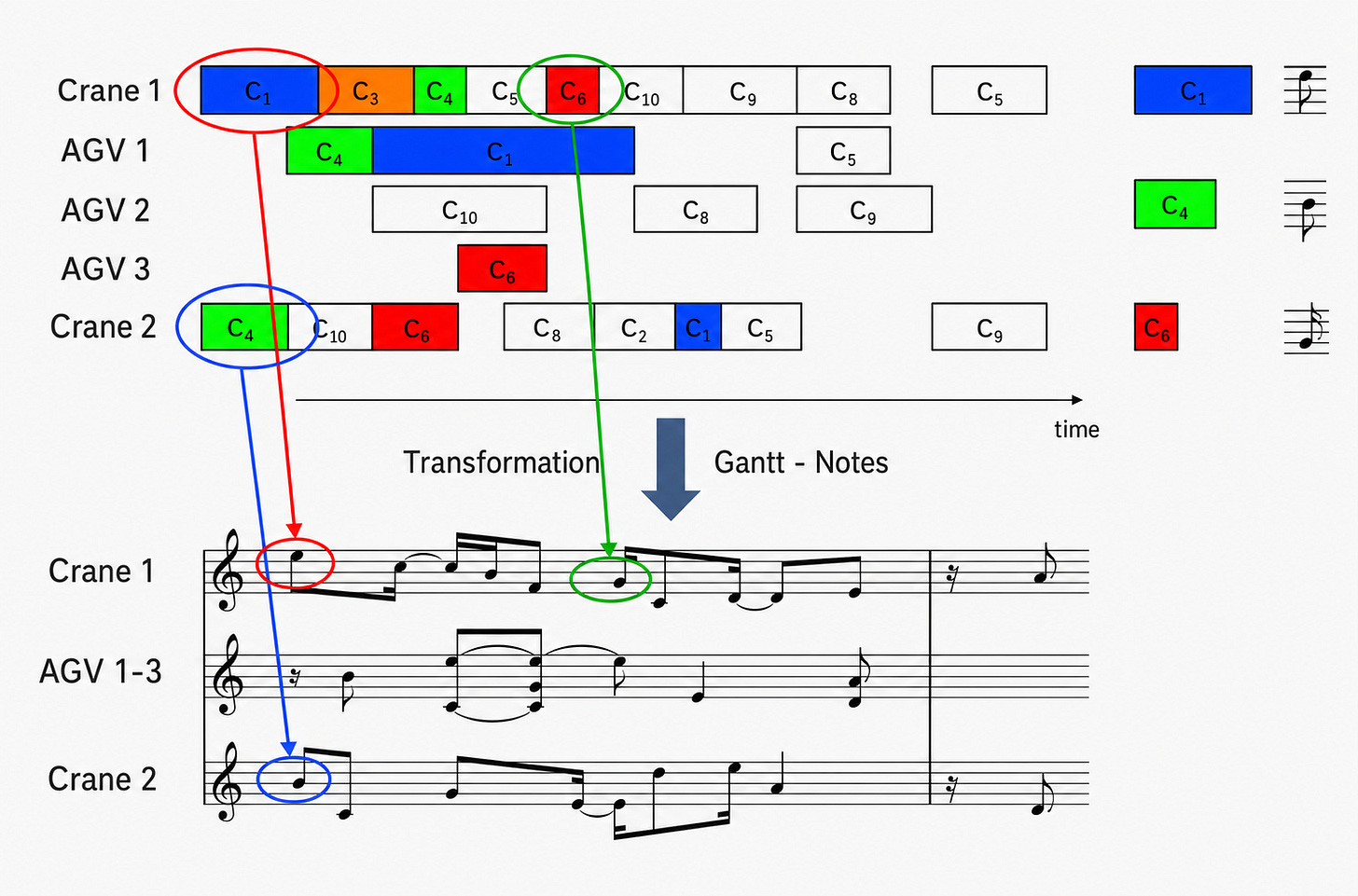
Music and logistics both live or die by their sequence, but judge it by opposite methods: one by ear, one by cost function. From my habilitation lecture over twenty years ago, I developed two experiments: mathematically analyzing Duke Ellington’s “Satin Doll” (matching its statistics perfectly still produces a lifeless tune) and transforming a real container terminal’s crane schedule into a playable three-voice score.
The experiment shows similarities between logistical and musical sequencing problems, even though formal correctness and quality are not the same thing in either field. This applies to today’s generative AI music tools and AI planning copilots.
Thanks for reading! Subscribe for free to receive new posts and support my work.
I close with four concrete takeaways for logistics practitioners drawn from musical practice: learn from existing patterns, keep human judgment in the evaluation loop, manage the meta-structure across the network, and standardize for real-time decentralized coordination.
In the late 1990s, I sat across from a planner responsible for sequencing the final assembly line of a German car plant. He has been working for 6 months on new software to optimize the sequence of cars on the final assembly line. The task is not easy, a set of complex sequencing rules like “not 3 combustion engines in a row” needs to be handled. The result of an optimization run was a number, such as 3498, representing the objective function’s value and indicating how well all constraints have been met. He looked at it the way you look at a phone number in a language you don’t speak. The other result was a picture: a scatter plot showing the list of cars in the assembly line, for which constraints were met, dense in some places, sparse in others. He called it, without a hint of irony, his Sternenhimmel, his heaven of stars.
He didn’t optimize the number. He optimized the picture. He’d sit with the tool and nudge the orders around by hand until the stars were evenly spread across the sky. It might be that nudging made 3498 even worse. When I asked him how he judges the quality of the solution, he was very clear: “The workers down at the line give feedback, and the best feedback I get is with a well-distributed heaven of stars.” He also talked, the way most experienced planners do, about “good patterns”, which are sub-sequences he kept in his back pocket and reused, shift after shift, because he’d learned they worked.
The optimization model took years to implement and the planner did not care about the objective function. The quality of the output was the heaven of stars, and only a human eye, trained by years on the floor, could read it.
I am, by day, a Supply Chain Professional and University Professor, and by disposition, a saxophonist. I’d been collecting a version of that same observation from both sides of my life for a long time before I stopped treating it as a coincidence.
The Habilitation lecture
A few years later, I turned that observation into a formal piece of research, my habilitation lecture at the University of Karlsruhe, titled with more German directness than English elegance: “A Comparison of Musical and Logistical Sequencing Problems.” The premise was simple to state and hard to prove. In both music and logistics, the central variable is sequence. An order-picking run, a container terminal’s crane schedule, a final-assembly line. The quality of the solution depends entirely on the order in which things happen. A melody makes exactly the same claim, the same seven notes, rearranged, can be a hit or a mess.
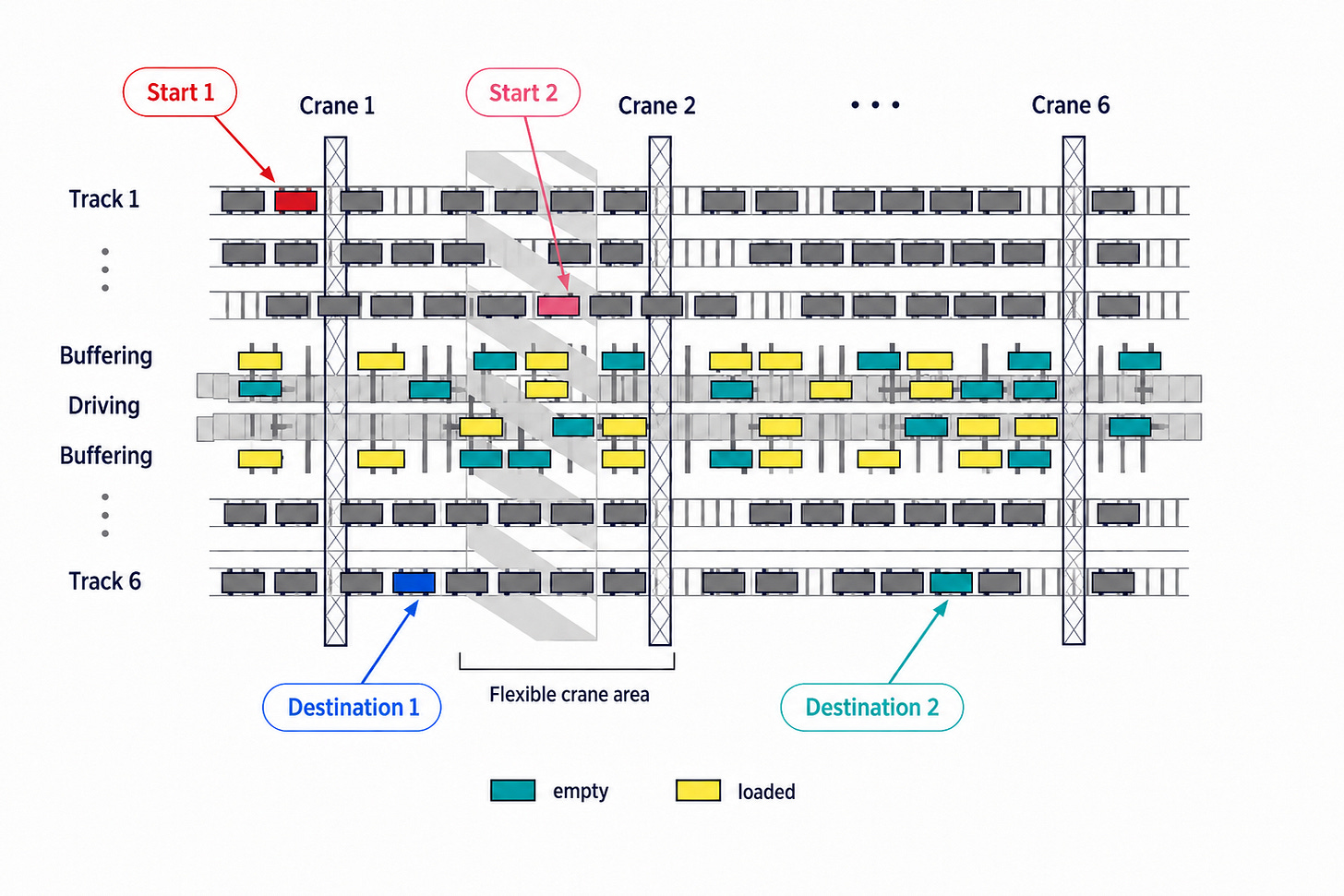
The centerpiece of that lecture, and of the argument that follows here, was a real container terminal (Picture 1), where trains exchange containers the way passengers change platforms. My idea was to represent the sequence of the containers, typically shown as a Gantt chart (Picture 2), as a musical sequence. An idea was born and had to be investigated in more detail. This article is about what I found out, similarities and lessons learned for music and for Logistics & Supply Chain.
How Each Field Builds and Judges a Sequence
Let’s get started with logistical sequencing: logistics cleanly splits its sequencing problems into two families.
Offline problems are those where every order is known before you start calculating and optimizing the sequence. The final-assembly sequence for tomorrow’s build plan, the pick sequence for a wave of orders already sitting in the warehouse management system. You have time, so you reach for exact or near-exact methods: branch-and-bound, constraint satisfaction, and metaheuristics like tabu search or genetic algorithms.
Online problems are the opposite, orders arrive live, the way calls arrive at an elevator bank, and you have to decide now which sequence to execute. This happens with incomplete information, using rules simple enough to execute in milliseconds.
These sequences optimize the objective function (i.e. minimize cost, minimize lateness, maximize utilization) and ensure constraints are met. Often planners call a good solution harmonic, well-designed, etc.
Music makes the identical split, under different names.
Composition is an offline problem: Imagine Johann Sebastian Bach sitting alone in a room in front of his piano composing a Cantata, or Duke Ellington composing Satin Doll. They do have nearly unlimited time to explore, try out, change the sequence and reevaluate until it matches their expectations. Johannes Brahms took that luxury to its extreme: his First Symphony took twenty-one years from first sketches to premiere, finally performed in 1876 in Karlsruhe. Brahms felt he was composing in Beethoven’s shadow and kept discarding what he’d written.
Improvisation is the online equivalent: a jazz combo trading choruses has no buffer, no chance to undo a phrase once it’s played, and has to generate a good sequence of notes in real time. Everyone in the room did agree to the set of rules like chord changes, functional harmony, the twelve-bar or 32-bar form, which are formally constraints in exactly the operations-research sense: they don’t tell you what to play, they tell you what you’re not allowed to play, and a good improviser searches the remaining space fast.
Sign up free to read the full article
Create a free account to unlock full access to all articles.
Sign Up FreeAlready have an account? Sign in