The Rhino in the Room
Why five years of shocks have not made us resilient, and the three numbers that would tell you whether you are.

Knut AlickeJul 17, 2026
Twenty percent of the world’s oil, forty percent of its helium, and nine percent transparency – notes from a conversation with Nico Nürbchen and Boris Felgendreher
For about ten years, every discussion about supply chain resilience opened with Fukushima. It was the reference case, wheeled out in every workshop and every steering committee, because apparently nothing else had happened worth citing.
Thanks for reading! Subscribe for free to receive new posts and support my work.
That era is over. Today you just need to refer to last week.
Chips are getting expensive again because data centers are being built and everyone wants the same silicon. Anyone buying a new phone will notice. Southern Germany experienced a heatwave that reduced productivity, and we are already discussing whether the Rhine will carry enough water. Disruption is no longer the exception we plan around, it is rather the condition we plan in.
The honest observation we discussed in the podcast is that companies learn remarkably little from each crisis. A shock arrives, a war room is built, the war room is dissolved, and six months later, someone calls to ask whether we could immediately set up a war room again to fight the shortage. A colleague of mine put it perfectly: the bigger the company, the shorter its memory – often only six months.
I discussed this topic in the latest Felgendreher & Friends masterclass with Nico Nürbchen, SVP of Global Supply Chain at Olympus, hosted by Boris Felgendreher. Olympus is now a pure MedTech company – Japanese, with roughly 30,000 employees, around €9 billion in revenue, headquartered in Tokyo, with the European center in Hamburg. It is a useful place to consider risk because the consequences of a stockout might affect a patient by delaying an operation.
We recorded on July 2, 2026. Some of the facts have already moved: as I write this, the strait is effectively closed again and traffic is down to a handful of vessels a day. That does not weaken the argument below.
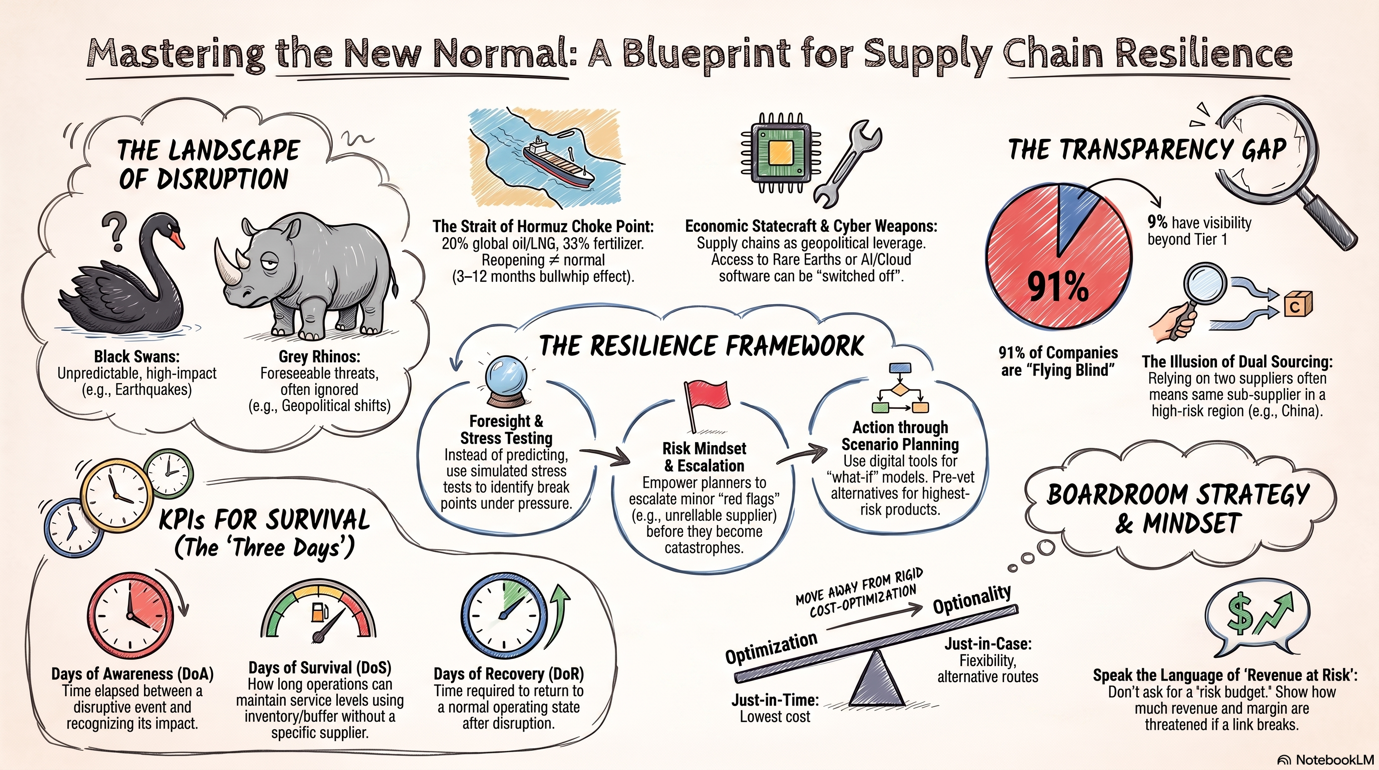
We have adopted the language of the black swan with enthusiasm, and it has quietly become an alibi. A black swan is unknowable by definition – a severe earthquake, an enormous impact, genuinely unpredictable. If it hits you, nobody can blame you.
Then there is the other category: equally large impact, but foreseeable. Most of what comes out of Washington belongs here. These are grey rhinos – big, slow, visible, walking straight at us while we watch the sky for black swans.
You can hold a philosophical debate about which category the Iran conflict falls into. What you cannot do is use the black swan as an excuse for the rhino.
The Strait of Hormuz is constantly in the news and is often understood only superficially. Roughly 20% of the world’s oil passes through it, 20% of LNG, a third of global fertilizer, and 45% of the world’s sulfur trade. A large share of the mono-ethylene glycol behind polyester, textiles, and packaging comes through it. Kerosene is already tight enough that airlines are cutting flights.
And then the one nobody has on their risk map: about 40% of global helium comes from Qatar. Helium is essential to semiconductor manufacturing. Fabs hold reserve tanks, and reserve tanks run out. On July 10, China, which imports most of its own helium, banned exports outright to keep its domestic fabs supplied.
Under normal conditions, 90 to 100 vessels transit the Strait of Hormuz per day. It was closed completely for long stretches; when it reopened, traffic ran at 20 to 40 a day, escorted, with mine clearance in between. The oil price went up, then came back down.
The strait is a choke point: a dependency you did not choose and can hardly substitute on a short-term basis.
Reopened is not recovered
Then the headline arrives – the strait is open again – and with it the narrative that we can go back to normal.
Picture the whole global supply chain as one very long pipeline. Normally, you keep filling it at one end, and the product keeps arriving at the other. Stop filling it, and it drains. Now turn the tap back on. The product does not immediately appear at the far end; there is a certain delay, or lead time, to fill the pipeline. The numbers say three to twelve months. Oil takes roughly three months; LNG roughly three. Fertilizer is worse because it is tied to planting seasons; if you miss the planting window, the delay compounds into a harvest delay.
That is a textbook bullwhip, arriving months after the news cycle has moved on.
And there is something new here that the Ever Given blocking the Suez Canal did not have. When the Ever Given was freed, you knew the canal would not be blocked again the following week. Hormuz is different: once a party has discovered how effective a choke point is, the tap can be opened and closed at will. Nobody – not the shipper, not the insurer, not the planner – can price that. The uncertainty is the weapon.
Tier n transparency still missing for the majority of companies (90+%)
Nico made the point that matters most: you have to understand the causal chains. Suez, then Panama running short of water, then Hormuz being closed. The events keep coming, and you cannot predict which one is next. What you can do is understand how it reaches you. Most companies, unfortunately, do not know this. The typical question is: “Hormuz? We don’t ship containers through there, so it doesn’t affect us.” Three or four weeks later somebody discovers that a supplier upstream is heavily exposed. By then it is far too late.
Sign up free to read the full article
Create a free account to unlock full access to all articles.
Sign Up FreeAlready have an account? Sign in