
Why Leaders Do Not Vibe Code. And Why That Has To Change
„My team does that“ has become the most expensive sentence in supply chain leadership

Knut AlickeJul 30, 2026
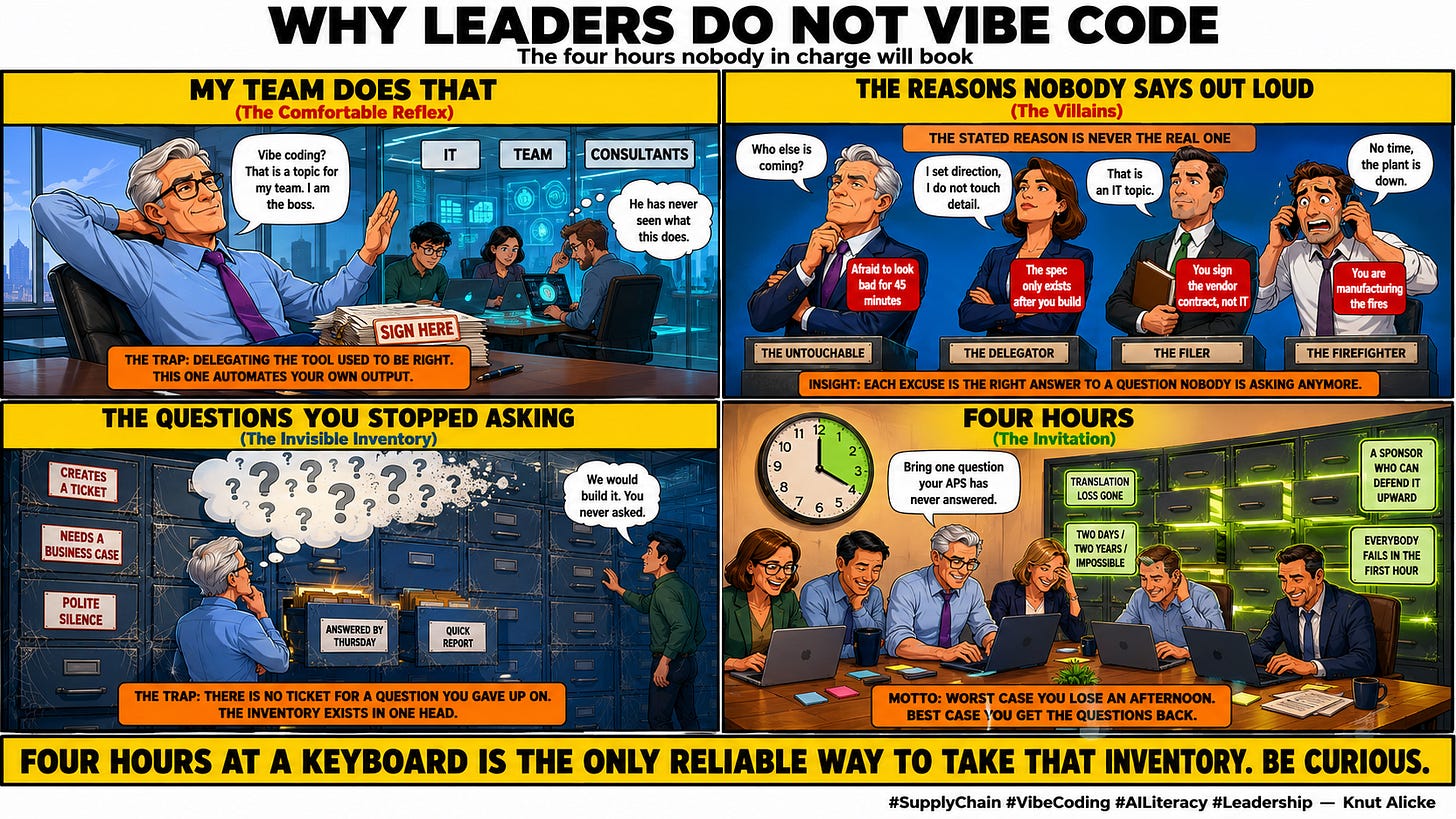
„Vibe coding? That is more a topic for my team. I am the boss.“
We heard some version of this repeatedly while inviting supply chain and logistics leaders to our first vibe coding workshop. It was never said defensively. It was said the way people state something obvious.
Thanks for reading! Subscribe for free to receive new posts and support my work.
Boris: For me this is close to negligent, and I say that with respect for the people. Handing the understanding of a technology this consequential to the team, IT, consultants, and service providers is not delegation. It is opting out of a decision you will still have to sign.
Which raises the more interesting question. If four hours produces that, why are senior people so reluctant to spend them?
We have now had this conversation many times, and the stated reason is almost never the real one. Underneath „my team does that“ sit four or five very human things that nobody says out loud in a room full of peers. They are worth naming, because each one has a specific answer.
Before the reasons, one page of context, because the objection is not stupid. It is the correct answer to a different question, asked at a different time.
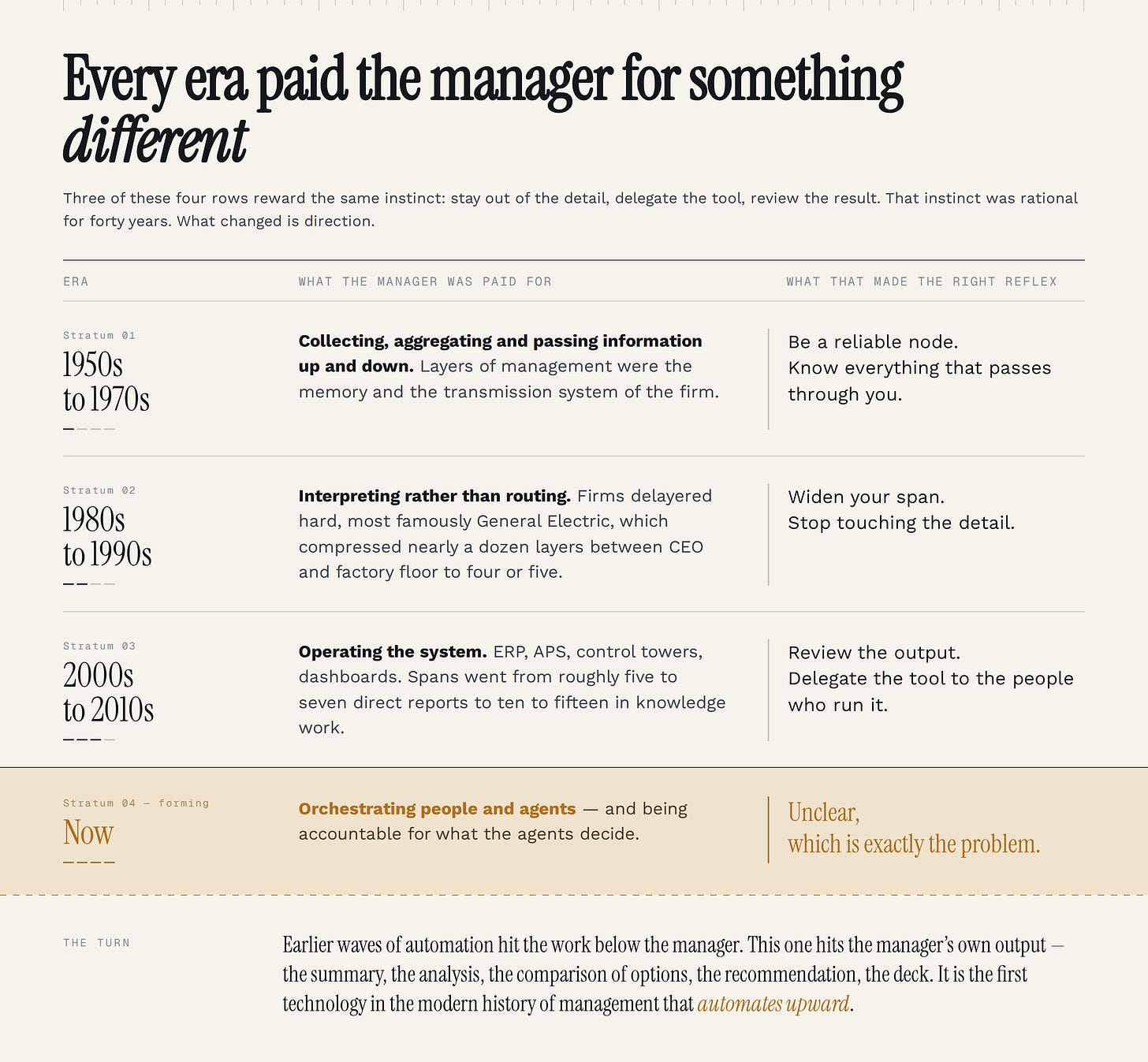
That is the whole reason a reflex that worked for two decades now fails.
A supply chain VP has spent 15 years becoming the person in the room who knows. That is the entire basis of the authority. Now somebody invites him to sit at a laptop, in front of people who either report to him or run companies like his, and be visibly bad at something for the first hour. There is no version of that which does not carry status risk.
The tell is easy to spot once you know it. Leaders who decline rarely ask „What is the value of this?“ They ask „Who else is coming?“
The discomfort is real; it lasts about 45 minutes and is not motivational packaging. It is what happens when somebody with 15 years of domain judgment finally gets a tool that responds to judgment rather than to syntax.
The second reason is training. Every management development program of the past 30 years taught the same rule: do not do the work yourself. Set direction, hire capable people, hold them accountable, resist the urge to get into the detail. Leaders who violate that rule get called micromanagers, and rightly so.
Delegation works by specification. It is the mechanism through which intent travels from the person who holds it to the people who execute it. When Knut built an S&OP application himself, he wrote no requirements document and no technical specification, and the reason is instructive. The capacity table started as a flat list of 68 rows, which proved unusable at that scale, so the next request was to add resource-level grouping with collapsible sections. The BOM navigator had no pegging until the basic tree was on screen and the gap could finally be articulated.
You cannot write the requirement until you have seen what it would replace. Iteration beats specification, every time.
If the specification only emerges from the building, then a leader who delegates does not get a specification executed badly. He never forms the specification at all.
The third reason is that vibe coding gets filed in the wrong folder. It looks like a tool topic, and tool topics belong to IT. IT topics get delegated, budgeted, queued and scheduled, and they compete against everything else in the quarter. Judged by that yardstick, which asks for a business case, a deliverable and a payback, four hours of prototyping ranks below almost every other item on the list. And it should. The mistake is not the ranking. It is the folder.
The clearest evidence is in what leaders do with vendors. Having built a planning application yourself, you know which parts of a planning system are genuinely hard and which parts are merely expensive. That changes how you sit in a vendor meeting, what you are willing to pay for, what you push back on, what you scope out of a project entirely. Nobody on any team holds vendor negotiation or capital approval. Those sit with the leader, which means the literacy has to sit there too.
Sign up free to read the full article
Create a free account to unlock full access to all articles.
Sign Up FreeAlready have an account? Sign in