
The Feds drop the hammer on illegal immigration

Craig Fuller, CEO at FreightWaves · Saturday, November 29, 2025
The Administration has announced a major new initiative targeting the financial channels used by undocumented immigrants, marking a strategic and powerful shift in enforcement priorities. Moving beyond traditional border security measures, this action focuses on financial institutions and money transmitters that facilitate the transfer of funds from undocumented workers to their home countries, effectively targeting the economic lifelines of the U.S. shadow economy.
The Administration dropped the hammer today on illegal immigration with its biggest announcement yet: It intends to go after financial institutions and money transmitters that allow illegal immigrants to transfer money back home. FinCEN, the criminal enforcement agency ran by… pic.twitter.com/wZs2213hwr
— Craig Fuller 🛩🚛🚂⚓️ (@FreightAlley) November 29, 2025
The Weapon: FinCEN and the Patriot Act
At the center of this enforcement is the Financial Crimes Enforcement Network (FinCEN), a powerful division of the Department of Treasury. FinCEN is often called “the most powerful law-enforcement agency you’ve never heard of.”
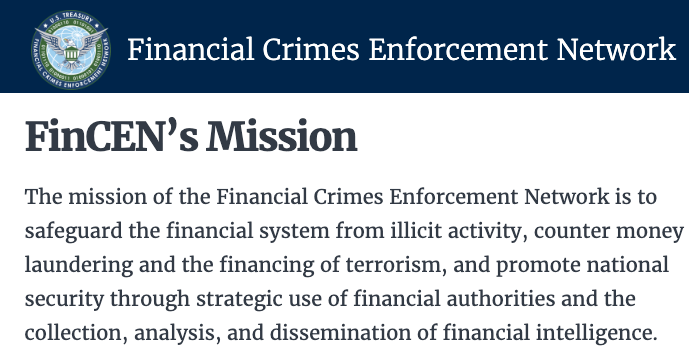
Created in 1990 and vastly empowered by Title III of the Patriot Act, FinCEN exerts extensive control over the banking system, giving it unique leverage over money transfer services. FinCEN’s far-reaching powers include the ability to:
- Compel any financial institution to hand over records without a warrant (via National Security Letters).
- Unilaterally freeze assets.
- Impose civil penalties of $250,000 per transaction.
- Criminally prosecute executives for “willful blindness.”
Crucially, FinCEN has now explicitly classified sending “proceeds of unlawful employment” as a form of illicit activity (akin to structuring or money laundering). This classification means a standard remittance transfer—for instance, an $800 Western Union transfer from an undocumented driver to family in Uzbekistan—could theoretically trigger felony charges against the CEO of the money transmitter for facilitating a crime. Financial institutions are absolutely terrified of FinCEN action, as violations target not just the companies but also their executives and principals.
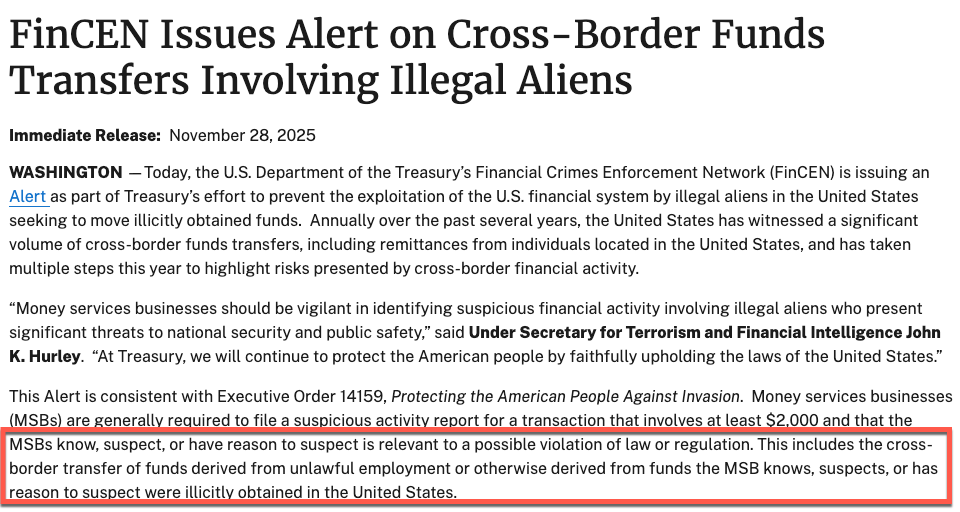
The Economic Choke Point: Remittances
This enforcement action targets the primary means by which undocumented immigrants support their families abroad. Of the estimated 11–14 million undocumented immigrants in the U.S., roughly 60% to 70% regularly send remittances, totaling approximately $160 billion annually—an amount exceeding the GDP of many countries. Mexico, Guatemala, Honduras, and El Salvador alone receive over $100 billion combined.
By explicitly criminalizing funds derived from unlawful employment, the Administration aims to choke off this massive financial flow. When these flows are severely restricted, the financial incentive to remain in the U.S. shadow economy evaporates, resulting in a collapse of the economic model of illegal immigration.
Sign up free to read the full article
Create a free account to unlock full access to all articles.
Sign Up FreeAlready have an account? Sign in