Skip to content

Warehousing & Transport

Analysis

HMM launches 22 intra-Asia vessels, expands Thailand routes

South Korea’s HMM is expanding aggressively into the intra-Asia container shipping market, acquiring two 1,956-teu vessels from Baozhou Shipping for delivery in October 2026 and January 2027. It plans to add 22 new vessels (1,800–2,800 teu) from 2028 onward, targeting Thailand’s Laem Chabang port — whose volumes rose 7% year-on-year to 10.15 million teu in 2025. The move responds to China’s 'China Plus One' manufacturing shift and intensifies competition with Korean peers like Dongjin Shipping and Namsung Shipping operating dense regional networks across Southeast Asia.

Original source: Source information pending

HMM launches 22 intra-Asia vessels, expands Thailand routes

According to theloadstar.com, South Korea’s flagship container carrier HMM is intensifying its presence in the intra-Asia shipping market — a segment historically led by regional feeder operators — with concrete fleet and route expansions targeting Thailand and broader Southeast Asia.

Strategic pivot from long-haul to regional networks

HMM, traditionally focused on trans-Pacific and Europe–Asia mainline services, is now realigning its network strategy to capture shifting cargo flows. The company is scheduled to take delivery of 22 container vessels ranging from 1,800 to 2,800 teu starting in 2028. These smaller-capacity ships are explicitly intended to support denser, more flexible intra-Asian deployments — a structural departure from its reliance on ultra-large vessels for long-haul lanes.

HMM already operates services linking South Korea with Laem Chabang — Thailand’s largest container gateway — via Japan and Vietnam, as well as direct China–Thailand routes. This expansion reflects a deliberate effort to build an integrated regional network rather than depend solely on hub-and-spoke connections feeding global mainlines.

The shift coincides with accelerating supply chain reconfiguration, particularly China’s “China Plus One” manufacturing strategy, which has spurred new factory investments across Thailand, Vietnam, and other ASEAN nations — directly increasing demand for short-sea container movements between these economies.

Newbuild acquisitions accelerate Thailand deployment

To fast-track its intra-Asia capacity, HMM recently acquired two 1,956 teu newbuilding resales from Chinese owner Baozhou Shipping. The vessels — named HMM Milestone and HMM Harmony — will be delivered from Zhejiang Tenglong Shipyard in October and January 2027, respectively, and assigned exclusively to intra-Asia routes.

Laem Chabang port — central to this strategy — recorded a 7% year-on-year volume increase in 2025, reaching 10.15m teu. In response, the Thai government plans to expand the port’s annual capacity from 11m to 18m teu.

This growth underscores how regional infrastructure development and shipping network upgrades are co-evolving to serve new manufacturing geographies — notably Chinese firms establishing production bases in Thailand to diversify supply chains and access ASEAN markets.

Intensifying competition among Korean carriers

HMM’s move places it in direct competition with established South Korean mid-sized carriers including Dongjin Shipping, Namsung Shipping, KMTC Line, Sinokor Merchant Marine, Heung-A Line, Pan Ocean, SM Line, and CK Line — all of which maintain local subsidiaries or agency networks in Thailand and operate dense regional services centered on Laem Chabang and Bangkok.

Unlike long-haul trades where scale dominates, intra-Asia success hinges on service frequency, port connectivity, and adaptability to fragmented cargo profiles — advantages these incumbents have cultivated over decades.

“HMM’s efforts to strengthen its intra-Asia presence, including in Thailand, are part of our broader mid-to-long-term strategy to optimise our regional network and enhance our hub-and-spoke feeder capabilities connecting with our mainline global services.” — HMM spokesperson

Source: The Loadstar

Compiled from international media by the SCI.AI editorial team.

Ask SCI.AI Finished reading? Continue with SCI.AI. Explore the related policy, route, company and historical context. Continue asking
Food Distributors Warn Cyberattacks Can Disrupt Supply Chains in 16 Months
Risk & Resilience

Food Distributors Warn Cyberattacks Can Disrupt Supply Chains in 16 Months

Cybersecurity executives warned foodservice distributors at the International Foodservice Distributors Association’s 2026 Solutions Conference in San Antonio that cyberattacks pose immediate operational threats — from halted orders and shuttered warehouses to physical cargo theft. A hacked third-party carrier enabled fraudulent blueberry pickup; an undetected intruder persisted in one network for 16 months, exfiltrating 12 terabytes. Panelists emphasized resilience over prevention, manual fallback plans for critical systems, zero-trust architecture, and treating data itself as a primary target — noting that 'we’re seeing a real shift towards data as the new currency.'

Ocean Freight Rates Hold at $6,000 Amid 157-Vessel Shanghai Backlog
Warehousing & Transport

Ocean Freight Rates Hold at $6,000 Amid 157-Vessel Shanghai Backlog

Ocean freight rates remain elevated post-peak as US September 2026 imports hit 2.3 million TEU — 10% above year-ago levels. Shanghai port faces a 157-vessel backlog as of 12 September, with typhoon delays extending to 7–10 days. China-US west coast rates hold near $6,000; east coast exceeds $9,000. Carriers plan 78 blank sailings ahead of Golden Week, removing 32% of capacity on Pacific Southwest routes. China-North Europe rates rose from $2,000 to $5,000 by late July amid renewed Red Sea transits.

Estes invests $56M in cross-border, offshore freight expansion
Warehousing & Transport

Estes invests $56M in cross-border, offshore freight expansion

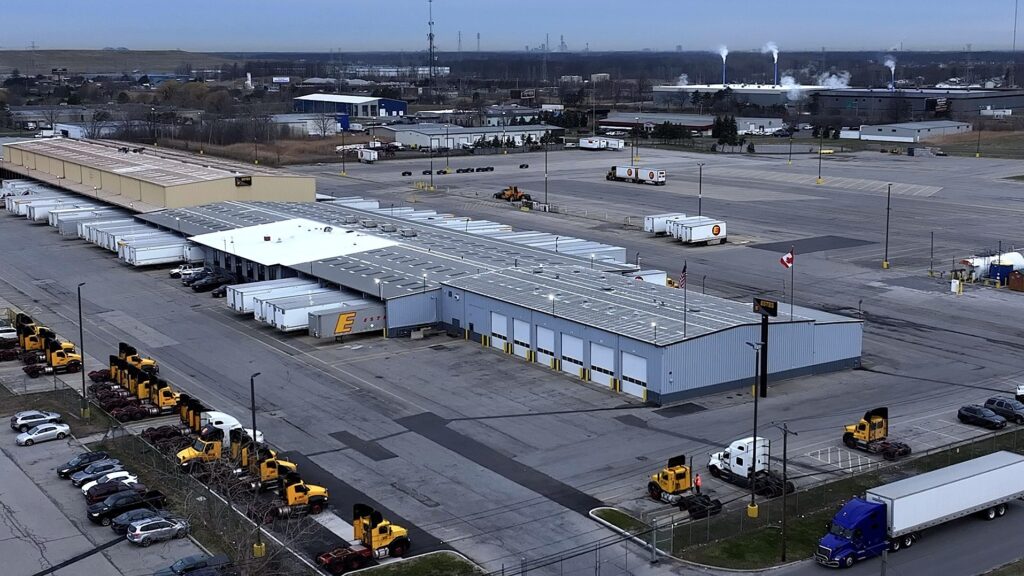
Estes Express Lines is investing nearly $56 million to expand cross-border and offshore freight operations across Canada, Mexico, Alaska, Hawaii, and Puerto Rico. The initiative includes infrastructure upgrades at key gateways — notably a significantly larger facility at the busiest U.S.-Mexico freight crossing — alongside fleet and capacity enhancements. Alex Peebles, senior director of offshore and international at Estes, stated the company is taking a long-term view to accommodate future growth in offshore markets. Current next-day service into Toronto achieves high-90s performance, and the $56 million investment spans terminals, equipment, and regional capacity.

Welcome Back!

Login to your account below

Create New Account!

Fill the forms below to register

Retrieve your password

Please enter your username or email address to reset your password.

Scan to share via WeChat

Open WeChat and scan the QR code to share

QR Code

Add New Playlist