Skip to content

Warehousing & Transport

Analysis

Container fuel prices surge 100% in 2026 as Hormuz disruptions persist

Container shipping fuel prices remain sharply elevated in 2026, with Singapore VLSFO rising over 100% from $433.50/ton on Jan. 1 to $878.50/ton by Sept. 11. Regional premiums persist: Fujairah VLSFO trades at $1,005/ton versus $731/ton in Rotterdam. The St. Louis Fed estimates fuel costs surged from $155 to $269 per 20-ft container on China–U.S. West Coast routes for newer ships, and from $360 to $626 for older vessels. Ship & Bunker revised its Q4 2026 global VLSFO forecast upward to $758/ton. Bunkering activity at Fujairah remains at just 40% of prewar levels.

Original source: Source information pending

Container fuel prices surge 100% in 2026 as Hormuz disruptions persist

According to FreightWaves, container shipping fuel prices remain at historically elevated levels, with Singapore’s very-low-sulphur fuel oil (VLSFO) climbing from $433.50 per metric ton on Jan. 1 to $878.50 per ton by Sept. 11, a rise of more than 100%.

Bunker price volatility intensifies despite easing supply constraints

While the acute marine-fuel shortage observed in March and April has abated, bunker prices continue to exert pressure on vessel operating costs. In Singapore — the world’s largest bunkering center — VLSFO was assessed at $908 per metric ton this week, while marine gasoil (MGO) stood at $1,448 per ton and high-sulphur fuel oil at $770 per ton, according to analyst Ship & Bunker.

Regional differentials persist: VLSFO in Rotterdam traded at $731 per ton, compared with $804 per ton in Houston and $1,005 per ton in Fujairah, United Arab Emirates. The premium at Fujairah reflects ongoing constrained traffic and supply-chain disruption around the Strait of Hormuz.

Industry comments reported from the Asia Pacific Petroleum Conference indicate that bunkering activity at Fujairah has recovered to about 40% of its prewar level, still well below normal operations.

Fuel cost impact varies by vessel age and trade lane

The St. Louis Fed estimated that the early-2026 fuel shock increased fuel cost on a typical China–U.S. West Coast voyage from $155 to $269 per 20-foot container for a newer ship, and from $360 to $626 per container for an older vessel. This differential underscores how fleet age magnifies exposure to fuel volatility.

Meanwhile, Brent crude oil rose above $107 per barrel on Sept. 14, driven by fears of renewed violence in the Red Sea and Strait of Hormuz. Disruption to tanker traffic and constrained access to Gulf-origin crude and fuel-oil feedstocks have tightened the marine fuel market.

Refiners are shifting focus toward higher-margin gasoline and diesel, threatening availability of blending components required to produce specification-compliant VLSFO — especially in Asia, which depends heavily on Gulf supply flows.

Outlook shifts from scarcity to pricing uncertainty

Ship & Bunker last week raised its expected average price for a 20-port VLSFO benchmark to $758 per ton in the fourth quarter, up from a prior estimate of $646 per ton. It projected Singapore VLSFO would average $720 per ton in Q4 — though current outright prices remain materially higher than that forecast.

Market observers cite preliminary ship-tracking data showing that 10 to 15 commodity vessels a day still use the Omani corridor on the southern side of Hormuz, though transits fell to single digits during the past weekend.

The result is a structural shift: operators can generally secure fuel, but face substantially higher costs and less certainty about regional price differentials — affecting container lines, tanker owners, bulk carriers, and ship managers alike.

Source: FreightWaves

Compiled from international media by the SCI.AI editorial team.
Ask SCI.AI Finished reading? Continue with SCI.AI. Explore the related policy, route, company and historical context. Continue asking
Food Distributors Warn Cyberattacks Can Disrupt Supply Chains in 16 Months
Risk & Resilience

Food Distributors Warn Cyberattacks Can Disrupt Supply Chains in 16 Months

Cybersecurity executives warned foodservice distributors at the International Foodservice Distributors Association’s 2026 Solutions Conference in San Antonio that cyberattacks pose immediate operational threats — from halted orders and shuttered warehouses to physical cargo theft. A hacked third-party carrier enabled fraudulent blueberry pickup; an undetected intruder persisted in one network for 16 months, exfiltrating 12 terabytes. Panelists emphasized resilience over prevention, manual fallback plans for critical systems, zero-trust architecture, and treating data itself as a primary target — noting that 'we’re seeing a real shift towards data as the new currency.'

Ocean Freight Rates Hold at $6,000 Amid 157-Vessel Shanghai Backlog
Warehousing & Transport

Ocean Freight Rates Hold at $6,000 Amid 157-Vessel Shanghai Backlog

Ocean freight rates remain elevated post-peak as US September 2026 imports hit 2.3 million TEU — 10% above year-ago levels. Shanghai port faces a 157-vessel backlog as of 12 September, with typhoon delays extending to 7–10 days. China-US west coast rates hold near $6,000; east coast exceeds $9,000. Carriers plan 78 blank sailings ahead of Golden Week, removing 32% of capacity on Pacific Southwest routes. China-North Europe rates rose from $2,000 to $5,000 by late July amid renewed Red Sea transits.

Estes invests $56M in cross-border, offshore freight expansion
Warehousing & Transport

Estes invests $56M in cross-border, offshore freight expansion

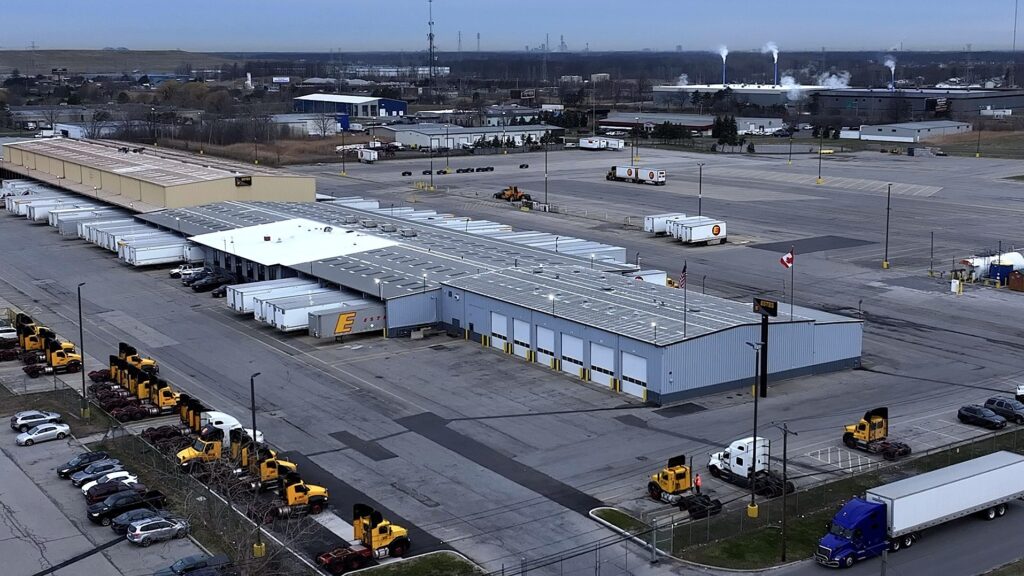
Estes Express Lines is investing nearly $56 million to expand cross-border and offshore freight operations across Canada, Mexico, Alaska, Hawaii, and Puerto Rico. The initiative includes infrastructure upgrades at key gateways — notably a significantly larger facility at the busiest U.S.-Mexico freight crossing — alongside fleet and capacity enhancements. Alex Peebles, senior director of offshore and international at Estes, stated the company is taking a long-term view to accommodate future growth in offshore markets. Current next-day service into Toronto achieves high-90s performance, and the $56 million investment spans terminals, equipment, and regional capacity.

Welcome Back!

Login to your account below

Create New Account!

Fill the forms below to register

Retrieve your password

Please enter your username or email address to reset your password.

Scan to share via WeChat

Open WeChat and scan the QR code to share

QR Code

Add New Playlist