Skip to content

Warehousing & Transport

Analysis

Estes invests $56M in cross-border, offshore freight expansion

Estes Express Lines is investing nearly $56 million to expand cross-border and offshore freight operations across Canada, Mexico, Alaska, Hawaii, and Puerto Rico. The initiative includes infrastructure upgrades at key gateways — notably a significantly larger facility at the busiest U.S.-Mexico freight crossing — alongside fleet and capacity enhancements. Alex Peebles, senior director of offshore and international at Estes, stated the company is taking a long-term view to accommodate future growth in offshore markets. Current next-day service into Toronto achieves high-90s performance, and the $56 million investment spans terminals, equipment, and regional capacity.

Original source: Source information pending

Estes invests $56M in cross-border, offshore freight expansion

According to FreightWaves, Estes Express Lines is investing nearly $56 million to expand its cross-border and offshore freight network, including terminals, equipment, and capacity serving Canada, Mexico, Alaska, Hawaii, and Puerto Rico.

Strategic infrastructure rollout

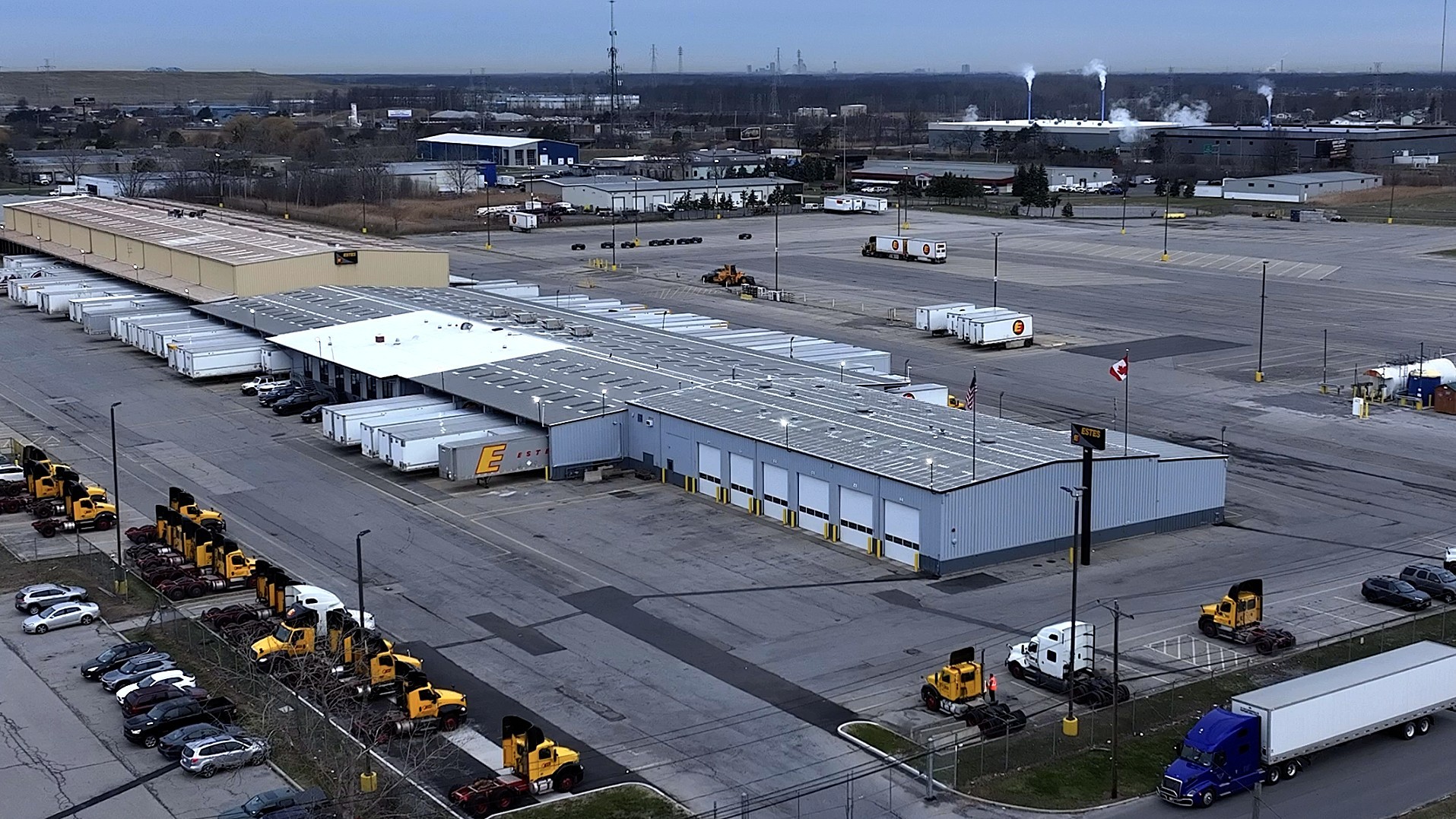
The carrier’s 171-door service center in Buffalo, New York, serves as a key gateway for U.S.-Canada cross-border freight operations. Estes currently offers next-day service into Toronto from markets as far south as Virginia and as far west as the Chicago area. Service performance on those shipments is in the “high 90s,” according to the report.

The company’s investment plan includes facility upgrades at major commercial gateways — notably a significantly larger facility at the nation’s busiest U.S.-Mexico freight gateway. This expansion occurs despite ongoing tariff uncertainty, underscoring Estes’ commitment to long-term capacity building rather than short-term market responsiveness.

Offshore freight represents another priority area for capital deployment. The original investment information characterized the $56 million as a series of offshore, cross-border, and international investments spanning fleet, infrastructure, and capacity.

Leadership perspective on long-term planning

Alex Peebles, senior director of offshore and international at Estes, emphasized the company’s forward-looking stance. As a privately held, family-owned carrier, Estes is prioritizing structural growth over reactive adjustments.

“We’re really looking at all of these investments from a long-term horizon and viewpoint perspective and one that’s going to help accommodate growth and capacity into all the offshore international markets that we service.”

— Alex Peebles, senior director of offshore and international at Estes

This outlook directly informs decisions across geographies: the $56 million allocation covers operations in five distinct regions — Canada, Mexico, Alaska, Hawaii, and Puerto Rico — each requiring tailored infrastructure and regulatory engagement.

The investment also reflects operational realities tied to specific jurisdictions, including U.S.-Mexico border enforcement dynamics and the role of B-1 visa holders in cross-border haulage — a factor cited by industry leaders as critical to maintaining available capacity.

Source: FreightWaves

Compiled from international media by the SCI.AI editorial team.

Ask SCI.AI Finished reading? Continue with SCI.AI. Explore the related policy, route, company and historical context. Continue asking
Food Distributors Warn Cyberattacks Can Disrupt Supply Chains in 16 Months
Risk & Resilience

Food Distributors Warn Cyberattacks Can Disrupt Supply Chains in 16 Months

Cybersecurity executives warned foodservice distributors at the International Foodservice Distributors Association’s 2026 Solutions Conference in San Antonio that cyberattacks pose immediate operational threats — from halted orders and shuttered warehouses to physical cargo theft. A hacked third-party carrier enabled fraudulent blueberry pickup; an undetected intruder persisted in one network for 16 months, exfiltrating 12 terabytes. Panelists emphasized resilience over prevention, manual fallback plans for critical systems, zero-trust architecture, and treating data itself as a primary target — noting that 'we’re seeing a real shift towards data as the new currency.'

Ocean Freight Rates Hold at $6,000 Amid 157-Vessel Shanghai Backlog
Warehousing & Transport

Ocean Freight Rates Hold at $6,000 Amid 157-Vessel Shanghai Backlog

Ocean freight rates remain elevated post-peak as US September 2026 imports hit 2.3 million TEU — 10% above year-ago levels. Shanghai port faces a 157-vessel backlog as of 12 September, with typhoon delays extending to 7–10 days. China-US west coast rates hold near $6,000; east coast exceeds $9,000. Carriers plan 78 blank sailings ahead of Golden Week, removing 32% of capacity on Pacific Southwest routes. China-North Europe rates rose from $2,000 to $5,000 by late July amid renewed Red Sea transits.

Container fuel prices surge 100% in 2026 as Hormuz disruptions persist
Warehousing & Transport

Container fuel prices surge 100% in 2026 as Hormuz disruptions persist

Container shipping fuel prices remain sharply elevated in 2026, with Singapore VLSFO rising over 100% from $433.50/ton on Jan. 1 to $878.50/ton by Sept. 11. Regional premiums persist: Fujairah VLSFO trades at $1,005/ton versus $731/ton in Rotterdam. The St. Louis Fed estimates fuel costs surged from $155 to $269 per 20-ft container on China–U.S. West Coast routes for newer ships, and from $360 to $626 for older vessels. Ship & Bunker revised its Q4 2026 global VLSFO forecast upward to $758/ton. Bunkering activity at Fujairah remains at just 40% of prewar levels.

Welcome Back!

Login to your account below

Create New Account!

Fill the forms below to register

Retrieve your password

Please enter your username or email address to reset your password.

Scan to share via WeChat

Open WeChat and scan the QR code to share

QR Code

Add New Playlist