
Lead Time: A Broken Gossamer
- +1 (617) 372-6921
- lora.cecere@supplychaininsights.com
- @lcecere
Youtube Twitter Linkedin
Lora's Latest Post
- July 16, 2026
- 6:38 pm
The world of supply chain management is full of experts.
I struggle with the fact that in the Supply Chains to Admire work that we find that global multi-nationals struggle to scale performance. We are not able to achieve economies of scale. I think that one of the reasons is a lack of focus on supply chain fundamentals.
The Dance With Shiny Objects
Many “experts”, I find, dance in the aura of new shiny objects- pontificating on the promise of the autonomous supply chain and touting the power of agentics. I say, let them have it.
“Faster horses?” Here is a quote that I like.
Users may not always articulate the solution — but they are living with the problem.And to understand that problem, you need to leave your own assumptions at the door. You need to stop projecting your context onto theirs.Innovation doesn’t come from asking users what to build.It comes from deeply understanding what it feels like to be them.
“Faster Horses” — Why Henry Ford Didn’t Say It, and Why We Should Stop Thinking Like He Did | by Karolien François | Medium
If you are struggling with supply chain planning, dancing in the light of shiny objects, and scratching your head, please read on. My goal is to help you.
Drive Value: Rethink Fundamentals
Please do not AI Stupid. What do I mean? AI Stupid is putting agents and agentics on top of existing architectures believing that making them faster and hands free add value. To me, this is fools play.
I love AI. I am excited about new technologies. To this end, I want to shine a light on how new technologies can help address the black holes and inconsistencies in today’s supply chain, which largely stem from the limitations of the first generation of supply chain planning and execution technologies. In this blog, I give you three places to start.
Step One: Align on First-Principle Thinking
In prior blog posts, I asked teams to rethink their processes using first principles and improve their AI readiness.
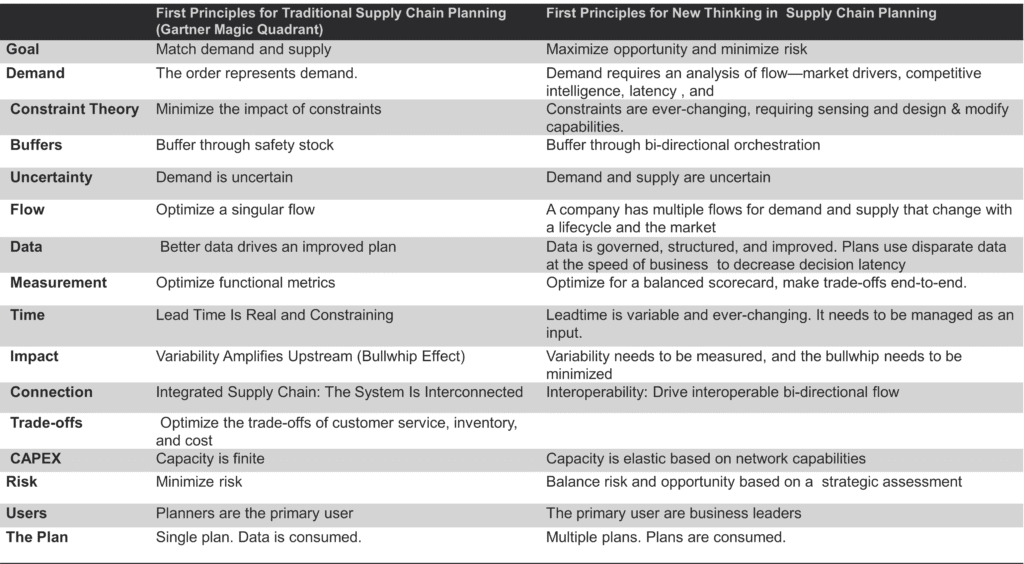
In essence, what is it that you to do anyway, spoken in plain language? To get started, read the first column and then think about the difference in the second column, and ask yourself if this delta is important in your organization. Once clarity is achieved, start a discussion with technologists. Get past the shiny-object bunk and focus on driving value.
Table 1. Supply Chain First Principles
Step 2. Redefine Your Relationship With Data
The second step is to take an inventory of the data you have and ideate possible use cases or opportunities to redefine data structures to reduce latency and improve relevance. Traditional processes have inherent process and data latency that we should no longer accept. I have written many blogs on the need for a planning master data layer and a unified data model in my market-driven research.
Step 3: Embrace and Understand Lead Time
In the supply chain, lead time is a gossamer thread. Lead time should connect and link planning, inventory management, procurement, manufacturing, and customer delivery; getting it right is key to driving supply chain reliability, but in most supply chains it is a broken gossamer.
Gossamer is a light, fine thread web. A broken gossamer is hard to see.
When supply chains become less predictable and difficult to control, supply chain entropy—the accumulation of uncertainty and inefficiency increases. Disorder reigns. Functions within a company are not aligned, and the systems are not interconnected with a consistent and accurate definition of lead time. Supply chain effectiveness requires order and alignment of parameters to actuals.
Whild companies try to put pat answers on the cunundrum like risk management or improving resilience, a lot of progress can be made by focusing on reducing disorder.
Entropy is a measure of uncertainty, disorder, or the number of possible ways a system can be arranged.
Sign up free to read the full article
Create a free account to unlock full access to all articles.
Sign Up FreeAlready have an account? Sign in