
Skip to content

Expert Columns

COP26: 5Zs that changed the world

Original source: logisym.org

COP26: 5Zs that changed the world

Ask SCI.AI about this story

COP26: 5Zs that changed the world

Reprinted. Original by Wolfgang Lehmacher · Source: LogiSYM(Wolfgang Lehmacher) · Original article

LogiSYM | COP26: 5Zs that changed the world

Article

Part 1–Defining the moment

by Wolfgang Lehmacher, Anchor Group & Mikael Lind, Research Institutes of Sweden (RISE)

“Even with all new Glasgow pledges for 2030, we will emit roughly twice as much in 2030 as required for 1.5 degrees Celsius,” states the Climate Action Tracker. This year the annual United Nations (UN) Climate Change Conference (COP26) was held at the SEC Centre in Glasgow, United Kingdom, from 31 October to 13 November 2021. Such meetings are generally hyped as platforms that can bring sweeping global action which makes it very hard for the participants to live up to the expectations. Critical is, though, that commitments are honored and actions followed through.

This article focuses on the most relevant initiatives, the five zero (5Zs) emission initiatives contributing to decarbonizing logistics and transport to place these initiatives into the industry context and reflect on them in light of the ongoing industry discussions and developments (see figure 1). We also indicate what each action may mean for the sector.

COP26 has received more attention than previous summits. Maybe because many have realized that the time has come to put an end to the self-destructive economic behavior of the last two centuries. In respect to logistics and transport something remarkable happened at COP26. The industry which previously showed largely low levels of commitment to engage in the COP agenda, showed the world that it exists and can take a seat at the COP table to actively contribute to fight climate change – but the sector also expressed its need for support.

Help is indeed needed from various sides, such as from automotive manufacturers in form of climate-friendly vehicles, from energy companies that need to provide alternative fuels and refueling infrastructure at scale, from training institutes that can support with new curricula and clean skills, and from public private partnerships that are required to create platforms of innovation to accelerate technological developments in the field of CO2 emission reductions. Very positively, these topics have not only been discussed at COP26 but multiple initiatives were launched with some of them having the potential to significantly contribute to decarbonizing the global supply chain network.
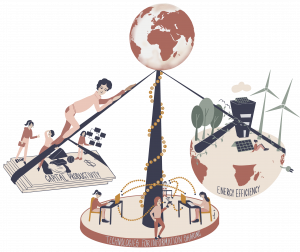
The optimal impact of such efforts will not be reached without collaboration to coordinate and synchronize operations across the shipping corridors; and collaboration at such scale will not be possible without digital means. At the core of the discipline of maritime informatics, is the balancing act between capital productivity, which is an organizations’ concern driving the development agenda, and energy efficiency, which is an urgent societal concern. Both type of concerns may be empowered by digital data sharing (see figure 2). This means that changes for enhanced energy efficiency need to be motivated by actors of the transport and logistics ecosystem through incentives that make it attractive or compulsory to contribute to a better good, either driven by business logic or legislation.

The first Z – Zero emission road transport: Global MOU for ZE-MHDVs

In 2018, according to data from the International Energy Agency (IEA) road transport accounted for three-quarters of transport emissions. Most of this, 45.1 percent resulted from passenger vehicles (cars and busses) and the remaining 29.4 came from trucks carrying cargo.

At COP26, CALSTART’s Global Commercial Vehicle Drive to Zero program and campaign (Drive to ZeroTM) and the Dutch government have facilitated a memorandum of understanding (MOU) plus endorsement which is a collective action that is dubbed the Global Agreement on Zero-Emission Trucks and Buses. 15 countries, Austria, Canada, Chile, Denmark, Finland, Luxembourg, The Netherlands, New Zealand, Norway, Scotland, Switzerland, Turkey, the United Kingdom, Uruguay and Wales declared that they will collaborate towards realizing 100 percent zero emission new trucks and bus sales by 2040. Under the first ever global agreement on zero emission busses and truck, the Global Memorandum of Understanding for Zero-Emission Medium- and Heavy-Duty Vehicles (ZE-MHDVs), the signatories have also set an interim goal of 30% zero emission new vehicle sales by 2030. Subnational governments like Québec in Canada and Telengana in India as well as manufacturers and fleets like DHL, Heineken and Scania are endorsing the MOU and declared that they will align with the decarbonization effort. Furthermore, 32 countries, 39 cities, states and regions, six vehicle manufacturers (Ford, GM, JLR, Mercedes, BYD, Volvo), 28 fleet operator and 13 investors declared their determination to achieve 100 percent zero emission new car and van sales latest by 2040 globally and 2035 in leading markets.

🔒

Sign up free to read the full article

Create a free account to unlock full access to all articles.

Sign Up Free

Already have an account? Sign in

Ask SCI.AI Finished reading? Continue with SCI.AI. Explore the related policy, route, company and historical context. Continue asking
Stay ahead of supply chain shifts

One email a week: the stories that matter and new risk events — in English, free.

Prefer RSS? Articles Risk events

How I vibe coded an S&OP app in 30 hours
Expert Columns Reprint 克努特·阿利克

How I vibe coded an S&OP app in 30 hours

How I vibe coded an S&OP app in 30 hours Reprinted. Original by Knut Alicke · Source: knutalicke.substack.com · Original article A personal experiment in AI-assisted supply chain planning “That’s cool,” she said politely when I opened the app. Then I clicked through the tabs, demand forecasting with manual overrides and natural language input, capacity […]

The Container That Learned to Swing
Expert Columns Reprint 克努特·阿利克

The Container That Learned to Swing

The Container That Learned to Swing Reprinted. Original by Knut Alicke · Source: knutalicke.substack.com · Original article A Comparison of Musical and Logistical Sequencing Problems Knut Alicke's avatar Knut AlickeJul 10, 2026 Music and logistics both live or die by their sequence, but judge it by opposite methods: one by ear, one by cost function. […]

The Rhino in the Room
Expert Columns Reprint 克努特·阿利克

The Rhino in the Room

The Rhino in the Room Reprinted. Original by Knut Alicke · Source: knutalicke.substack.com · Original article Why five years of shocks have not made us resilient, and the three numbers that would tell you whether you are. Knut Alicke's avatar Knut AlickeJul 17, 2026 Twenty percent of the world’s oil, forty percent of its helium, […]

Welcome Back!

Login to your account below

Create New Account!

Fill the forms below to register

Retrieve your password

Please enter your username or email address to reset your password.

Scan to share via WeChat

Open WeChat and scan the QR code to share

QR Code

Add New Playlist