
Supply Chain Visibility. If It Seems Simple, Look More Closely.
The most significant risk to today’s supply chain is the supply chain leader’s entrenched beliefs in historical practices. Functional excellence and enterprise transactional efficiency dominate the digital supply chain agenda. As a result, we find progress stalled on building multi-tier supply chain visibility.
Unlearning is hard. Building supply chain visibility requires rethinking conventional approaches. Today, companies are stuck. Over the past decade, the measurement of supply chain visibility shows that supply chain leaders are not making progress. Given the levels of uncertainty and variability, closing this gap grows in importance.
Supply chain leaders need visibility across all modes and functions to improve insights. Signals surround the supply chain but are not used effectively in traditional Information Technology (IT) architectures.
Embracing the Need for Change
Driving improvement starts with a clear definition. There are four primary visibility data streams: manufacturing, supplier, logistics, and enterprise. Annually since 2015, we have measured the gap in each of these process streams at Supply Chain Insights. Bottom-line conclusion: the industry is not progressing but is going backward with more significant gaps, despite multi-million dollar investments.

Elements of visibilitySupply Chain Insights
With unprecedented variability and economic uncertainty, the focus of supply chain leaders is financial viability. In a recent survey by Supply Chain Insights, 48% of manufacturing companies greater than 5B$ in annual revenue have a digital supply chain program. It sounds like progress could finally happen to improve visibility. Right? Unfortunately, the answer is not so fast. Most leaders are unclear on what digital means and mistakenly focus on improving supply chain visibility using traditional approaches. In the industry, as analytics capabilities improve, there is no clear roadmap to define core capabilities.
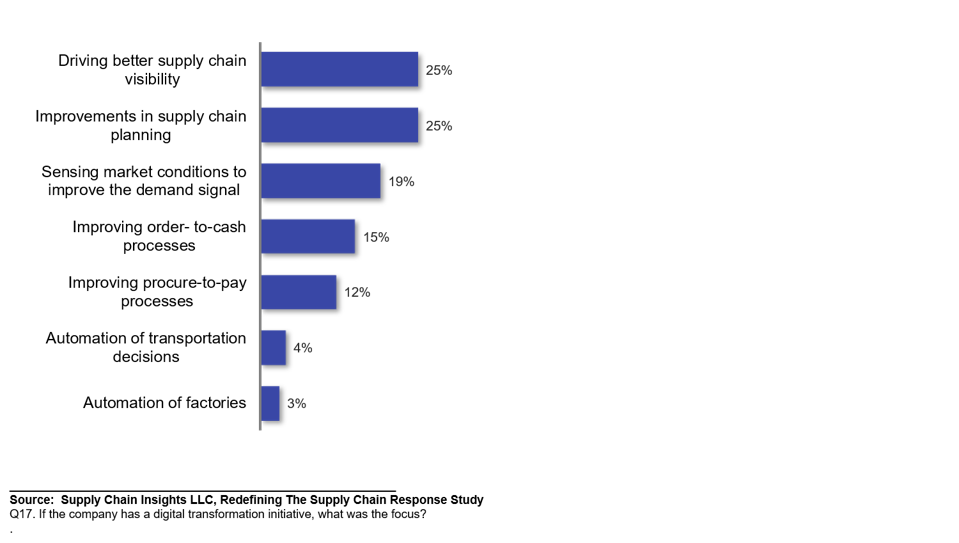
Supply Chain Insights Summary Data from Recent Report on Supply Chain Digital TransformationSupply Chain Insights
Why is visibility so hard? The factors are many: alignment, data latency, supply network latency, semantic reconciliation, and channel translation latency. All are barriers. Current processes are batch with data moving across Application Programming Interfaces (APIs) from one relational database technology to another relational database technology. Traditional approaches for integration add latency to data processes.
However, the IT issues are more manageable than the organizational barriers. Each function (sales, marketing, manufacturing, planning, logistics, and procurement) has a different data structure embedded in processes to drive functional excellence. The functional definitions of excellence are not aligned, often throwing the supply chain out of balance.
Sign up free to read the full article
Create a free account to unlock full access to all articles.
Sign Up FreeAlready have an account? Sign in