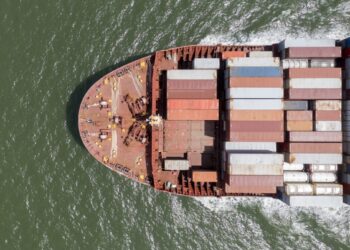
According to theloadstar.com, Maersk and MSC have each launched additional transpacific container services to meet surging demand ahead of the anticipated 2026 seasonal peak — projected by Sea-Intelligence to occur within the next two to three weeks, potentially aligning with week 27 — i.e., early July.
Shifting peak season dynamics
Sea-Intelligence’s analysis confirms a consistent trend toward earlier annual peaks in ocean freight demand. As stated in its recent assessment:
“Apart from the oddities of the pandemic, we see a development where the peak season does appear to happen earlier, with 2025 seeing the earliest peak so far — in week 27, i.e. at the beginning of July. We do not yet know when we will see the seasonal peak in 2026, as spot rates continue to trend upwards, but on the basis of the development seen in the last couple of years, we could potentially expect to see the apex reached within the next two to three weeks.”
This marks the third consecutive year that the traditional August–September peak has advanced — with 2025’s apex occurring in early July and current market signals pointing to a similar or even earlier timing for 2026. Spot rates across the transpacific corridor remain elevated, reinforcing carrier confidence in near-term volume strength.
Ocean carrier responses to demand pressure
Maersk and MSC have both responded operationally: Maersk introduced an extra transpacific service earlier in June 2026, while MSC followed suit with its own new offering, targeting high-demand lanes between Asia and North America. These deployments are classified as “extra loaders” — short-term capacity injections designed to absorb cargo backlogs and mitigate port congestion.
The moves come amid broader industry tension over pricing transparency. The Global Shippers Forum (GSF) has publicly criticized carriers for opaque surcharge structures, including the Bunker Adjustment Factor, peak season surcharges, and general rate increases (GRIs). James Hookham, director of the Global Shippers Forum, highlighted shipper frustration during a June 9, 2026 podcast appearance, noting deteriorating customer-carrier relations across key trades.
Regional supply chain stress points
Beyond transpacific dynamics, multiple geographies face acute logistical strain. Indian exporters and forwarders moving freight to Latin America report major disruptions — particularly around Nhava Sheva Port (JNPA) — citing infrastructure bottlenecks and inconsistent rail-road feeder connectivity. Meanwhile, the Strait of Hormuz was reported closed on July 2, 2026, triggering rerouting and increased insurance premiums across Middle East–North America routes.
Cargo theft remains a persistent threat: Verisk CargoNet data shows truck cargo theft incidents rose 17% year-on-year in Q2 2026, with hotspots concentrated in Mexico, South Africa, and Eastern Europe. In parallel, Oman Air Cargo expanded its Road Feeder Services (RFS) network across the Gulf region in June 2026, aiming to offset maritime uncertainty with overland alternatives.
Technology and operational adaptation
Freight forwarders are accelerating technology adoption to manage volatility. Artificial intelligence is now embedded in core operations — from predictive ETAs and dynamic routing to automated customs documentation. As noted in a June 16, 2026 episode, AI-related shipments themselves are emerging as one of air freight’s fastest-growing verticals, driven by semiconductor tooling, medical diagnostics equipment, and edge-computing hardware logistics.
Rhenus, the German freight forwarder, appointed Scott Dudley as managing director of Air & Logistics on June 9, 2026, signaling strategic emphasis on air cargo scalability. Similarly, LX Pantos, led by Yong Ho Lee, president and CEO, emphasized digital integration during its July 2, 2026 collaboration with The Loadstar
“Digital visibility isn’t optional anymore — it’s the baseline for contract renewal with Tier 1 shippers.”
Source: The Loadstar
Compiled from international media by the SCI.AI editorial team.