According to www.aircargonews.net, Air Canada Cargo reported first-quarter 2026 operating revenues of C$259 million, up 3.5% from C$250 million in Q1 2025 — driven primarily by stronger domestic cargo volumes and yields, alongside fuel surcharges.
Domestic Strength Offsets International Weakness
The airline attributed the revenue growth to ‘higher cargo volumes in all markets and yields in the domestic market’, while noting that ‘the growth was partially offset by weaker yields year-over-year in international and transborder markets’. In response to rising jet fuel prices, Air Canada Cargo implemented fuel surcharges — a measure contributing ‘to a lesser extent’ to the overall increase.
During the company’s Q1 earnings call, Mark Galardo, Chief Commercial Officer and President, Cargo, confirmed that the cargo division had increased spot rates and introduced a carrier surcharge in light of the Middle East conflict — a geopolitical factor affecting routing, capacity, and pricing across key airfreight lanes.
Fleet and Broader Financial Context
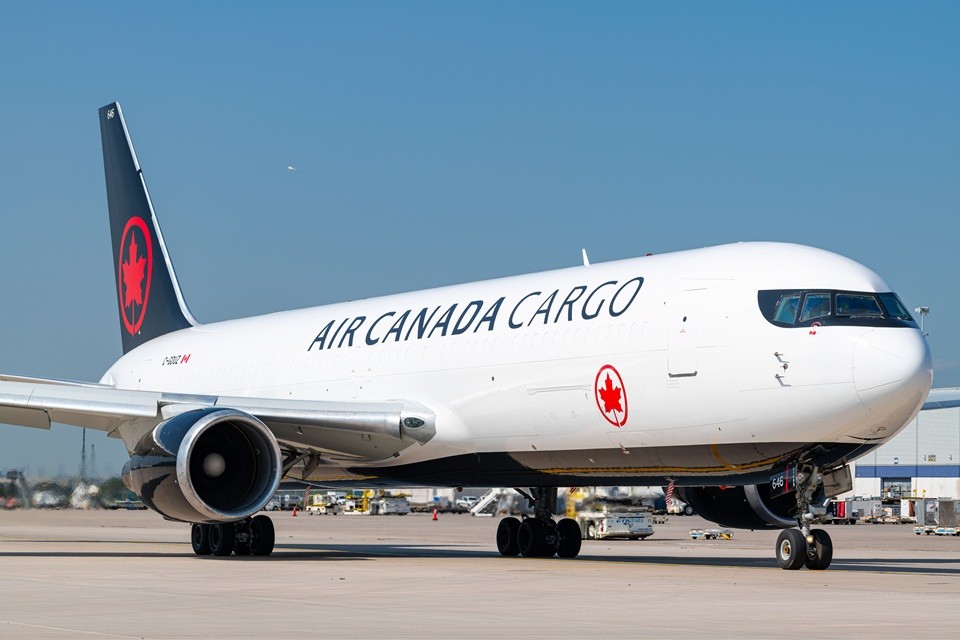
Air Canada’s freighter fleet remains unchanged since March 2025, with six Boeing 767 dedicated freighter aircraft in service. This stable asset base supports its domestic and transborder network but does not reflect recent industry-wide trends toward freighter conversions or expanded all-cargo capacity seen among peers like Cargolux and DHL.
Across the broader airline, operating revenues rose 11% to C$5.8 billion. CEO Michael Rousseau highlighted record operating income of C$117 million — a C$225 million improvement year-over-year — and record adjusted EBITDA of C$623 million, up 61%. These gains underscore the outsized contribution of cargo to Air Canada’s profitability amid ongoing passenger recovery.
Industry Context for Supply Chain Professionals
This performance aligns with broader sector patterns: DHL Group reported a 3.8% rise in airfreight volumes in Q1 2026 but noted pressure on revenues due to lower rates; AF KLM Martinair Cargo saw volumes rise while revenues fell; and Cargolux flagged a ‘volatile’ outlook for 2026 despite improved 2025 results. Collectively, these reports signal persistent rate softness on international lanes — especially transatlantic and Asia–North America corridors — even as regional demand (e.g., domestic Canada, US intra-regional, or EU internal) shows resilience.
For supply chain professionals, Air Canada’s experience highlights three practical implications: (1) domestic and near-shore air cargo lanes may offer more pricing stability and capacity reliability than long-haul routes amid geopolitical stress; (2) fuel and carrier surcharges are now embedded levers — not temporary anomalies — requiring proactive contract clause review and cost modeling; and (3) airlines with dedicated freighters (like Air Canada’s six 767s) provide more predictable belly- and deck-capacity access than passenger carriers relying solely on scheduled bellyhold space.
“The increase was primarily driven by higher cargo volumes in all markets and yields in the domestic market.” — Air Canada
“In the first quarter, Air Canada built on the momentum of our best-ever fourth quarter to launch strongly into 2026.” — Michael Rousseau, President and Chief Executive
Source: Air Cargo News
Compiled from international media by the SCI.AI editorial team.