According to roboticsandautomationnews.com, Nvidia and seven major industrial partners — including Siemens, SAP, ABB, Dassault Systèmes, Microsoft, Wandelbots, and Deutsche Telekom — showcased AI-driven manufacturing systems at Hannover Messe 2026, held April 20–24 in Hannover, Germany. The demonstrations signal a decisive shift from AI experimentation to operational integration across engineering, factory operations, and robotics deployment at scale.
Industrial AI Infrastructure Takes Center Stage
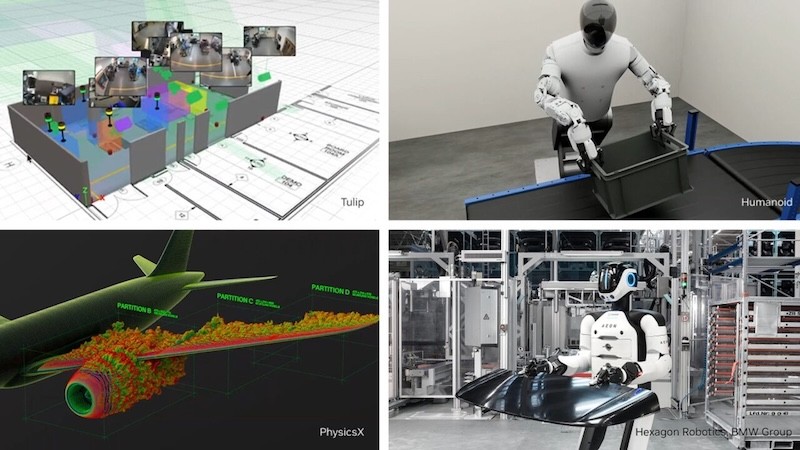
A cornerstone of the event was the Industrial AI Cloud, described as one of Europe’s largest AI “factories”, built in Germany by Deutsche Telekom using Nvidia infrastructure. The platform is designed to provide a secure and sovereign foundation for running AI workloads across manufacturing and supply chains. Companies including Agile Robots, Siemens, SAP, PhysicsX, and Wandelbots demonstrated how it supports applications ranging from real-time simulation and AI physics to factory-scale digital twins and software-defined robotics. To meet compute demand, hardware providers Dell Technologies, IBM, Lenovo, and PNY presented Nvidia-accelerated systems spanning edge devices through to data center deployments.
AI Transforms Engineering and Simulation
Software providers Cadence, Dassault Systèmes, Siemens, and Synopsys are integrating Nvidia technologies — including CUDA-X, Omniverse libraries, and Nemotron models — into their platforms. These integrations enable real-time, physics-based simulation and more automated, agent-driven engineering workflows. Digital twins featured prominently across multiple booths: ABB demonstrated how its Genix Industrial IoT and AI Suite, powered by Nvidia Omniverse and Microsoft Azure services, delivers contextual insights into asset performance and accelerates root-cause analysis.
AI Agents Move onto the Factory Floor
- Invisible AI launched its Vision Execution System — an AI agent platform already deployed in automotive manufacturing environments, including at Toyota facilities
- Tulip Interfaces demonstrated its Factory Playback system, which synchronizes operational data into a searchable timeline; Terex expects an estimated 3 percent increase in yield and a 10 percent reduction in rework using the platform
Toward Autonomous Industrial Robotics
At a Siemens electronics factory in Erlangen, Germany, a wheeled humanoid robot developed by Humanoid completed a proof-of-concept logistics deployment using Nvidia’s Jetson Thor edge AI module. Its simulation-first development approach reduced development time from up to two years to seven months. Elsewhere, Hexagon Robotics used Nvidia’s physical AI stack to accelerate robot training and deployment, with its AEON system expected to perform assembly operations at a BMW plant in Leipzig.
“As demand outpaces capacity, automation engineering is becoming a bottleneck,” Philomin said. “Manufacturers are under pressure to deliver increasingly complex systems faster, while skilled engineering resources remain constrained.” — Vasi Philomin, executive vice president and head of data and AI at Siemens
The breadth of demonstrations confirms AI is moving beyond pilot projects into core industrial processes — with implications for supply chain professionals in procurement, logistics planning, supplier collaboration, and resilience planning. Real-time digital twins and AI agents enhance visibility into production bottlenecks, while sovereign AI infrastructure like the Industrial AI Cloud supports compliance-sensitive supply chain analytics across EU jurisdictions. For practitioners, early adoption of these tools correlates with measurable gains in yield, rework reduction, and time-to-deployment — critical levers amid persistent skilled labor shortages and tightening production cycles.
Source: Robotics & Automation News
Compiled from international media by the SCI.AI editorial team.