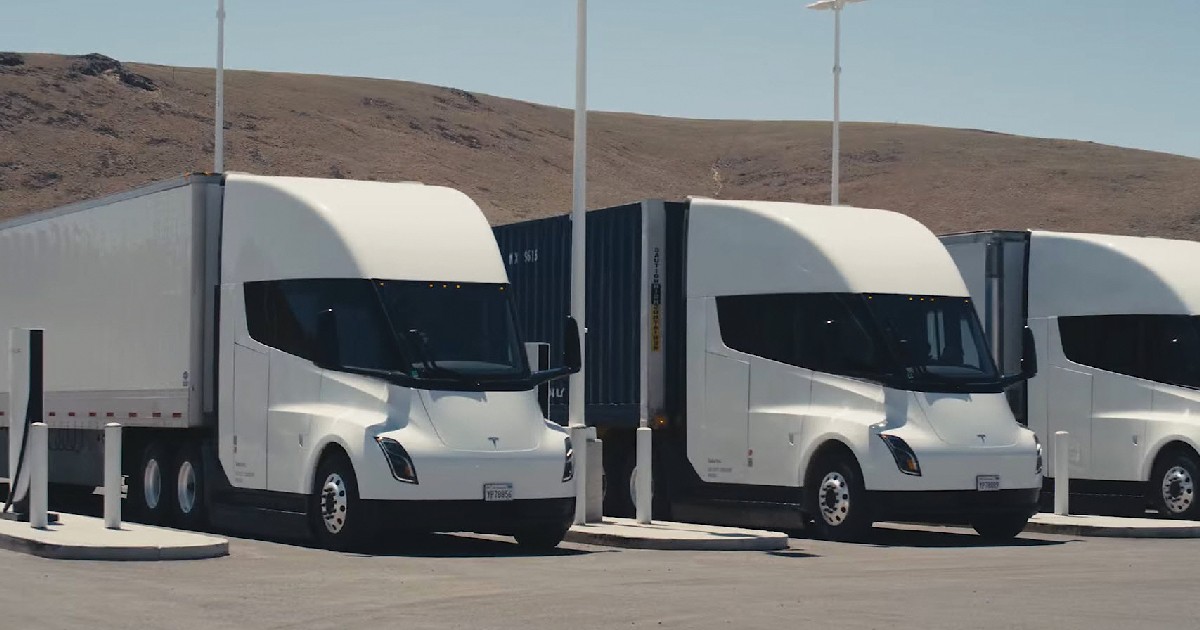
According to www.ttnews.com, the first Tesla Semi rolled off the company’s high-volume production line in Reno, Nev., on April 29, 2026 — marking the official start of scalable manufacturing for Tesla’s Class 8 battery-electric tractor.
Reno Factory Scale and Timeline
Tesla states the Reno facility — located adjacent to Gigafactory Nevada — can produce up to 50,000 Class 8 battery-electric tractors per year. Site work began in 2023; factory construction concluded in October 2025, and production line installation was completed in the first quarter of 2026. Tesla previously announced that volume manufacturing would ramp up in 2026, following those milestones.
Product Specifications and Performance
Tesla released official specifications for two variants on February 8, 2026:
- A standard version with a range of about 325 miles, curb weight of less than 20,000 pounds
- A long-range version with a range of around 500 miles, curb weight of 23,000 pounds
- Both feature three independent rear-axle motors and up to 800 kilowatts of drive power
- Both achieve 1.7 kilowatt-hours per mile energy consumption and can charge up to 60% of range in 30 minutes
Market Positioning and Early Adoption
According to the International Council on Clean Transportation (ICCT), the median price for a long-range Tesla Semi is $290,000. This compares with a median price range of $428,000 to $514,000 for alternative Class 8 battery-electric tractors available under California’s Clean Truck & Bus Voucher incentive program.
Fleets actively testing the Semi include ArcBest (No. 13 on Transport Topics’ Top 100 For-Hire Carriers), DHL Supply Chain (North America) (No. 12 on TT’s Top 100 Logistics Companies), and PepsiCo (No. 2 on TT’s Top 100 Private Carriers). PepsiCo was Tesla’s first test partner.
Context for Supply Chain Professionals
For supply chain professionals, the launch signals a material shift in heavy-duty freight electrification timelines. Unlike earlier pilot deployments — such as Volvo’s VNR Electric or Freightliner’s eCascadia — the Tesla Semi’s 50,000-unit annual capacity represents the first U.S.-based high-volume production line dedicated solely to Class 8 BEVs. Its sub-$300,000 pricing tier (per ICCT data) may accelerate fleet adoption where charging infrastructure and duty cycles align with 325–500-mile ranges. Energy consumption at 1.7 kWh/mile also suggests potential total cost of ownership advantages over higher-consumption alternatives — especially when paired with off-peak or on-site renewable charging. However, logistics teams must assess depot-level grid upgrades, battery thermal management in extreme climates, and interoperability with existing trailer coupling and telematics systems before scaling procurement.
Source: Transport Topics
Compiled from international media by the SCI.AI editorial team.