Explore

  • Trending
  • Latest
  • Tools
  • Browse
  • Subscription Feed

Logistics

  • Ocean
  • Air Cargo
  • Road & Rail
  • Warehousing
  • Last Mile

Regions

  • Southeast Asia
  • South Asia
  • Central Asia
  • Japan & Korea
  • Middle East
  • Europe
  • Russia
  • Africa
  • North America
  • Latin America
  • Australia
SCI.AI
  • Supply Chain
    • Strategy & Planning
    • Logistics & Transport
    • Manufacturing
    • Inventory & Fulfillment
  • Procurement
    • Strategic Sourcing
    • Supplier Management
    • Supply Chain Finance
  • Technology
    • AI & Automation
    • Robotics
    • Digital Platforms
  • Risk & Resilience
  • Sustainability
  • Research
  • Expert Columns
  • English
    • Chinese
    • English
No Result
View All Result
  • Login
  • Register
SCI.AI
No Result
View All Result
Home Southeast Asia Supply Chain

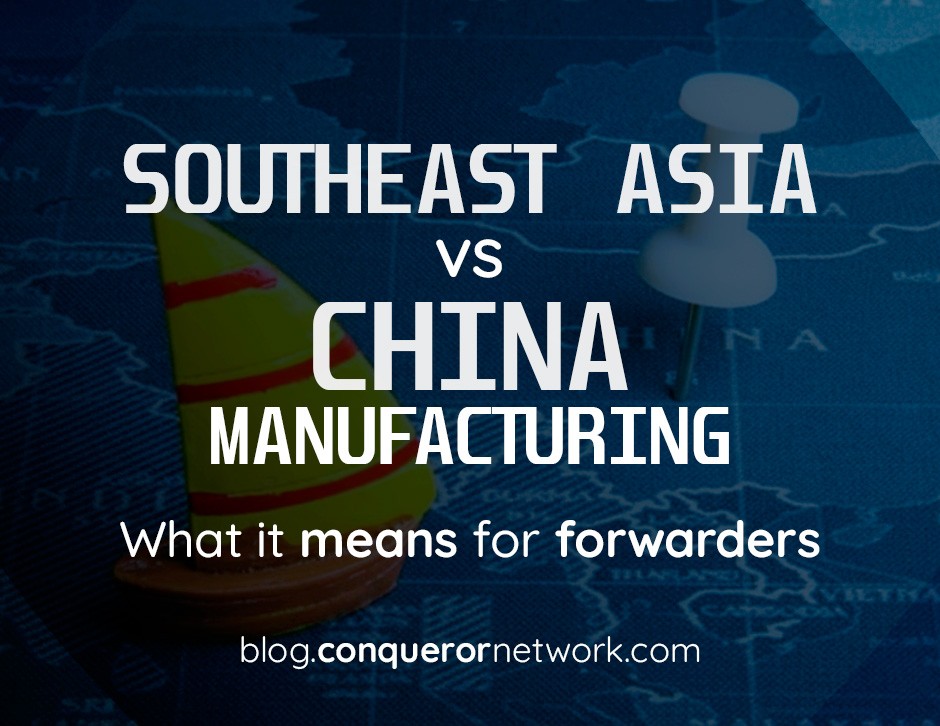
Southeast Asia vs China Manufacturing: 5 Logistics Shifts for Forwarders

2026/04/23
in Southeast Asia Supply Chain
0 0
Southeast Asia vs China Manufacturing: 5 Logistics Shifts for Forwarders

According to blog.conquerornetwork.com, the global manufacturing map is being quietly redrawn as manufacturers shift production from China to Southeast Asia—not in an exodus, but via the China Plus One strategy, where core production remains in China while capacity expands across Vietnam, Thailand, Indonesia, Malaysia, Cambodia, and the Philippines.

Core Differences in Manufacturing Models

China offers scale, speed, and deeply integrated supply chains, ideal for high-volume, complex production. In contrast, Southeast Asia emphasizes cost efficiency and risk diversification, with manufacturing fragmented across multiple countries—creating more flexible but less standardized production networks.

ASEAN Is Not a Monolith

Forwarders must recognize that ASEAN manufacturing hubs are highly specialized and non-interchangeable:

  • Vietnam: Electronics, garments, footwear, furniture
  • Thailand: Automotive, machinery, food processing
  • Malaysia: Semiconductors, medical devices
  • Indonesia: Heavy industry, batteries, raw materials
  • Cambodia & Laos: Labor-intensive manufacturing

This specialization fragments freight flows—replacing one mega-export corridor with multiple mid-sized origins feeding global trade lanes.

Operational Impacts on Forwarders

The manufacturing shift drives tangible daily changes for freight forwarders:

  • More cross-border trucking within ASEAN
  • Smaller but more frequent shipments
  • Less standardized processes
  • Greater reliance on local partners

Transit times vary more, cost predictability declines, and planning margins shrink—especially amid seasonal issues, labor shortages, and uneven customs digitization.

China Factory Relocation Logistics Implications

Partial relocations create hybrid supply chains: components may still originate in China, be assembled in Vietnam, and ship out from Singapore or Laem Chabang. This generates specific challenges:

  • Increased intra-Asia movements
  • More transshipment dependence
  • Complex rules of origin compliance
  • Higher documentation sensitivity

Forwarders evolve from transport providers into coordinators managing timing between suppliers across borders.

Growth Opportunities Amid Complexity

Freight forwarding opportunities in ASEAN countries are expanding for forwarders who invest in regional capability. Key growth areas include:

  • Cross-border road freight within ASEAN
  • Multimodal consolidation services
  • Vendor-managed logistics for dispersed suppliers
  • Trade compliance and origin advisory

Manufacturers entering Southeast Asia often lack local logistics experience—making forwarders who design end-to-end solutions long-term strategic partners.

Infrastructure and Risk Realities

Southeast Asia logistics infrastructure readiness remains uneven compared to China’s mature system. Challenges include limited hinterland connectivity, equipment imbalances, port congestion risks during export surges, and capacity pressure during peak seasons. Regulatory inconsistency between ASEAN states further complicates cross-border logistics—what clears smoothly in Singapore may stall in Myanmar or Laos.

When comparing China and ASEAN supply chain risks, neither is risk-free—the nature of risk simply changes. China risks include policy shifts, geopolitical pressure, and cost inflation; ASEAN risks center on infrastructure bottlenecks, regulatory variation, and operational inconsistency. Smart shippers—and smart forwarders—balance both.

The logistics impact of China Plus One is long-term: freight patterns will remain multi-origin, multi-port, and multi-modal. Success depends on regional expertise, strong local agents across ASEAN, flexibility in routing and capacity planning, and advisory capability—not just execution.

“Manufacturing is no longer concentrated. Logistics cannot be either.” — blog.conquerornetwork.com

Source: blog.conquerornetwork.com

Compiled from international media by the SCI.AI editorial team.
More on This Topic

  • SE Asia Freight Rates Double Amid Middle East Supply Chain Shifts (Apr 22, 2026)
  • Southeast Asia Supply Chain Shift: 50–60% Lower Labor Costs (Apr 21, 2026)
  • China Supply Chain Accelerates Adaptation Amid Shortened Sourcing Timelines (Apr 20, 2026)
  • Nippon Express to Acquire Metro Supply Chain for $1.25bn (Apr 20, 2026)
  • Vietnam’s Feb 2026 Customs Rules Raise Supply Chain Compliance Burden (Apr 19, 2026)
ShareTweet

Related Posts

SE Asia Freight Rates Double Amid Middle East Supply Chain Shifts
Southeast Asia Supply Chain

SE Asia Freight Rates Double Amid Middle East Supply Chain Shifts

April 22, 2026
0
Southeast Asia Supply Chain Shift: 50–60% Lower Labor Costs
Southeast Asia Supply Chain

Southeast Asia Supply Chain Shift: 50–60% Lower Labor Costs

April 21, 2026
4
China Supply Chain Accelerates Adaptation Amid Shortened Sourcing Timelines
Southeast Asia Supply Chain

China Supply Chain Accelerates Adaptation Amid Shortened Sourcing Timelines

April 20, 2026
6
Nippon Express to Acquire Metro Supply Chain for $1.25bn
Southeast Asia Supply Chain

Nippon Express to Acquire Metro Supply Chain for $1.25bn

April 20, 2026
4
Vietnam’s Feb 2026 Customs Rules Raise Supply Chain Compliance Burden
Southeast Asia Supply Chain

Vietnam’s Feb 2026 Customs Rules Raise Supply Chain Compliance Burden

April 19, 2026
7
Southeast Asia Supply Chain Disruption Drives 20% Order Return to China
Southeast Asia Supply Chain

Southeast Asia Supply Chain Disruption Drives 20% Order Return to China

April 18, 2026
11

Leave a Reply Cancel reply

Your email address will not be published. Required fields are marked *

Recommended

Wesco与Relex合作升级供应链运营

Wesco Collaborates with Relex to Upgrade Supply Chain Operations

9 Views
February 15, 2026
Semiconductor Supply Chain: $701B Market in 2025

Semiconductor Supply Chain: $701B Market in 2025

0 Views
April 23, 2026
Logistics Reshapes North America’s Trade Map: 3 Key Shifts

Logistics Reshapes North America’s Trade Map: 3 Key Shifts

6 Views
March 28, 2026
Power-Flexible AI Factories: 100% Grid Response in UK Trial

Power-Flexible AI Factories: 100% Grid Response in UK Trial

7 Views
April 1, 2026
Show More

SCI.AI

Global Supply Chain Intelligence. Delivering real-time news, analysis, and insights for supply chain professionals worldwide.

Categories

  • Supply Chain Management
  • Procurement
  • Technology


  • Risk & Resilience
  • Sustainability
  • Research

© 2026 SCI.AI. All rights reserved.

Powered by SCI.AI Intelligence Platform

Welcome Back!

Sign In with Facebook
Sign In with Google
Sign In with Linked In
OR

Login to your account below

Forgotten Password? Sign Up

Create New Account!

Sign Up with Facebook
Sign Up with Google
Sign Up with Linked In
OR

Fill the forms below to register

All fields are required. Log In

Retrieve your password

Please enter your username or email address to reset your password.

Log In

Scan to share via WeChat

Open WeChat and scan the QR code to share

QR Code

Add New Playlist

No Result
View All Result
  • Supply Chain
    • Strategy & Planning
    • Logistics & Transport
    • Manufacturing
    • Inventory & Fulfillment
  • Procurement
    • Strategic Sourcing
    • Supplier Management
    • Supply Chain Finance
  • Technology
    • AI & Automation
    • Robotics
    • Digital Platforms
  • Risk & Resilience
  • Sustainability
  • Research
  • Expert Columns
  • English
    • Chinese
    • English
  • Login
  • Sign Up

© 2026 SCI.AI