In the wave of digital transformation, Microsoft, as a global technology giant, is leading a new paradigm in supply chain strategy and planning. Recently, Microsoft released its “Supply Chain 2.0: How Microsoft is powering simulations, AI agents, and physical AI” whitepaper, detailing its complete roadmap for transitioning from traditional Excel-driven supply chain management to an autonomous, intelligent Supply Chain 2.0. This transformation has not only brought significant efficiency gains to Microsoft itself but also provides a replicable digital transformation template for global enterprises.
“Our goal is to operate over 100 AI agents by the end of 2026 and equip every employee with agent support. AI in logistics is already saving our teams hundreds of hours monthly, demonstrating how agentic operations directly translate to efficiency and business value.” — Microsoft Supply Chain Transformation Lead
The Three Pillars of Supply Chain 2.0: Core Technology Drivers
Microsoft defines Supply Chain 2.0 as the next-generation supply chain system driven by three core technologies: AI-powered supply chain simulation, agentic supply chain systems, and physical AI integration. These three pillars together form the complete technology stack for intelligent supply chains, enabling a fundamental shift from reactive to predictive, and from manual decision-making to autonomous optimization.
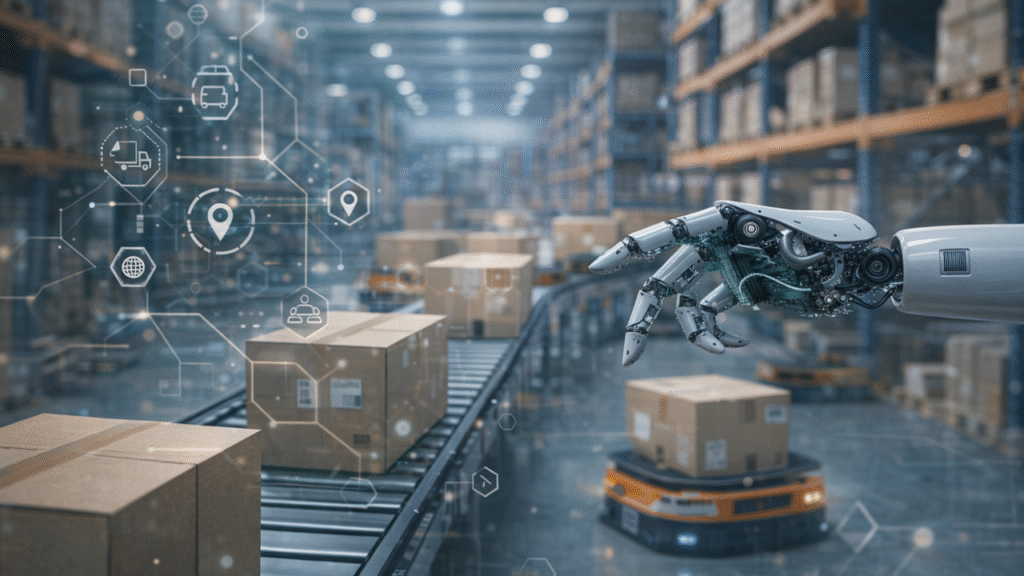
At the simulation level, Microsoft builds comprehensive virtual models of supply chains through digital twin technology. These models not only simulate physical warehouses, production lines, and logistics networks but also predict supply chain performance under various scenarios. Through deep integration with platforms like NVIDIA Omniverse, Microsoft achieves high-fidelity 3D supply chain simulations, allowing teams to test optimization solutions in virtual environments, significantly reducing the risks and costs of actual deployment.
Agentic Supply Chains: From Point Intelligence to System Autonomy
Agentic supply chains represent the core innovation of Microsoft’s Supply Chain 2.0. Currently, Microsoft has deployed over 25 specialized AI agents covering critical areas such as demand planning, inventory optimization, and transportation management. These agents not only perform specific tasks but also achieve complex supply chain optimization through multi-agent collaboration.
For example, the demand planning agent significantly improves forecast accuracy for non-IT rack components through AI-driven demand simulation while reducing manual coordination efforts. The multi-agent datacenter spare parts space solver uses computer vision monitoring and multi-agent reasoning to predict spare parts storage needs and proactively mitigate space or inventory risks. The freight navigation agent continuously analyzes transportation patterns, routes, cost structures, carbon impact, and cycle times to provide optimized shipping recommendations that balance speed, sustainability, and efficiency.
Physical AI Integration: Bridging Digital and Physical Worlds
The integration of physical AI represents another breakthrough in Supply Chain 2.0. Through collaboration with partners like NVIDIA and SoftServe, Microsoft seamlessly integrates AI agents into physically accurate digital twins. In Krones’ beverage production simulation, this integration reduced cycle times from hours to under five minutes. At Toyota Material Handling Europe, digital twin technology enabled autonomous forklift simulation testing in virtual warehouse environments, reducing autonomous system training time by over 30%.
TeamViewer’s augmented reality platform Frontline provides new interaction methods for frontline supply chain work. Through smart glasses or wrist-worn devices, frontline workers receive hands-free guidance, enabling more efficient picking and packing operations. At DHL Supply Chain, TeamViewer’s solution has been deployed globally, supporting over 1,500 workers across 25 U.S. sites for hands-free picking operations.
Microsoft’s “Customer Zero” Transformation Practice
As “Customer Zero,” Microsoft’s own supply chain transformation provides valuable experience for the industry. Microsoft operates one of the world’s most extensive cloud supply chains, spanning over 70 Azure regions, 400+ datacenters, and more than 600,000 kilometers of fiber networks. Over the past decade, Microsoft’s supply chain has undergone a fundamental transformation from a passive, manual environment to a rapidly evolving autonomous, agentic supply chain.
In 2018, Microsoft consolidated over 30 systems into a single supply chain data lake on Azure, enabling predictive analytics and first-generation cognitive supply chain capabilities. In 2022, Microsoft began experimenting with generative AI, subsequently developing an AI platform for operating agents at scale. Today, this foundation is accelerating toward fully autonomous agents, with the goal of operating over 100 agents by the end of 2026 and equipping every employee with agent support.
Strategic Implications: Building Future-Ready Supply Chain Planning Systems
Microsoft’s Supply Chain 2.0 transformation provides important strategic implications for global enterprises. First, a unified data foundation is a prerequisite for AI-driven transformation. Enterprises need to break down data silos and build unified supply chain data platforms. Second, an incremental implementation path is crucial. Starting with specific use cases and gradually expanding AI agent coverage ensures each phase delivers measurable business value.
Finally, ecosystem collaboration is key to accelerating transformation. Through deep collaboration with partners like NVIDIA, SoftServe, and TeamViewer, Microsoft rapidly integrated cutting-edge technologies, shortening innovation cycles. For enterprises planning supply chain digital transformation, Microsoft’s experience shows that successful transformation requires not only technology investment but also comprehensive organizational change, process reengineering, and talent development.
Looking Ahead: The Intelligent Evolution of Supply Chain Planning
With the rapid development of AI technology, supply chain planning is undergoing a profound transformation from traditional S&OP (Sales and Operations Planning) to intelligent, autonomous planning. Microsoft’s Supply Chain 2.0 vision demonstrates three characteristics of future supply chains: predictive, adaptive, and sustainable. Predictive supply chains can identify risks in advance and develop response strategies; adaptive supply chains can adjust operational parameters in real-time to optimize performance; sustainable supply chains can find optimal balances between efficiency, cost, and environmental impact.
For Chinese supply chain practitioners, Microsoft’s transformation experience has particular reference value. In the context of global supply chain restructuring, Chinese enterprises need to accelerate digital transformation, building more resilient, efficient, and sustainable supply chain systems through integrated applications of AI, digital twins, and IoT technologies. Microsoft’s practice demonstrates that technology-driven supply chain innovation not only improves operational efficiency but also creates new competitive advantages, delivering long-term value for enterprises.
Source: www.microsoft.com
Compiled from international media by the SCI.AI editorial team.