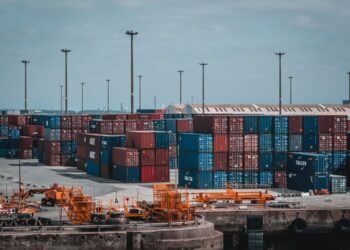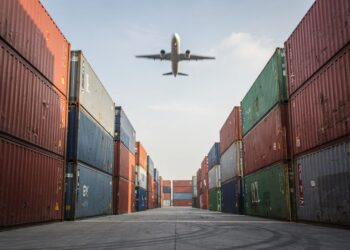
Global supply chains are confronting a systemic rupture—not from pandemic aftershocks or port labor strikes, but from the rapid militarization of critical maritime and aerial corridors across the Middle East. As of March 18, 2026, 138 container ships carrying 470,000 TEUs remain trapped in the Persian Gulf, while over 25,000 regional flights have been canceled and air cargo capacity across the Middle East/South Asia region has plunged 36%. This is not a localized incident; it is a structural fracture in the world’s most concentrated logistics artery, where 124 container liner services—operating 520 vessels—call regularly at Persian Gulf ports, and where Middle East carriers collectively account for 13.6% of global air cargo capacity (IATA). The implications extend far beyond regional volatility: ocean transit times from Asia to Europe now routinely exceed 42 days due to Cape of Good Hope diversions, and fuel surcharges are being revised weekly, with VLSFO prices up 80% since the Strait of Hormuz closure. What distinguishes this crisis from prior disruptions is its dual-domain simultaneity—air and sea networks collapsing in tandem—and its deliberate targeting of infrastructure rather than incidental congestion. This article dissects the operational anatomy, strategic recalibrations, and long-term reconfiguration imperatives emerging from what industry analysts now call ‘the Hormuz Shock.’
Middle East Logistics: A Dual-Domain Collapse
The current Middle East logistics crisis represents an unprecedented convergence of air and maritime network failure—what logistics scholars term ‘dual-domain vulnerability.’ Unlike the Red Sea crisis of 2023–2024, which primarily affected vessel routing and marine insurance, today’s escalation targets both physical infrastructure and regulatory airspace sovereignty. Iran, Iraq, and Kuwait have imposed total airspace closures, while Israel, Qatar, and Bahrain enforce Prior Permission Required (PPR) protocols that delay cargo acceptance by 48–72 hours on average. Simultaneously, the Port of Salalah suspended operations following a drone strike on its fuel storage tanks—a direct assault on energy logistics that cascaded into terminal paralysis. The ONE Majesty container ship (6,700 TEU) was impacted while at anchor in the Persian Gulf, underscoring how even stationary assets are no longer safe. This dual-domain collapse has shattered the foundational assumption of modern global trade: that redundancy exists between transport modes. With air routes shuttered and ocean lanes weaponized, shippers cannot simply pivot—they must reconstruct entire logistical pathways.
Crucially, this is not merely a matter of capacity reduction—it is a crisis of predictability. Airlines like Emirates now operate at 60% capacity, while Etihad functions at just 15%, meaning schedule reliability has collapsed to single-digit percentages. Meanwhile, ocean carriers face compounded uncertainty: MSC declared ‘End of Voyage’ for all shipments destined for the Arabian Gulf, effectively terminating contractual obligations mid-transit. Such declarations are legally fraught and operationally unprecedented outside wartime embargoes. The jet fuel price surge of 58% in one week further destabilizes cost models, as carriers cannot hedge against such acute, asymmetric shocks. As Dr. Lena Al-Farsi, Senior Fellow at the Dubai Logistics Institute, observes:
‘This isn’t volatility—it’s ontological insecurity. When your primary transshipment hub becomes a high-risk zone, and your secondary air gateway requires PPR clearance, you’re not managing logistics—you’re negotiating survival.’ — Dr. Lena Al-Farsi, Senior Fellow, Dubai Logistics Institute
The result is a wholesale erosion of trust in scheduled services, forcing multinationals to abandon lean inventory models in favor of buffer stockpiling across three continents.
Ocean Freight Disruption: From Straits to Surcharges
The ocean freight dimension of the Middle East logistics crisis reveals how geopolitical risk has metastasized into contractual and financial instruments. The Strait of Hormuz—through which 21 million barrels of oil and 30% of globally traded seaborne crude pass daily—has been fully suspended since March 2, triggering immediate rerouting of over 10.7% of the global container fleet capacity. This figure translates to 138 container ships totaling 470,000 TEUs immobilized within the Persian Gulf, many anchored off Jebel Ali and Bandar Abbas under armed guard. The Source Blessing vessel (3,200 TEU) struck near Jebel Ali was not an isolated incident but part of a pattern: four confirmed kinetic impacts on commercial vessels within 12 days, including the Safeen Prestige incident on March 4. These events have catalyzed emergency financial responses: CMA CGM and Hapag-Lloyd announced a $3,000/FEU emergency conflict surcharge, while MSC’s ‘End of Voyage’ declaration forces shippers to absorb demurrage, detention, and transshipment costs previously covered under standard bills of lading.
What makes this disruption structurally distinct is its impact on bunker economics and vessel deployment strategy. With VLSFO up 80% and IFO380 up 70% since the Hormuz closure, carriers are forced into tactical fleet optimization—prioritizing scrubber-equipped vessels, which constitute 45% of the global fleet and deliver 10–15% bunker savings. However, scrubbers require compliant port infrastructure, and only 17% of Persian Gulf terminals currently support open-loop scrubber discharge. This creates a vicious cycle: vessels avoid high-risk ports to save fuel, but avoidance reduces port revenue, delaying environmental upgrades, further deterring vessel calls. Moreover, the diversion around the Cape of Good Hope adds 10–14 days transit time, inflating working capital requirements and exposing shippers to elevated interest rate exposure. As Maersk’s Head of Global Trade Finance notes:
‘A $50 million shipment delayed 12 days incurs $180,000 in additional financing costs at current LIBOR+350bps rates—before insurance, war risk premiums, or demurrage. This isn’t a surcharge—it’s a liquidity tax.’ — Henrik Jørgensen, Head of Global Trade Finance, Maersk
Air Cargo Paralysis: Capacity, Cost, and Contingency
Air cargo has entered a phase of functional paralysis rarely seen outside declared war zones. The total airspace closures in Iran, Iraq, and Kuwait have eliminated 42% of traditional Middle Eastern air corridors, while restricted access in Israel, Qatar, and Bahrain requiring Prior Permission Required (PPR) has turned what was once a 2-hour customs clearance process into a 3-day bureaucratic bottleneck. This is not administrative friction—it is systemic exclusion. Global air cargo capacity is down 12%, but the regional contraction is catastrophic: Middle East/South Asia capacity fell 36%, directly impacting pharmaceuticals, semiconductors, and perishables moving between India, Europe, and North America. Rates reflect this scarcity: India to Europe airfreight surged 80%, while Hong Kong to Europe hit $5.15/kg, exceeding pre-pandemic peaks by 217%. Crucially, these figures mask deeper distortions—Emirates operates at 60% capacity, yet its available tonnage is skewed toward passenger bellyhold space, which lacks temperature-controlled capability essential for biologics. Etihad’s 15% operational capacity is almost entirely dedicated to diplomatic and humanitarian charters, leaving commercial shippers without viable alternatives.
The operational adaptations reveal both ingenuity and desperation. Airlines are adding ‘technical stops’ in Jeddah to bypass restricted zones, effectively turning Saudi Arabia into an unregulated air bridge—even though Riyadh’s own airspace is partially closed near the Iraq/Persian Gulf border. Meanwhile, major EU/US carriers embargo cargo until March 28, citing insufficient war risk coverage, while Oman Air rolls out weekly fuel and war risk surcharges—a pricing model previously reserved for charter operators. Insurance costs have escalated so sharply that standard all-risks policies now exclude ‘hostile acts’ unless supplemented with bespoke war risk endorsements costing 3.2–4.7% of shipment value. This bifurcation—between insured and uninsurable cargo—threatens to fragment global air logistics into parallel tiers: one for defense contractors and pharmaceutical giants with captive insurance arms, another for SMEs priced out of the market entirely. As noted in a confidential IATA risk assessment:
- Over 25,000 regional flights canceled since February 28
- Jet fuel prices jumped 58% in one week
- Carriers implementing War Risk Surcharges weekly—not quarterly
Strategic Responses: Beyond Diversification to Deconstruction
The strategic responses unfolding across global logistics are not incremental adjustments—they signal a deconstruction of decades-old network assumptions. Carriers are abandoning ‘hub-and-spoke’ logic in favor of ‘multi-nodal resilience,’ deploying sea-air solutions through Southeast Asia (e.g., Bangkok and Ho Chi Minh City as consolidation points), while simultaneously activating road feeder services through Saudi Arabia to bypass flight cancellations. But these are stopgaps, not strategies. The alternative air gateways—Muscat, Riyadh, Jeddah—are themselves constrained by carrier risk decisions, not infrastructure limits: Oman Air’s capacity remains capped at 35% of pre-escalation levels despite functional runways because insurers refuse to cover flights originating there without 72-hour advance notice. Similarly, port congestion at transshipment hubs is increasing not due to volume spikes, but because vessels arriving via Cape routes arrive unpredictably, overwhelming yard planning systems designed for ±4-hour ETA windows.
This operational chaos exposes a deeper truth: digital supply chain tools built for efficiency are failing catastrophically when confronted with existential risk. Visibility platforms cannot track vessels that go dark for 72 hours after entering high-threat zones; AI-driven predictive analytics trained on historical transit data produce nonsense forecasts when transit times from Shanghai to Rotterdam now range from 38 to 54 days. Consequently, forward-thinking firms are pivoting toward ‘scenario-native’ architectures—systems that ingest real-time AIS, NOTAM, and insurance bulletin feeds to trigger pre-approved contingency protocols. One European pharma firm activated 17 separate contingency plans in 11 days, including chartering a Boeing 777F from Singapore to Muscat for time-critical mRNA shipments. Yet even these heroic measures falter: equipment imbalances are becoming critical, with empty 40-ft reefers piling up in Rotterdam while full ones sit idle in Colombo, unable to clear customs without Iranian-origin documentation—a requirement now blocked by EU sanctions enforcement algorithms. As Gartner’s Supply Chain Resilience Lead states:
‘Diversification was yesterday’s answer. Today’s imperative is deconstruction—the deliberate dismantling of monolithic networks in favor of modular, jurisdictionally bounded, and legally insulated sub-networks.’ — Anika Patel, Supply Chain Resilience Lead, Gartner
Economic Fallout: From Brent Oil to Working Capital
The economic reverberations of the Middle East logistics crisis extend far beyond freight rates and surcharges—they are reshaping macroeconomic fundamentals. Brent oil hit $100/barrel for the first time since summer 2022, not due to production cuts, but because insurance premiums for tankers traversing the Persian Gulf have spiked 320%, making voyages economically unviable below $92/barrel. This energy shock ripples into manufacturing: German auto suppliers report raw material lead times extending from 6 to 22 weeks, while Japanese electronics firms face 14-day delays on specialty resins shipped from UAE-based producers. Critically, the Shanghai Containerized Freight Index (SCFI) rose 12% week-over-week, but this masks extreme divergence—Red Sea routes spiked 210%, while Transpacific services remained flat, confirming that Transpacific services are largely unaffected except Indian-Subcontinent-linked routings. This asymmetry fractures global pricing power: shippers can no longer negotiate lane-wide contracts, forcing them into spot-market bidding wars for scarce capacity.
Perhaps most consequential is the working capital strain. With emergency conflict surcharges at $3,000/FEU for Persian Gulf/Red Sea and bunker markets regionally fragmented—with Asian hubs commanding 22% premiums over Rotterdam benchmarks, finance teams are recalculating cost-of-carry models in real time. A $20 million monthly import program now incurs $1.2 million in surcharges alone—before war risk insurance at 3.8% of value, or demurrage penalties averaging $14,500/day per container. This liquidity pressure is accelerating two irreversible trends: supply chain finance adoption is up 64% YoY among Fortune 500 firms, and nearshoring investments in Morocco and Turkey have accelerated by 41% since March 1. Yet even these mitigations carry risk: Moroccan ports lack cold-chain infrastructure for pharma, and Turkish rail capacity is saturated, creating new bottlenecks. As highlighted in recent IMF trade finance assessments:
- Bunker markets are now regionally fragmented, with Asian hubs commanding 22% premium
- Equipment availability has become a critical issue, with 40-ft reefer shortages exceeding 37% in key hubs
- Schedule reliability is expected to fall below 18% for Q2 2026, down from 63% in Q4 2025
Source: www.flexport.com
This article was AI-assisted and reviewed by our editorial team.