As the automotive industry undergoes unprecedented transformation, Stellantis is redefining the core principles of supply chain management. At the recent ALSC Europe 2026 conference, Carlos Vazquez, Vice-President of Global Purchasing and Supply Chain at Stellantis, and Benoit Gaucherand, Senior Manager for Enlarged Europe Aftersales Transport Network Design and Cost Control, revealed a critical shift: from cost-driven logistics models to AI-enabled, multimodal, and human-centric supply chain systems, with resilience and partner collaboration as strategic cornerstones. This transformation marks the automotive supply chain’s entry into a new developmental phase, no longer relying solely on technology and digitalization but placing greater emphasis on human cooperation and trust-building.
From Lean to Anti-Fragile: The Evolution of Stellantis’ Supply Chain
Vazquez detailed the evolution of Stellantis’ supply chain management philosophy. In the 1980s-1990s, best practices focused on lean production and cost optimization, a necessary response to the aftermath of the first oil crisis. “We were in the aftermath of the first oil crisis, and the focus was on production and cheap production,” he recalled. Entering the 1990s to 2000s, the emphasis shifted to ERP systems, aiming to achieve inventory and order visibility and establish Sales & Operations Planning (S&OP) processes. This period required attention to the future, conducting forecasting and planning, and studying various “what-if” scenarios. The 2000s were driven by customer-centricity, “This was truly an agility period that completely changed how we operate,” Vazquez stated. However, when the COVID-19 pandemic arrived, this agility changed once again.
Vazquez noted that with the pandemic’s arrival, “resilience moved from PowerPoint presentations in boardrooms to everyday meetings and activities.” This prompted Stellantis to propose an “anti-fragile” approach, which he described as the ability to fail, learn, and grow incrementally. Artificial intelligence is a core component of the “anti-fragile” era the OEM currently inhabits, using digital twin technology to map the supply chain, predictive AI for forecasting, anticipation, and prescription, and AI-driven automation to improve efficiency. But Vazquez posed a crucial question: “What is the next frontier in supply chain best practices? What is the future?”
“When AI has all the answers, what’s truly important are the questions. Technology is essential, but it’s only an enabler.” — Carlos Vazquez, Vice-President of Global Purchasing and Supply Chain at Stellantis
The Human Value in the AI Era of Supply Chains
Vazquez emphasized that while AI is essential in today’s supply chains, its benefits cannot be fully realized without people and collaboration. “When AI has all the answers, what’s truly important are the questions,” he said. “When AI has all the answers, we place at the center the people who will ask questions and collaboration across companies and value chains, because we’re all working in AI silos within our own companies.” He added: “Technology is essential, but it’s only an enabler.”
This philosophy is fully embodied in Stellantis’ supply chain practices. The company is entering this new era through a framework developed by the supply chain and procurement teams—the Engaged Program. This year-long program involves continuous meetings and knowledge sharing among teams across the OEM’s value chain. Gaucherand explained how the program builds trust and collaboration with Stellantis’ supply chain partners. “We have an ever-changing market with new challenges and crises every day—it’s complex and competitive. But can we do it alone? We’re humble and know we can’t do it alone; we need our partners because they have skills and experience and can provide critical perspectives on what we’re doing.”
The Engaged Program: Building a New Paradigm for Supply Chain Collaboration
Stellantis’ Engaged Program is a systematic partner collaboration framework designed to break down information silos and trust barriers in traditional supply chains. The program’s first phase begins with remote town hall meetings to share learnings from the previous year. Then, goals and expectations for the coming year are shared, including trends and expected volumes, key projects, and any potential impacts on partners. Partnerships are also reviewed through RFQs to enhance transparency and build trust. Operational reviews are conducted throughout the year with regular KPI discussions.
The most critical part of the program is Booster Days, where Stellantis and its supply chain partners meet in person at the OEM’s plants or warehouses. Gaucherand stated these Booster Days are the most important component of the Engaged Program, explaining their content. “These days are based on four pillars,” he said, starting with brief presentations of any valuable new information to partners. Then, discovery tours allow Stellantis’ partners to better understand what the OEM actually does on the shop floor, including how parts are picked and prepared for shipping. Individual meetings with procurement and operations follow, aiming for joint improvement and increased efficiency. The days conclude with networking to strengthen relationships. “I think this is the main point because we can have all the AI we want, but if we don’t have people behind it, then what is AI?” he said. “Knowing each other and coming together creates value.”
Challenges and Strategies for European Automotive Supply Chains
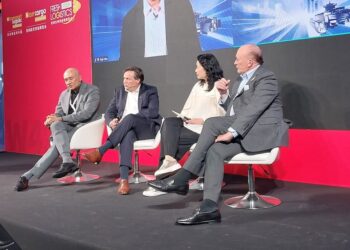
In panel discussions, Vazquez joined Sean Bricknell, Head of Performance Office, Supply Chain at Volvo Cars; Jost Hock, Vice-President of Global Key Accounts Automotive, Commercial Management at DSV; and Tobias Fenzl, Global Director, Key Account at DP World to further discuss how to become more connected, collaborative, and strategic in meeting the evolving needs of Europe’s automotive industry. The panel agreed that traditional supply chain models and sourcing methods are inadequate in the current environment. The industry needs to adapt to continuous change and model it effectively. Regarding data and information flow, good, trusted information needs to flow freely between partners. The current data analytics phase is intense during RFQs but often stops afterward, creating gaps in ongoing processes. Data cleansing remains a significant challenge, consuming most of the time in data analytics.
Regarding mid-term planning gaps, there’s a “U-shaped” situation with abundant data for the present and past, and long-term future (5+ years), but a significant gap in reliable data and visibility for the mid-term (1-2 years). This gap complicates building relationships and shared futures with partners. In terms of anticipation in a VUCA world (Volatility, Uncertainty, Complexity, Ambiguity), in a market characterized by volatility, uncertainty, complexity, and ambiguity, scenario ranges are broad, making preparation for unforeseen events like the Suez Canal blockage difficult. The challenge lies in effective anticipation and maintaining planning energy even when plans may need rewriting.
Strategic Application of AI and Technology
Regarding AI and technology adoption, the panel emphasized several key points. AI as a support tool assists data analysis, but human first responders remain crucial for guiding operations during crises. AI brings data analytics to hyperscale, but data cleansing still consumes most of the time. Proof of concept and continuous learning are vital, as unexpected value can be discovered even in failures. A 2013 example involved a control tower for container monitoring that initially aimed to notify customers of delays but later revealed the value of a clean database for network modeling and understanding challenges.
Regarding trust in AI results, trust in AI-generated results needs to be built, as people tend to question them more than human-derived analyses. Education is necessary to help people accept and effectively utilize AI outputs. Regarding AI upskilling, Volvo Cars is heavily investing in mass AI upskilling across all employee levels to federate AI and empower teams for future industrial operations. Regarding business-driven AI, AI and data initiatives must be driven by business needs to fully leverage their potential. The combination of business expressing needs and IT bringing ideas is essential for successful implementation.
Outcomes of the Engaged Program and Future Outlook
Stellantis’ new program is already evolving its supply chain and shaping operational and logistics decisions. Stellantis now transports 34% of its outbound volume by rail, part of a broader push toward low-emission transport modes across Europe. “We are very committed to shifting as much as possible to low-emission transport modes,” Vazquez said, emphasizing modal balance’s role in reducing vehicle logistics’ environmental impact. A key takeaway from Booster Days is the need to carefully consider transport modes. “Knowing we have driver shortages, CO₂ reduction targets, and need to improve costs means we need to think outside the box and find new ways to transport our goods,” Vazquez said. “We’re asking our partners to propose multimodal solutions even if they don’t meet all our criteria.”
While AI is rapidly transforming visibility, forecasting, and automation, both Vazquez and Gaucherand emphasize that technology alone won’t define best practices. Instead, the next frontier lies in combining AI with stronger human collaboration, deeper supplier integration, and more flexible multimodal logistics solutions to navigate increasingly volatile markets. This strategic shift not only reflects Stellantis’ deep understanding of supply chain management but also provides valuable insights for the entire automotive industry: in an era of rapid technological advancement, human care and partnership remain core elements in building sustainable competitive advantage.
Source: www.automotivelogistics.media
This article was AI-assisted and reviewed by our editorial team.