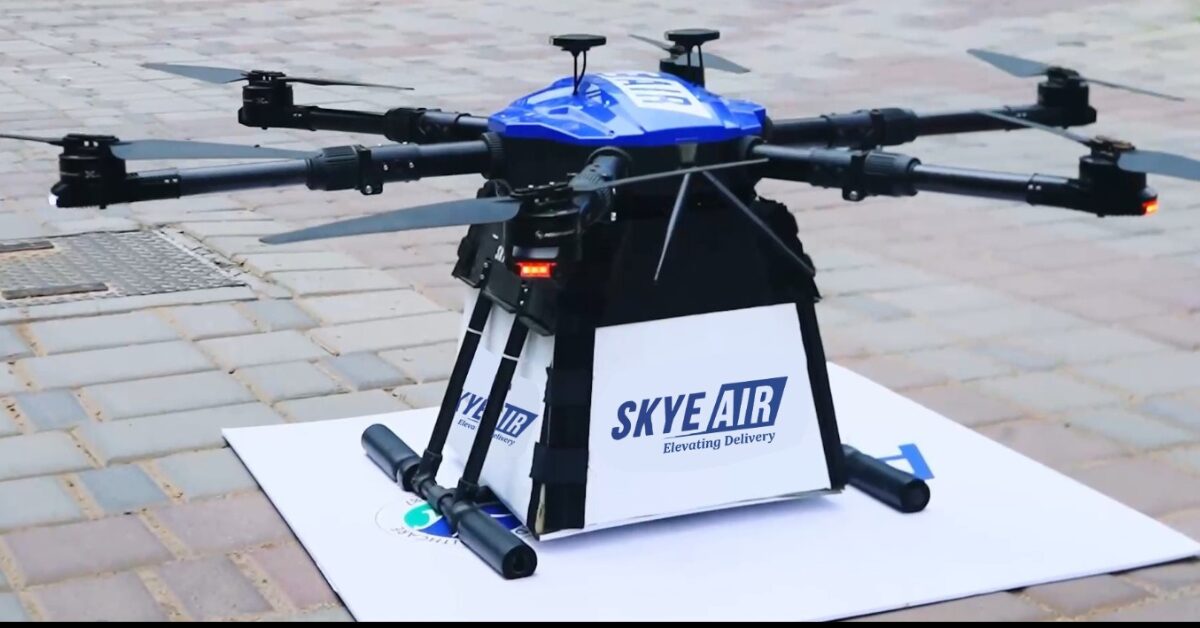
In a significant development for India’s logistics sector, drone delivery startup Skye Air Mobility has secured $9Mn in a Series B funding round led by IAN Alpha Fund. This investment marks a pivotal moment for the company as it prepares to expand its innovative last-mile delivery solutions across multiple Indian cities. The funding will be raised in two tranches, with $4Mn expected to close this month and the remaining $5Mn to be secured over the next three to four months.
The Gurugram Success Story
Founded in 2019 by Ankit Kumar, Skye Air has established a robust operational model in Gurugram, where it currently operates 60 Skye pods with a fleet of 33 drones. The company’s unique approach combines aerial drone delivery with ground-based walkers, creating a hybrid system that addresses both efficiency and accessibility challenges in urban logistics. ‘It took some time to put together the entire playbook we were trying to build in Gurugram,’ Kumar explained. ‘Once we figured out how we needed to scale, how to expand, and what kind of unit economics needed to work, we decided it was time to move beyond Gurugram and expand to multiple other cities.’
Expansion Strategy and Market Reach
With the new funding, Skye Air plans to expand its services to Noida, Greater Noida, Faridabad, and other parts of Delhi NCR, followed by expansion to Bengaluru, Mumbai, Pune, Hyderabad, and Kolkata. This strategic expansion aligns with India’s growing e-commerce market and the increasing demand for efficient last-mile delivery solutions. The company’s B2B2C model has already attracted 12 major clients, including Flipkart, The Bombay Shaving Company, Bluedart, and Shiprocket, demonstrating strong market validation for its drone delivery services.
Technological Innovation: Physical AI Focus
A significant portion of the funding will be directed toward developing physical AI technology, which represents Skye Air’s commitment to creating intelligent, adaptive delivery systems. This technology focuses on understanding and navigating complex urban environments, including variable weather conditions, building structures, and social dynamics. The company’s emphasis on physical AI sets it apart from conventional drone delivery services by prioritizing contextual intelligence over mere automation.
Industry Impact and Supply Chain Transformation
Skye Air’s expansion comes at a time when India’s logistics sector is undergoing rapid transformation. The drone delivery market is projected to grow at a CAGR of 37% from 2021 to 2026, reaching $10.3Bn by 2026. Skye Air’s success could catalyze broader adoption of drone technology in India’s supply chain, potentially reducing delivery times by 70% and cutting logistics costs by 40% for time-sensitive shipments. The company’s model also addresses environmental concerns by reducing carbon emissions associated with traditional delivery vehicles.
Strategic Implications for Global Logistics
The success of Skye Air has significant implications for global logistics companies, particularly those looking to expand in emerging markets. The company’s approach demonstrates how localized innovation can overcome infrastructure challenges while maintaining operational efficiency. For Chinese companies expanding internationally, Skye Air’s model offers valuable insights into navigating regulatory environments, building local partnerships, and adapting technology to specific market needs.
- Market Growth: India’s drone delivery market projected to reach $10.3Bn by 2026
- Operational Efficiency: Skye Air’s hybrid model reduces delivery times by 70% for time-sensitive shipments
- Environmental Impact: Drone delivery can reduce carbon emissions by up to 90% compared to traditional vehicles
- Economic Benefits: Potential to create 50,000+ jobs in drone operations and maintenance by 2030
Future Outlook and Challenges
While Skye Air’s expansion represents a major step forward for India’s logistics sector, several challenges remain. Regulatory frameworks for drone operations continue to evolve, requiring ongoing adaptation from companies in the space. Additionally, public acceptance of drone delivery services must be cultivated through transparent communication and community engagement. Skye Air has already begun addressing these challenges through its community outreach programs and educational initiatives.
Looking ahead, Skye Air’s success could pave the way for broader innovation in India’s supply chain ecosystem. As the company expands to new cities, it will generate valuable data on urban logistics patterns, potentially informing future infrastructure development and policy decisions. The integration of physical AI technology could also lead to new applications beyond delivery, including emergency response, agricultural monitoring, and infrastructure inspection.
‘We’re not building an unmanned logistics system; we’re building an augmented logistics system that makes human workers more efficient, safer, and more dignified. Walker incomes have increased by 32% because drones eliminate 70% of their unproductive commute time.’ — Ankit Kumar, Founder and CEO of Skye Air
Conclusion: A New Era for Indian Logistics
Skye Air’s $9Mn funding round represents more than just financial validation; it signals the beginning of a new era for India’s logistics industry. By successfully combining drone technology with ground-based operations, the company has created a scalable model that addresses both efficiency and accessibility challenges. As Skye Air expands to new cities, it will not only transform last-mile delivery but also contribute to broader economic development through job creation and technological innovation. The company’s focus on physical AI and community engagement positions it as a leader in responsible, sustainable logistics innovation.
Source: inc42.com
This article was AI-assisted and reviewed by our editorial team.