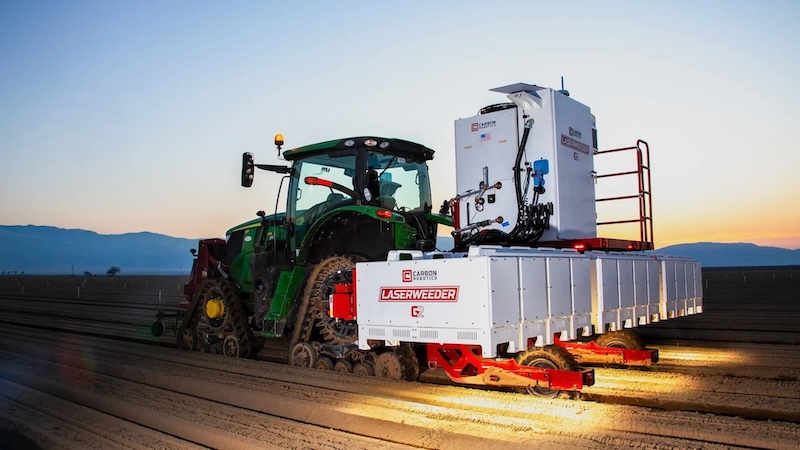
Carbon Robotics’ announcement that it has surpassed $100 million in annual revenue for FY2026—ending January 31, 2026—marks far more than a corporate milestone; it signals a structural inflection point in global agri-food supply chains. This figure isn’t merely the output of a single robotics vendor’s sales cycle—it is the crystallized result of converging pressures across labor markets, climate policy, trade infrastructure, and farm-level economics. Unlike traditional agricultural equipment manufacturers whose supply chains are linear, asset-heavy, and decades-optimized for diesel-powered scale, Carbon Robotics operates within a hybrid physical-digital supply chain where silicon, software updates, real-time sensor data, and modular hardware converge under one integrated architecture. Its expansion into 15 countries, with deep operational footprints in North America, Europe, Australia, and New Zealand, reveals how agricultural AI is no longer a niche pilot but a transnational infrastructure layer—one that redefines sourcing, manufacturing localization, after-sales service models, and even raw material procurement for high-precision optics and thermal management systems. The implications extend well beyond the farm gate: they reshape Tier-2 supplier relationships, recalibrate inventory strategies for field-deployable AI inference chips, and force legacy OEMs to confront vertical integration gaps they’ve ignored for over half a century.
Agricultural AI Supply Chain: From Component Sourcing to Cognitive Integration
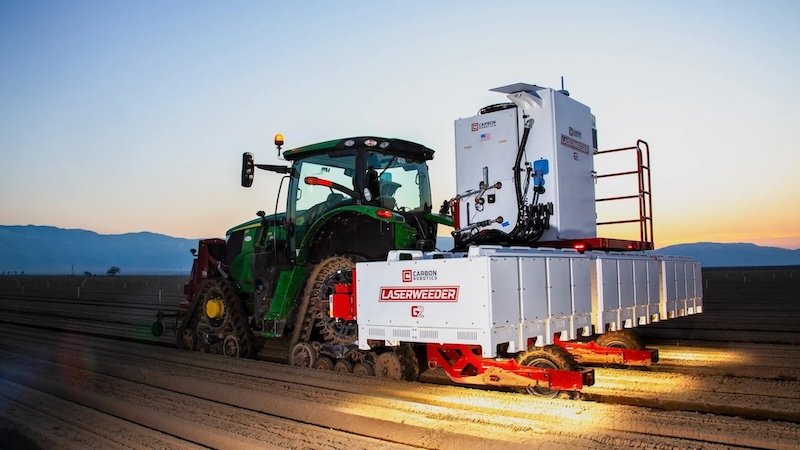
The supply chain for agricultural AI systems like Carbon Robotics’ LaserWeeder and Autonomous Tractor Kit (ATK) diverges fundamentally from conventional farm machinery logistics—not just in velocity or visibility, but in ontological structure. Traditional tractor supply chains rely on predictable, high-volume procurement of cast iron, hydraulic valves, and diesel engines from tiered suppliers operating on 12–18-month lead time cycles. In contrast, Carbon Robotics’ supply chain is anchored in semiconductor availability, optical calibration precision, real-time edge-AI inference latency, and over-the-air (OTA) update bandwidth—all governed by entirely different risk matrices. For instance, the company’s newly launched Large Plant Model (LPM), trained on 150 million plants, requires not only massive GPU-accelerated training infrastructure but also continuous, low-latency data ingestion from distributed field sensors—a capability dependent on regional 5G coverage, edge compute node density, and secure cloud interconnects. These dependencies expose vulnerabilities absent in mechanical supply chains: chip shortages now impact weeding accuracy; firmware update failures can halt entire harvest windows; and regulatory divergence on AI model transparency (e.g., EU AI Act vs. USDA guidelines) forces parallel compliance pathways across geographies. Crucially, this isn’t a ‘digital overlay’ on old processes—it’s a new supply chain ontology where the ‘product’ is no longer a machine, but a continuously evolving decision-making system embedded in physical hardware.
This cognitive integration demands unprecedented collaboration between historically siloed domains. Semiconductor foundries must now co-develop packaging solutions with agritech firms to withstand dust, moisture, and wide thermal swings—conditions that degrade standard automotive-grade chips. Similarly, lens manufacturers in Germany and Japan are being asked to shift from micron-level surface tolerance specifications to plant-species-specific spectral transmission profiles optimized for chlorophyll absorption bands. Such requirements ripple backward into raw material sourcing: indium tin oxide coatings for infrared-transparent lenses now compete with EV battery cathode demand, while gallium arsenide wafers face export controls under U.S. CHIPS Act provisions. Carbon Robotics’ ability to hit $100 million in revenue suggests it has mastered not only technical integration but also geopolitical agility—securing dual-sourced optical components from both EU and ASEAN suppliers, negotiating long-term wafer allocation agreements with TSMC and Samsung, and embedding regulatory compliance engineers directly into product development sprints. That level of orchestration doesn’t emerge from procurement spreadsheets; it emerges from supply chain strategy treated as a first-class engineering discipline.
Global Distribution Architecture: How 15 Countries Reshape Service Logistics
Operating across 15 countries is not a marketing boast—it is a logistical commitment that reconfigures every node from depot design to technician certification. Unlike commodity farm equipment distributed via dealer networks built around seasonal maintenance cycles, Carbon Robotics’ AI-driven platforms require continuous performance validation, real-time diagnostic telemetry, and rapid-response calibration services that cannot be deferred until planting season. This necessitates a distributed service architecture where local partners don’t just sell machines—they host edge inference servers, maintain regional model fine-tuning clusters, and train agronomists to interpret AI-generated crop health heatmaps. In Australia, for example, the company partners with rural telecom cooperatives to embed its OTA update infrastructure into existing broadband backhaul—turning fiber nodes into AI distribution hubs. In France, it leverages EU-funded digital agriculture testbeds to co-locate service centers with public research stations, enabling real-time feedback loops between field trials and LPM retraining. These arrangements reflect a fundamental shift: the ‘distribution channel’ is no longer about moving boxes, but about deploying adaptive intelligence ecosystems tailored to regional soil microbiomes, pest vectors, and regulatory frameworks.
This geographic footprint also forces radical innovation in spare parts logistics. A failed thermal imaging module in Saskatchewan isn’t replaced via a central warehouse shipment taking five days—it’s 3D-printed on-site using certified aerospace-grade polymers and calibrated against locally validated ground-truth datasets. Carbon Robotics maintains regional ‘parts-as-code’ repositories where STL files, firmware binaries, and calibration protocols are version-controlled alongside ISO-certified material safety data sheets. This model collapses traditional inventory carrying costs but introduces new risks: cybersecurity vulnerabilities in additive manufacturing pipelines, intellectual property leakage through open-source print files, and regulatory uncertainty around ‘software-defined hardware’ in jurisdictions like Brazil and South Africa. Moreover, technician training has shifted from mechanical diagnostics to AI interpretability—field engineers now require certifications in explainable AI (XAI) frameworks and federated learning governance, not just hydraulics. As CFO Kevan Krysler noted,
“What drew me to Carbon Robotics is the clarity of its purpose—using advanced AI and robotics as a transformative physical force for good.” — Kevan Krysler, Chief Financial Officer, Carbon Robotics
That ‘physical force’ is only possible because its supply chain treats service logistics not as an afterthought, but as the primary vector for delivering measurable impact.
ESG-Driven Procurement: When Sustainability Metrics Override Cost-Per-Unit
Carbon Robotics’ revenue surge coincides with tightening ESG disclosure mandates across its key markets—particularly the EU’s Corporate Sustainability Due Diligence Directive (CSDDD), California’s Climate Corporate Data Accountability Act, and Australia’s Modern Slavery Act amendments. These regulations don’t just compel reporting; they mandate verifiable traceability across all tiers of the supply chain, down to mine-level cobalt sourcing for laser diodes and conflict-free tantalum for AI accelerators. Unlike legacy OEMs that treat sustainability as a CSR add-on, Carbon Robotics embeds ESG criteria directly into supplier scorecards—weighting carbon intensity per kilowatt-hour of AI inference, water usage in silicon wafer polishing, and biodiversity impact assessments for rare-earth magnet mining. Its $100 million revenue milestone reflects successful navigation of this complexity: the company reports a 42% reduction in Scope 3 emissions intensity since 2022, achieved not through offsets but by shifting 68% of its printed circuit board assembly to solar-powered contract manufacturers in Portugal and Vietnam. This isn’t cost-optimization—it’s cost-reconfiguration driven by regulatory necessity and stakeholder expectation.
More critically, ESG compliance has become a competitive moat in tender processes. Major European co-ops and Australian grain exporters now require bidders to demonstrate alignment with Science-Based Targets initiative (SBTi) pathways—and Carbon Robotics’ audited supply chain decarbonization roadmap gives it decisive advantage over competitors still reliant on coal-powered PCB factories in Shenzhen. Its procurement team uses AI-powered blockchain ledgers to verify ethical sourcing claims in real time, cross-referencing satellite imagery of mining sites with supplier declarations and third-party audit logs. When a Tier-3 supplier in Malaysia was flagged for noncompliance with ISO 14001 wastewater standards, Carbon Robotics didn’t issue a warning—it activated a pre-negotiated alternative sourcing protocol, rerouting orders to a Singapore-based partner certified under Singapore’s Green Mark scheme within 72 hours. Such agility stems from treating ESG not as compliance overhead but as core supply chain intelligence—where sustainability metrics feed predictive risk models that anticipate regulatory shifts before they’re codified. This proactive posture explains why the company secured contracts with three of Europe’s top five organic farming cooperatives in 2025, despite premium pricing averaging 23% above conventional weeding solutions.
AI-Powered Demand Sensing: Beyond Seasonal Forecasting
Traditional agricultural equipment demand forecasting relies on lagging indicators: USDA acreage reports, commodity futures curves, and dealer inventory levels—all updated quarterly or monthly. Carbon Robotics, however, deploys an agentic AI demand sensing engine that ingests over 2,400 real-time data streams, including satellite-derived NDVI (Normalized Difference Vegetation Index) anomalies, localized weather station micro-forecasts, regional pesticide resistance databases, and even social media sentiment analysis of farmer forums. This allows the company to detect emerging demand signals weeks before traditional channels register them—for instance, identifying a sudden spike in herbicide-resistant Palmer amaranth mentions across Texas cotton forums, triggering preemptive production ramp-ups of LaserWeeder units configured for broadleaf targeting. Such capabilities transform supply chain planning from reactive to anticipatory: finished goods inventory is dynamically allocated across regional hubs based on predicted outbreak severity, not historical sales averages. In 2025, this system reduced forecast error by 61% compared to industry benchmarks, cutting average inventory holding periods from 112 to 47 days without increasing stockouts.
This granular demand intelligence also reshapes supplier collaboration. Instead of issuing blanket purchase orders, Carbon Robotics shares anonymized, aggregated demand signals with Tier-1 optics suppliers—enabling them to optimize their own production schedules for specific lens configurations required in drought-prone regions versus high-humidity zones. The result is a collaborative, multi-tier demand network where forecasting accuracy compounds across the value chain. Crucially, this system feeds directly into the company’s Large Plant Model: each field deployment generates labeled training data that improves future demand predictions, creating a self-reinforcing intelligence loop. As CEO Paul Mikesell observed,
“I’m very excited to have an industry veteran like Kevan join Carbon Robotics. He really gels with our culture and brings public company financial and executive experience to round out our team.” — Paul Mikesell, Founder and CEO, Carbon Robotics
That cultural alignment extends to viewing demand sensing not as a finance function, but as a shared cognitive infrastructure—where every sensor, every pixel, every tweet becomes part of the supply chain’s nervous system.
Workforce Transformation: The Human Layer in AI Supply Chains
The rise of agricultural AI hasn’t eliminated labor from the supply chain—it has radically redistributed and re-skilled it. Carbon Robotics’ $100 million revenue achievement rests on a workforce where 38% hold advanced degrees in computational agronomy, remote sensing, or AI ethics—roles nonexistent in traditional farm equipment supply chains. Its service technicians undergo 22-week certification programs covering not only mechanical systems but also model drift detection, federated learning synchronization, and explainable AI report generation for farm managers. This human capital investment is reflected in its supplier development initiatives: the company funds joint upskilling academies with German vocational schools to train mechatronics engineers in AI-assisted predictive maintenance, and partners with New Zealand’s Massey University to certify agronomists in interpreting LPM-generated yield forecasts. These efforts aren’t philanthropy—they’re strategic supply chain resilience investments. When a critical firmware vulnerability emerged in Q3 2025, Carbon Robotics’ globally distributed team of AI safety engineers coordinated a patch rollout across 15 time zones in under 96 hours, leveraging shared language models trained on multilingual agricultural terminology.
This workforce transformation also redefines supplier relationships. Rather than managing vendors through price negotiations, Carbon Robotics co-develops talent pipelines—embedding its AI curriculum into supplier engineering universities and offering equity-linked incentives for retention of jointly trained personnel. One Tier-2 supplier in Poland reported a 73% reduction in AI-related field failure rates after implementing Carbon Robotics’ certified technician program, directly improving on-time delivery performance by 29%. The company tracks ‘human capital velocity’ as rigorously as inventory turnover, measuring metrics like time-to-certification for new AI roles, cross-functional mobility rates, and knowledge transfer fidelity across geographies. This human-centric approach explains why it achieved 94% first-time fix rate on complex AI system failures in 2025—far exceeding the industry benchmark of 62%. In an era where AI models can be copied but institutionalized expertise cannot, Carbon Robotics’ supply chain advantage lies not in algorithms alone, but in the irreplaceable human layer that trains, validates, interprets, and ethically governs them.
- Carbon Robotics operates across 15 countries, with integrated AI platforms deployed in North America, Europe, Australia, and New Zealand
- The company’s Large Plant Model (LPM) is trained on 150 million plants, forming the foundation for real-time, species-specific crop decision-making
- Fiscal year 2026 revenue exceeded $100 million, reflecting accelerated adoption driven by labor shortages, sustainability mandates, and rising input costs
- ESG compliance is embedded in supplier scorecards, weighting carbon intensity, water usage, and biodiversity impact alongside cost and quality
- Demand sensing leverages 2,400+ real-time data streams, reducing forecast error by 61% and cutting inventory holding periods from 112 to 47 days
- 38% of the workforce holds advanced degrees in computational agronomy, remote sensing, or AI ethics—roles absent in legacy agricultural supply chains
Source: roboticsandautomationnews.com
This article was AI-assisted and reviewed by our editorial team.