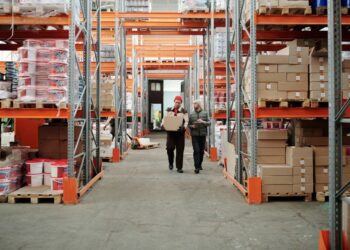
Warehouse robotics and AI — once tools reserved for billion-dollar enterprises — are undergoing rapid democratization in 2026. New industry data reveals a decisive shift: robot adoption has more than doubled in just three years, with small and mid-sized enterprises (SMEs) driving much of that growth. The RaaS (Robotics-as-a-Service) subscription model is at the center of this transformation, converting capital-heavy automation into manageable operating expenses accessible to companies of all sizes.
Adoption Doubles in Three Years: The MHI 2025 Data
A landmark study by MHI, Peerless Research Group, and The Robotics Group found that 48% of participating organizations were using robots in their facilities in 2025, up from just 23% three years earlier — more than doubling in a single technology cycle.
The survey, which covered 216 respondents between January and February 2025, carries an equally important structural finding: more than half of respondents came from companies with less than $50 million in annual revenue. The growth engine is the SME segment — businesses that were priced out of automation just years ago are now leading adoption.
MHI’s ProMat trade show in March 2025 drew record-breaking attendance, with robotics solutions filling the exhibition floor. Sonya Snellenberger, VP of Partnerships at Conexus Indiana, called the turnout a clear signal: “That’s a huge indicator for there’s an appetite for this. It’s not just all the big companies.“
The RaaS Revolution: Subscription Models Lower the Entry Barrier
What changed to drive such rapid adoption? MHI’s Jayesh Mehta points to the maturation of as-a-service platforms. RaaS and SaaS models convert the traditional capital expenditure of warehouse automation into predictable operational costs — a shift that makes robotics accessible to organizations that cannot absorb large upfront hardware costs.
The trajectory confirms this: in MHI’s 2024 survey, 64% of companies reported using a RaaS or SaaS system, compared to just 46% two years prior — an 18-point jump in subscription model penetration that outpaces overall robot adoption growth. The business model innovation is itself a primary accelerant.
Traditional robot procurement requires substantial upfront investment: hardware, systems integration, software licensing, and ongoing maintenance — cost layers that compound into sums many mid-sized warehouses cannot justify. RaaS converts these into manageable monthly or annual fees, often paired with flexible lease terms. For warehouses managing seasonal peaks or uncertain growth, this model dramatically lowers the decision-making barrier.
“I can hear all day from a tech integrator what they believe the ROI is. But I want to hear from my peers.” — Sonya Snellenberger, VP of Partnerships, Conexus Indiana
Case Studies: Mid-Market Companies Walking the RaaS Path
The numbers come alive through companies already on this path. Mobile accessories distributor Superior Communications is integrating 37 Brightpick autopicker multi-purpose robots into its Tennessee distribution center through a RaaS arrangement. CEO Solomon Chen cited the RaaS purchasing structure as a key decision factor, noting that the robots will optimize throughput and reduce fulfillment costs.
Parcel carrier UniUni, operating over 100 warehouses across North America, began its automation journey in 2023 through a partnership with Global Robotics Services (GRS). UniUni’s CEO Peter Lu chose to automate parcel sorting and sequencing first — “two of the most labor-intensive and time-sensitive stages of warehouse operations” — capturing ROI from the highest-friction bottlenecks before expanding further.
In April 2025, UniUni publicly announced deployment of two AI-powered sorting tools integrated with its existing warehouse execution system. Lu’s view extends beyond UniUni: “This trend is exciting. It’s driving innovation throughout the industry, encouraging both large and small companies to rethink how technology can enhance efficiency and service quality.”
NAPA’s Playbook: Pilot, Validate, Then Scale
Auto parts retailer NAPA demonstrates how large traditional retailers use a disciplined pilot-then-scale approach. After a 2025 Brightpick robot pilot, NAPA signed an agreement to deploy more than 100 Brightpick robots at a new facility, with potential to expand to additional locations in the future.
NAPA’s scale makes automation imperative: 6,000 auto parts stores and over 16,000 auto care and collision centers in the U.S., supported by distribution centers carrying approximately 800,000 parts, accessories, and supplies. At that SKU density, manual warehouse operations face structural constraints that technology uniquely addresses.
Justin Ducharme, EVP of Distribution and Logistics at NAPA, framed the rationale clearly: “Brightpick’s expertise in warehouse automation will help optimize our store network’s handling, replenishment, and overall performance to support the growing demand for fast and reliable auto parts delivery.” Consumer expectations around speed, set by e-commerce leaders, are now fully permeating the auto parts distribution sector.
The ROI Barrier: The Hardest Part Isn’t the Cost Anymore
Despite falling cost barriers, a Penn State University whitepaper commissioned by MHI identified the real adoption obstacle: identifying and achieving a clear ROI path remains the top barrier to technology investment. The problem has shifted from “can we afford it?” to “can we prove the business case?”
Vendor-provided ROI projections, however sophisticated, tend to underperform as decision tools. What moves organizations is peer evidence. Snellenberger’s insight: “I can hear all day from a tech integrator what they believe the ROI is. But I want to hear from my peers.” This dynamic creates a compounding adoption effect: as more companies successfully deploy robots and share outcomes, the evidence base for others grows proportionally stronger.
UniUni’s Lu articulates the ecosystem logic: each new deployment generates knowledge and proof points that reduce informational friction for subsequent adopters. As warehouse robotics adoption grows alongside more accessible financing, each deployment accelerates the next — benefiting the broader logistics ecosystem even as companies must evaluate robotics on their own operational merits.
Strategic Framework: Avoiding the Automation Hype Trap
With industry enthusiasm running high, MHI’s Mehta issues an important caution against the “keeping up with the Joneses” mentality — investing in robotics primarily because competitors are doing so. “SMEs, or anyone for that matter, need to thoroughly investigate if they need to implement robotics — and if this is helping them become more efficient, or is this just automating a task with little to no difference.”
A practical evaluation sequence emerges: first, identify genuine operational bottlenecks where speed or accuracy constraints create measurable service failures. Second, prioritize high-volume, rule-based repetitive processes — sorting, sequencing, and replenishment consistently generate clearest ROI. Third, fully model integration costs: WMS reconfiguration, algorithm licensing, and workflow redesign often exceed equipment costs in initial deployments.
The broader trajectory closely mirrors historical technology adoption curves: capability maturation, cost reduction, business model innovation (RaaS), peer demonstration effects, then mass SME entry. For supply chain leaders, the question is no longer whether to automate but when conditions align to do so advantageously — early movers absorbed higher costs, but late movers risk structural efficiency disadvantages against competitors who have already captured automation gains.
Related Reading
Source: supplychaindive.com
This article was AI-assisted and reviewed by our editorial team.