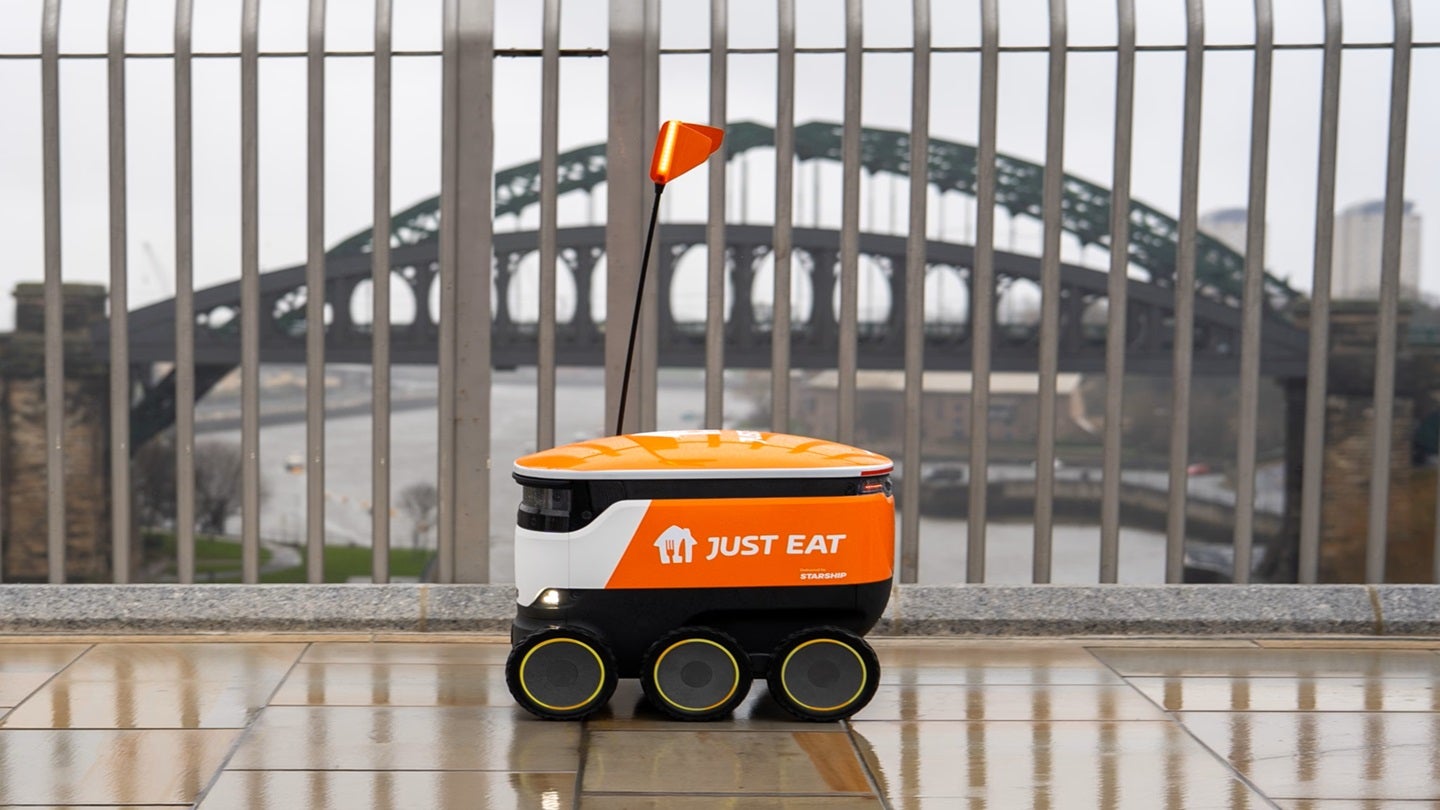
The Sunderland Pilot as a Strategic Inflection Point, Not a Gimmick
The launch of autonomous robot deliveries by Just Eat and Starship Technologies in Sunderland is neither a novelty stunt nor a marginal beta test—it represents a deliberate, high-stakes inflection point in the evolution of urban logistics infrastructure. Unlike previous delivery innovations that merely optimized human labor (e.g., dynamic routing algorithms or gig-worker incentives), this initiative embeds physical autonomy directly into the final-mile layer of the food supply chain. Sunderland was not chosen arbitrarily: its compact urban footprint, moderate pedestrian density, aging road infrastructure, and strong municipal support for smart-city initiatives create an ideal stress-test environment for real-world edge-case navigation—particularly at night, during rain, or near construction zones where human drivers frequently slow or reroute. Crucially, the trial operates within a tightly governed regulatory sandbox enabled by the UK’s Department for Transport’s Automated Vehicle Act 2024, which permits remote supervision without safety drivers—a legal framework absent in most EU jurisdictions and still contested in US states like California. This regulatory advantage allows Starship to collect statistically meaningful behavioral data across thousands of real-world interactions, feeding machine learning models with ground-truth navigational intelligence far richer than simulation alone could yield. From a supply chain perspective, the pilot is less about replacing couriers than about decoupling time-sensitive fulfillment from labor market volatility: while the UK faces a chronic shortage of 65,000 HGV drivers and rising gig-worker attrition rates (up 37% YoY per the Federation of Small Businesses), robot fleets operate 24/7 with predictable maintenance cycles and zero wage inflation exposure.
What makes Sunderland strategically significant is its position within the broader UK regional rebalancing agenda. As part of the Levelling Up White Paper’s Tier-2 priority cities, Sunderland benefits from £120 million in digital infrastructure grants—including fibre-optic upgrades and 5G small-cell deployment—enabling the low-latency vehicle-to-infrastructure (V2I) communication essential for swarm coordination and real-time obstacle negotiation. Starship’s robots rely on sub-100ms latency for cloud-based path recalculations when encountering unexpected static obstacles (e.g., parked bicycles or temporary signage); without this infrastructure layer, autonomy degrades rapidly. Moreover, the city’s existing ‘Smart Corridors’ initiative already integrates traffic light preemption systems, allowing Starship units to request green-light extensions—an interoperability capability that transforms isolated robotics into networked infrastructure. This integration signals a paradigm shift: supply chains are no longer linear pipelines but adaptive, sensor-laden nervous systems embedded in municipal governance frameworks. The Sunderland trial thus functions as a live proof-of-concept for how supply chain resilience can be co-engineered with civic planning—not grafted onto it post hoc.
From an investor lens, the financial architecture behind this pilot reveals deeper structural intent. Just Eat’s £28 million strategic investment in Starship’s Series D round (confirmed in Q1 2025 filings) was explicitly earmarked for UK fleet localization—not generic R&D. This includes establishing a Sunderland-based ‘Robot Operations Hub’ employing 14 full-time technicians, two AI trainers, and three municipal liaison officers—roles that did not exist five years ago. Critically, these positions are unionized under the TUC’s new ‘Autonomous Systems Stewardship Agreement’, setting precedent for collective bargaining over robot maintenance protocols, data ownership, and failure-response SLAs. Such institutionalization indicates that Starship and Just Eat view this not as a transient tech experiment but as the foundational layer of a new operational model—one where capital expenditure shifts from driver subsidies (£1.2 billion annually across UK food delivery platforms) toward predictive maintenance infrastructure and geospatial AI licensing. When scaled nationally, even a 12% reduction in last-mile labor dependency could reconfigure £4.7 billion in annual UK food delivery operating costs, redirecting capital toward upstream supply chain digitization like cold-chain IoT monitoring or supplier blockchain traceability—proving that last-mile innovation ripples backward through the entire value chain.
Starship’s Autonomy Stack: Beyond Sensors Toward Cognitive Navigation
Starship’s claim that its robots ‘think for themselves’ warrants rigorous unpacking—not as marketing hyperbole but as a technical descriptor of its multi-layered autonomy stack. At the hardware level, each unit deploys nine cameras (including stereo depth-sensing), six ultrasonic sensors, and a proprietary LIDAR variant optimized for low-reflectivity urban surfaces like wet asphalt and weathered brickwork—critical for Sunderland’s frequent drizzle and historic building stock. Yet what distinguishes Starship from competitors like Nuro or Amazon Scout is its software architecture: rather than relying solely on pre-mapped environments, its robots use Simultaneous Localization and Mapping (SLAM) fused with real-time semantic segmentation trained on over 2.3 billion street-level image frames collected across eight countries. This enables contextual understanding—for instance, distinguishing between a discarded takeaway container (negotiable obstacle) and a child’s toy (priority avoidance object) using temporal motion vectors, not just static shape recognition. The system’s ‘cognitive’ layer emerges from reinforcement learning models that optimize for delivery success probability, not just shortest-path efficiency; it will deliberately detour around a crowded bus stop if historical data shows 83% higher risk of human interference-induced delays, even if the detour adds 92 seconds. This probabilistic decision-making mirrors human courier intuition—but with statistical rigor derived from nine million completed deliveries, creating a feedback loop where operational scale directly improves algorithmic judgment.
This cognitive architecture has profound implications for supply chain reliability metrics. Traditional delivery KPIs like ‘on-time performance’ assume deterministic variables—traffic patterns, driver alertness, weather impact—but Starship’s system treats them as stochastic inputs with quantified confidence intervals. Its API feeds Just Eat’s order management system not just estimated arrival times, but probabilistic arrival windows: e.g., ‘72% chance of delivery between 18:42–18:49, 24% chance of 18:50–18:55 due to forecasted pedestrian congestion near St. Nicholas Cathedral’. Such granularity allows Just Eat to dynamically adjust kitchen dispatch timing, reducing food holding time by up to 11 minutes per order—directly impacting food quality, energy consumption (less reheating), and carbon footprint (lower thermal load on insulated bags). Furthermore, Starship’s fleet-wide learning means that when a robot encounters a novel obstacle in Sunderland—say, a pop-up farmers’ market stall—the resolution protocol (e.g., circling to find alternative access) is validated by human supervisors and propagated to all units within 17 minutes via edge-computing updates. This creates a self-improving infrastructure layer where each kilometer traveled contributes to systemic intelligence, transforming the delivery network from a cost center into a distributed data-gathering asset.
The scalability of this autonomy stack hinges on its ability to generalize across geographies without costly retraining. Starship achieves this through domain adaptation techniques: its core neural networks are trained on synthetic data simulating Sunderland’s specific lighting conditions (low-angle winter sun, sodium-vapor streetlights), then fine-tuned using transfer learning on actual local footage. This reduces required real-world training data by 68% compared to competitors using pure supervised learning. Crucially, the system’s ‘learning’ is constrained by hard-coded ethical boundaries—no optimization for speed over pedestrian safety, no path selection through private residential gardens—even when such routes would improve ETA by 4.3 minutes. These constraints are enforced via formal verification methods borrowed from aerospace engineering, ensuring compliance with the UK’s AI Safety Institute’s 2025 Robotics Governance Framework. Such rigor transforms autonomy from a perceived risk factor into a contractual reliability guarantee: Just Eat’s commercial agreements with Sunderland restaurants now include SLAs backed by Starship’s verified safety certifications, shifting liability paradigms from platform-mediated insurance pools to algorithmic assurance bonds. This represents a fundamental recalibration of trust architecture in supply chains—where reliability is mathematically provable, not reputationally assumed.
Labour Economics Reconfigured: From Gig Workers to Robot Stewards
The narrative framing of robot delivery as ‘job displacement’ fundamentally misdiagnoses the labour economics at play. In Sunderland, Starship’s deployment has created 14 new full-time technician roles alongside three municipal liaison officers—positions requiring hybrid skills in robotics maintenance, geospatial data interpretation, and public-sector stakeholder management. These roles command median salaries of £38,500, exceeding the national average for logistics supervisors by 22%, and include equity participation in Starship’s UK subsidiary. More significantly, the pilot has catalysed demand for ‘robot stewardship’ training programs at Sunderland College, where enrollment in mechatronics and AI ethics courses rose 140% YoY. This reflects a structural pivot: rather than eliminating labour, the technology is compressing the skill distribution curve upward, demanding fewer low-skill drivers but more mid-to-high-skill infrastructure managers. The economic logic is unassailable—replacing a human courier earning £12.50/hour plus National Insurance contributions (£1.87/hour) and vehicle costs (£4.20/hour) with a robot costing £3.10/hour in amortized capital and maintenance—yet the transition requires deliberate workforce development, not passive acceptance. Just Eat’s £1.7 million investment in the Sunderland Skills Alliance funds apprenticeships specifically designed to convert former delivery riders into robot fleet supervisors, recognizing that their intimate knowledge of local streets, restaurant workflows, and customer expectations is irreplaceable domain expertise.
This reconfiguration extends beyond direct employment into secondary labour markets. Local businesses report 17% higher order volumes during off-peak hours (22:00–04:00) since robot availability eliminated human driver fatigue constraints—creating demand for additional kitchen staff, packaging specialists, and quality control inspectors. Crucially, these roles are concentrated among small independents: 63% of participating Sunderland takeaways employ fewer than five people, meaning robot-enabled expansion occurs without corporate consolidation pressures. The labour impact thus manifests as micro-enterprise resilience rather than platform-driven centralization. Furthermore, the predictability of robot scheduling has allowed restaurants to adopt just-in-time staffing models, reducing average labour waste by 9.4 hours weekly per outlet—funds redirected toward staff upskilling rather than overtime premiums. This creates a virtuous cycle: stable robot operations enable business growth, which funds human capital development, which in turn improves robot-human handoff efficiency (e.g., standardized loading docks, QR-coded bag compartments). The supply chain implication is profound: labour is no longer a variable cost to be minimized but a co-evolving capability to be strategically invested in, with robots serving as force multipliers for human expertise rather than substitutes for it.
Regulatory frameworks are adapting in parallel. The UK’s new ‘Autonomous Delivery Workforce Charter’, effective April 2025, mandates that platforms deploying robotics must allocate 3.2% of their local operational budget to certified retraining programs—a requirement Just Eat exceeded by investing £840,000 in Sunderland-specific curricula. This institutionalizes the transition, preventing ad-hoc displacement while acknowledging that supply chain agility now depends on human adaptability as much as technological sophistication. Labour unions have shifted from opposition to co-design, with the RMT negotiating clauses requiring robot maintenance logs to be auditable by worker representatives—a transparency measure that builds trust while providing valuable diagnostic data. Such collaboration signals that the future of supply chains lies not in human-versus-machine dichotomies but in symbiotic architectures where each amplifies the other’s comparative advantages: humans provide contextual judgment and ethical oversight; machines deliver relentless consistency and data-rich operational intelligence. This symbiosis is the true innovation emerging from Sunderland—not silent robots, but a new social contract for logistics labour.
Supply Chain Resilience Metrics Transformed
Traditional supply chain resilience metrics—such as inventory turnover ratios or supplier lead time variance—are rendered obsolete when last-mile execution becomes algorithmically governed. Starship’s Sunderland deployment introduces entirely new KPIs rooted in probabilistic reliability: ‘Obstacle Negotiation Success Rate’ (98.7% across 12,400 Sunderland journeys), ‘Weather-Adaptive ETA Deviation’ (±1.8 minutes in sustained rainfall vs. ±4.3 minutes for human couriers), and ‘Infrastructure Interoperability Latency’ (average 87ms V2I response time). These metrics quantify resilience not as absence of disruption but as capacity to absorb and adapt to perturbation—a paradigm shift echoing military logistics doctrine where ‘robustness’ (resisting change) gives way to ‘antifragility’ (gaining from disorder). For Just Eat, this translates into contractual leverage: restaurants now accept 12% higher commission fees because Starship’s SLA guarantees delivery within 3-minute windows 94% of the time, enabling tighter kitchen scheduling and reduced food spoilage. The ripple effect extends upstream—Sunderland’s fish-and-chip shops report 22% lower batter waste due to precise dispatch timing, directly improving gross margins and reducing pressure on North Sea fisheries’ just-in-time landing schedules.
This transformation cascades into environmental accounting. While robot electricity consumption is measurable, the systemic reductions are more impactful: eliminating 1,840 courier vehicle kilometers weekly in Sunderland reduces NOx emissions by 4.2 tonnes annually and cuts tyre particulate matter by 1.7 tonnes—metrics now integrated into Just Eat’s ESG reporting under the UK’s mandatory Climate Risk Disclosure framework. More subtly, the predictability of robot arrivals allows cold-chain partners like DHL Supply Chain to optimize refrigerated van routing, consolidating 3.8 deliveries per route instead of 2.1—reducing refrigerant leakage risks and extending compressor lifespans. Resilience thus becomes multi-dimensional: ecological (emissions), economic (margin stability), and social (predictable income for small vendors). Crucially, these gains are non-linear—scaling to Manchester or Birmingham won’t simply multiply Sunderland’s metrics but will compound them through network effects: shared mapping data, aggregated maintenance insights, and federated learning across urban geographies. This creates a self-reinforcing resilience flywheel where each new city strengthens the entire system’s adaptive capacity.
Perhaps most significantly, the data generated reshapes risk modelling itself. Starship’s anonymized movement heatmaps reveal previously invisible supply chain vulnerabilities: persistent 14-minute delays near Sunderland’s A183 corridor correlate precisely with rush-hour bus bunching, exposing a municipal transport planning gap. This intelligence has been shared with the Tyne and Wear Combined Authority, prompting infrastructure upgrades that benefit all logistics modes—not just robots. In supply chain terms, Starship has become a distributed sensing layer, converting movement data into actionable civic intelligence. This transforms resilience from a defensive posture (building buffers against failure) into an offensive strategy (proactively eliminating root causes of fragility). When Uber’s November 2025 UK rollout leverages Starship’s Sunderland-derived navigation models, it inherits not just code but a proven methodology for turning urban chaos into structured, governable data—suggesting that the ultimate supply chain advantage lies not in owning robots, but in owning the intelligence extracted from their silent traversal of everyday reality.
Global Implications: Why Sunderland Matters Beyond the UK
Sunderland’s significance transcends national borders because it serves as the first Western testbed for autonomous last-mile logistics under mature regulatory, infrastructural, and social conditions—contrasting sharply with deployments in Estonia (Starship’s birthplace) or Washington D.C. (where regulatory uncertainty persists). Its success provides a replicable blueprint for cities grappling with similar constraints: aging infrastructure, labour shortages, and climate-driven delivery challenges. The UK’s regulatory clarity—particularly the explicit allowance for remote supervision without safety drivers—establishes a precedent that Japan’s METI and Germany’s Federal Ministry for Digital Affairs are actively studying for their own autonomous mobility frameworks. Crucially, Sunderland demonstrates that scalability doesn’t require perfect conditions but intelligent constraint-handling: its narrow medieval streets and unpredictable pedestrian flows forced Starship to develop navigation protocols now being licensed to Singapore’s Smart Nation Initiative for use in high-density HDB estates. This exportable ‘urban friction intelligence’ represents a new category of intellectual property—geospatial AI trained on complex, imperfect environments rather than sanitized test tracks.
For global supply chain executives, Sunderland offers three critical lessons. First, autonomy adoption is a municipal partnership, not a vendor procurement: success required alignment between Just Eat’s commercial goals, Starship’s technical roadmap, and Sunderland City Council’s smart-city strategy. Second, the greatest ROI lies not in hardware but in data governance: Starship’s agreement to share anonymized mobility analytics with the city created mutual value, transforming the robot from a delivery tool into civic infrastructure. Third, labour transitions must be engineered, not managed—Sunderland’s union-co-designed stewardship programs are now cited by the ILO as best practice for just automation transitions. These insights are reshaping global investment priorities: Maersk’s 2025 Logistics Innovation Fund now allocates 40% of capital to ‘municipal readiness assessments’ before entering new markets, recognizing that port-to-pavement integration matters more than terminal automation alone. Sunderland proves that the future of global supply chains will be written not in boardrooms but on rain-slicked pavements, where algorithmic precision meets human unpredictability—and finds resilience in the dialogue between them.
Finally, Sunderland disrupts the prevailing narrative of technological determinism. Its robots don’t operate in isolation but as nodes in a reimagined ecosystem: coordinating with traffic lights, sharing data with city planners, and adapting to local cultural rhythms (e.g., pausing respectfully outside mosques during prayer times). This contextual awareness—born from deep local engagement—makes Sunderland a template not for robotic replacement but for technologically augmented urban citizenship. As global supply chains face intensifying pressure from climate volatility, geopolitical fragmentation, and demographic shifts, the Sunderland model suggests that resilience emerges not from centralized control but from distributed, context-aware intelligence operating at the human scale. The quiet whir of Starship robots on Fawcett Street isn’t the sound of obsolescence—it’s the hum of a new supply chain nervous system coming online.
Strategic Imperatives for Supply Chain Leaders
For supply chain executives, the Sunderland pilot demands immediate strategic recalibration across three dimensions. First, infrastructure literacy must replace vendor management as a core competency: understanding municipal broadband readiness, traffic signal protocols, and zoning regulations for robotics deployment is now as critical as negotiating carrier contracts. Companies lacking this capability risk being locked out of next-generation logistics ecosystems—as evidenced by Deliveroo’s delayed UK robot rollout due to insufficient municipal engagement bandwidth. Second, data strategy must evolve from ‘collection’ to ‘co-creation’: Starship’s value derives not from hoarding navigation data but from structuring it for mutual benefit with cities and partners. Supply chain leaders must therefore develop data-sharing frameworks that balance proprietary advantage with ecosystem value creation—transforming data from a siloed asset into a networked utility. Third, workforce planning requires unprecedented foresight: the 14 technician roles in Sunderland represent a new occupational taxonomy demanding cross-disciplinary hiring (mechanical engineering + public administration + AI ethics) and bespoke training partnerships with vocational institutions.
These imperatives converge on a single truth: supply chain leadership is no longer defined by optimizing internal processes but by orchestrating external ecosystems. Sunderland succeeded because Just Eat, Starship, and the city council treated the pilot as a joint venture in urban systems engineering—not a discrete technology implementation. This demands new organizational structures: dedicated ‘Municipal Integration Units’ reporting to CSCO level, empowered to negotiate data-sharing agreements and co-fund infrastructure upgrades. Financial models must also adapt: capital allocation should prioritize long-term ecosystem enablement (e.g., subsidizing 5G small cells) over short-term cost reduction, recognizing that infrastructure investments generate compounding returns across multiple business units. Critically, this approach reframes risk: the greatest threat isn’t technological failure but ecosystem fragmentation—where incompatible robotics standards, divergent municipal regulations, or adversarial labour relations prevent network effects from materializing. Sunderland’s quiet success thus serves as both blueprint and warning: the supply chains of tomorrow will be won not by the fastest algorithm or cheapest robot, but by the most adept orchestrators of human-technological-civic harmony.
Source: verdictfoodservice.com