Skip to content

Strategy & Planning · Supply Chain · Warehousing · Warehousing & Transport

Reflex Robot 20 Times Cheaper Than Competitors and Masters New Skills in 60 Minutes – The Times HUB

GXO Enhances Productivity and Reduces Costs with Reflex Robotics for Automated Warehouse Operations

Original source: Source information pending

Reflex Robot 20 Times Cheaper Than Competitors and Masters New Skills in 60 Minutes – The Times HUB

Ask SCI.AI about this story

📋 本文要点

GXO Enhances Productivity and Reduces Costs with Reflex Robotics for Automated Warehouse Operations

[Technology]

# Reflex Robots Are 20 Times Cheaper Than Competitors and Learn New Skills in 60 Minutes

![Natasha Kumar](https://thetimeshub.in/wp-content/uploads/2024/05/LLAqhZjVS2k-150×150-1.jpg) By Natasha Kumar Sep 26, 2024

![](https://thetimeshub.in/wp-content/uploads/2024/09/robot-reflex-u-20-raziv-deshevshij-za-konkurentiv-i-navchayetsja-novih-navichok-za-60-hvilin-9eacb34.jpg)

## GXO Uses Reflex Robotics to Automate Warehouse Operations, Boost Productivity and Reduce Costs

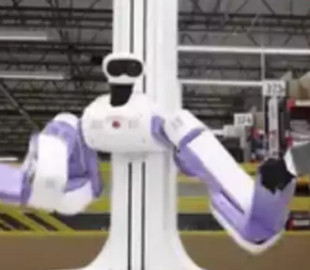
GXO, a leading global logistics solutions provider, has started using robots from Reflex Robotics in its warehouses, significantly accelerating the automation of daily operations.

Reflex Robotics’ robots are designed to perform routine warehouse tasks such as moving goods, picking orders, and restocking inventory. Equipped with machine learning systems, they can quickly adapt to new tasks by observing human actions. Consequently, these robots become fully autonomous within an hour of operation, making them one of the most efficient technologies on the market. Additionally, their cost is only a twentieth of similar humanoid robots, significantly reducing automation expenses.

Reflex Robotics’ robots are used under a “Robotics as a Service” (RaaS) model, allowing companies to subscribe to services rather than purchasing expensive systems. The subscription fees for these robots are half that of labor costs, making them financially viable solutions for large warehouses. Furthermore, the robots can be remotely controlled by operators to efficiently perform more complex tasks.

GXO is actively testing these robots in its “Operations Incubator” program, collaborating with developers to adapt the latest technologies to real-world conditions. In a pilot project, Reflex Robotics’ robots were deployed in a large Fortune 100 retailer’s warehouse and demonstrated the efficiency of automated systems.

Reflex Robotics’ robots are developed by a team of MIT engineers with experience from Tesla, Boston Dynamics, and Amazon, based in New York. Their design focuses on creating affordable universal solutions for automating warehouses and production processes. Unlike most humanoid robots, Reflex robots are significantly cheaper and easier to use, facilitating large-scale implementation.

The collaboration between GXO and Reflex Robotics aims to promote these robots globally to enhance productivity and address labor shortages in the logistics industry. Ritesh Raghavender, CEO of Reflex Robotics, noted that their work has shown significant potential to transform logistics processes and thanked GXO for providing an opportunity to implement projects.

![Natasha Kumar](https://thetimeshub.in/wp-content/uploads/2024/05/LLAqhZjVS2k-150×150-1.jpg)

#### By Natasha Kumar

Natasha Kumar has been a reporter at the news station since 2018. Prior to that, she wrote articles for Styles on adolescence and family dynamics and served as a legal affairs reporter for the Metro desk. Before joining The Times Hub, Natasha Kumar was a contributing writer for Village Voice and a freelance writer for Newsday, The Wall Street Journal, GQ, and Mirabella.

—

Source: The Times HUB

Ask SCI.AI Finished reading? Continue with SCI.AI. Explore the related policy, route, company and historical context. Continue asking
Stay ahead of supply chain shifts

One email a week: the stories that matter and new risk events — in English, free.

Prefer RSS? Articles Risk events

North American robot orders hit highest level since 2022 boom
Strategy & Planning

North American robot orders hit highest level since 2022 boom

North American robot orders climbed to their highest level since the 2022 boom and continued that trend into 2026, according to Association for Advancing Automation data reported by DC Velocity. Strong demand from semiconductor and electronics, pharmaceutical, and food and beverage industries offset declining automotive orders in the first half of 2026, with shipments up 21% and 24% year over year. Rocrich AGV, a joint venture of Logisnext Americas and Jungheinrich, supplies automated guided vehicles for warehouse automation. Shifting trade policies and a warehouse labor shortage intensified by tightened immigration policies are pushing more companies toward automation, while falling costs are making the technology accessible to small and medium-sized players.

Xeneta: Asia-US West Coast spot rates jump 343% on Iran war
Warehousing & Transport

Xeneta: Asia-US West Coast spot rates jump 343% on Iran war

Asia-U.S. West Coast container spot rates were 343% above their February 28 level in October, just 14% below the pandemic-era record, according to freight-rate intelligence provider Xeneta. The company forecasts a 5% decline in long-term contract rates for 2027, with the global container fleet expected to grow 6.8% while demand rises between 2.5% and 4%. Xeneta chief analyst Peter Sand traces the volatility to the Red Sea conflict in 2024, U.S. tariffs in 2025 and the Strait of Hormuz closure in 2026, and warns that fuel costs and route disruptions could still upend the outlook.

AI hardware demand lifts air cargo rates 30% year over year
Warehousing & Transport

AI hardware demand lifts air cargo rates 30% year over year

Air cargo rates are up 30% year over year and volumes have grown about 6%, according to FreightWaves, as surging AI equipment demand offsets slower e-commerce and automotive flows. The strength has defied forecasts of a 2025 softening after a down 2024. Meanwhile, Walmart is deploying Wing and Zipline drones across nearly 300 stores; Zipline raised $1.5 billion and Wing plans a $125 million Texas factory ahead of anticipated FAA beyond-line-of-sight rules.

Welcome Back!

Login to your account below

Create New Account!

Fill the forms below to register

Retrieve your password

Please enter your username or email address to reset your password.

Scan to share via WeChat

Open WeChat and scan the QR code to share

QR Code

Add New Playlist