When Harold Daggett sees self-checkout scanners at supermarkets or E-ZPass automated toll lanes on highways, he does not view them as modern conveniences. He sees the disappearance of jobs.
Daggett is the aggressive president of the International Longshoremen’s Association (ILA), and he is determined to prevent his 47,000 dockworkers from facing the same fate as cashiers and tollbooth attendants. After a massive three-day port strike, he secured significant victories, with members receiving a 62% wage increase over six years. Now, union leaders will shift their focus to a more formidable adversary: the trend of technological advancement.
Following the reopening of ports along the East Coast and Gulf on Friday, the ILA and employer organizations announced a wage hike agreement on Thursday evening. However, the wage dispute was only half the battle. Both sides agreed to extend their previous contract, which expired on September 30, until January 15, to continue negotiations over remaining issues. Nothing is more prominent than the issue of automation.
American ports lag behind European and Asian counterparts in technology adoption. Daggett hopes to maintain this status quo by prohibiting marine terminal operators from automating cargo handling processes.
“If they had their way, they would see everyone lose their jobs… They don’t want to pay anyone,” he said in a recent union video. “Someone has to stand up and tell Congress, ‘Hey, pause.’ This world is moving too fast for us. Machines must stop… What’s the point of making people unemployed?”
Dockworkers’ challenges are not unique. For over two centuries, technology has been phasing out some jobs while creating others. In recent decades, elevator operators, secretaries, and steel workers have faced demand disruptions due to mechanization.
Today, the rise of artificial intelligence is fueling concerns about increasingly capable machines replacing human labor.
Historically, despite the disruptive nature of new technologies, they have made workers more efficient and contributed to making America wealthier than other developed nations. According to the Bureau of Labor Statistics, today’s American workers produce twice as much per hour compared to 1987 levels.
Despite accelerated technological development, there is no evidence that more capable machines are causing permanent mass unemployment. Bloomberg data shows that the average unemployment rate over the past 25 years has been lower than in the previous 25-year period, including during the economic downturn of the pandemic.
Over the last 25 years, the U.S. economy added nearly 30 million new jobs.
This week, Daggett demanded “absolutely strict clauses” in the next six-year contract with the United States Maritime Alliance (USMX) to ensure no automation or semi-automation is introduced.
Employer organizations proposed extending current ILA contract provisions that prohibit “fully automated” equipment and give unions effective veto power over partial automation systems deployment.
The contract stipulates, “Semi-automatic devices or technology/automation shall not be implemented until both parties reach an agreement on labor protection and staffing.”
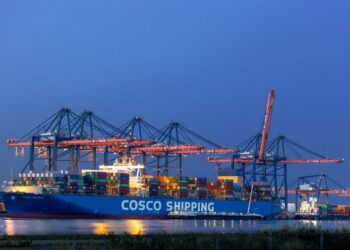
At least two ports under ILA jurisdiction have already adopted some automation systems. In 2015, a global container terminal in Bayonne, New Jersey, became the first existing facility in the Western Hemisphere to adopt semi-automated systems. The Port of Virginia in Norfolk has semi-autonomous dock operations and is hailed as “America’s most modern gateway.”
Despite the introduction of some new technologies, ILA members’ working hours have increased faster than cargo volumes. According to USMX’s 2023 annual report, since 2019, work hours have grown by 13.4%, while tonnage has risen by only 5.1%.
It remains unclear how the union’s existing ability to block what it deems employment-disrupting technologies will be strengthened. Daggett has not publicly clarified the contract language he seeks. An ILA spokesperson did not respond to two requests for comment.
Daggett’s opposition to automation seems genuine. In a video interview filmed weeks ago, he complained about lost union tollbooth jobs and supermarket cashier positions, calling the extensive installation of cameras on docks “Big Brother” behavior. He reluctantly acknowledged that “computers” might have had positive impacts on port operations. He also publicly vowed to expand his anti-automation campaign globally.
Daggett’s movement received support from Senator Bernie Sanders, who posted on X: “Billionaires in the shipping industry should not be allowed to get richer by replacing port workers with robots.”
But some analysts argue that ILA can only delay inevitable changes.
“The argument for stopping automation now is like closing the stable door after the horse has bolted. It won’t work in the long run. The economic incentives are too strong,” said Harley Shaiken, a labor issues expert at UC Berkeley.
Longshore workers have long resisted innovations that could replace them. According to Marc Levinson, author of “The Box,” when standardized marine containers replaced cargo-filled holds in the 1960s, East and West Coast dockworker unions adopted different strategies.
On the East Coast, the ILA negotiated a guaranteed annual income plan for those unable to secure sufficient work on docks. The last payment under this arrangement was made in 2005, according to Levinson. Its West Coast counterpart accepted containerization with a lump-sum payment. Stable trade growth ensured that feared job losses did not occur.
“In the past, longshore unions have agreed to various types of automation, but protecting jobs and maintaining union jurisdiction always came at a cost,” he said. “I think this dispute will also be resolved at some cost.”
In recent years, global ports have introduced a range of new technologies, from automated truck gates to autonomous dock cranes and shuttles that transport containers from the dock to the yard. According to a 2021 report by the International Transport Forum (ITF) based in Paris, the most ambitious projects require over one billion dollars in capital investment and do not always yield returns.
Port operators’ expectations for labor cost savings are often overly optimistic, failing to recognize the need for new personnel to maintain and operate expensive new equipment, not all of whom may be union members.
The study concluded that “container terminal automation only has benefits under certain conditions, thus limiting its application to a portion of terminals.”
Automation makes the most sense for large ports with predictable and stable cargo flows, many of which are located in other countries. For example, Shanghai handled nearly 50 million containers last year, about six times more than America’s busiest port, the Port of Los Angeles.
The lack of advanced systems partly explains why U.S. ports perform poorly in the World Bank’s annual Trade Facilitation Index rankings. The highest-ranked American facility is the Port of Charleston, which placed 53rd on the 2023 list.
“Port automation isn’t a panacea for many people. Yes, American ports are relatively inefficient in terms of container crane operations per hour. But many ports around the world have invested too much in automation and found it not very profitable,” Levinson said.
Fully automated ports do not exist yet. The constant and unpredictable movement of ships docking at terminals requires skilled dockworkers to operate large ship-to-shore cranes, removing containers from ocean carriers.
The first partially automated container terminal debuted in Rotterdam, the Netherlands, in 1993. According to a 2021 report by ITF, today there are 53 automated terminals globally, accounting for only 4% of total global capacity.
In the U.S., many ports have introduced partial automation. A prominent example within the industry is the Port of Long Beach Container Terminal in Southern California. It processes three and a half million standard containers annually and is the fastest facility at the Port of Long Beach, enabling trucks to enter and exit within an hour. However, another large terminal at the port has not been automated and is equally efficient in handling containers, according to Port Executive Mario Cordero.
This week, at the strike site outside Red Hook Terminal in Newark, strikers unanimously agreed that automation was their top concern.
Lydia Ortiz, 60, said she notices every day how machines are doing work. With E-ZPass, no one sits in tollbooths anymore. Supermarket checkout lines are almost devoid of workers and filled with self-checkout machines.
“They want everything automated,” she said. “Don’t we have families to support?”
Ortiz has worked at the port for 25 years and is preparing to retire, looking forward to spending time with her soon-to-be-born granddaughter. But she worries about newcomers, many of whom are veterans or former police officers.
“We worked during the pandemic. We work at midnight. We work in the rain, we work in the heat, 365 days a year around the clock,” she said. “Now they want automation? How many jobs will be lost?”
Standing nearby, a burly man wearing a neon yellow safety vest declined to give his name, citing union leadership’s request that members not speak with reporters, and agreed.
“I don’t want to be replaced by machines! I’m not against progress, but,” he left the sentence unfinished.
He shook his head and pointed at a sign on the street reading “Workers Before Machines.”
—
Source: Washington Post