Venti Technologies is running about 60 autonomous container trucks around the clock at intermodal yards in California and Texas, according to FreightWaves. CEO Heidi Wyle said the fleets exceed human productivity with a clean safety record, and that Venti has agreements with several Class I railroads. The MIT-founded software company values its deployed stack at $70 million to $80 million, says 85% to 90% of its code carries across applications, and estimates yard automation can address 40% to 70% of transportation costs. Venti expects broad U.S. rail-yard volume within two years, while inner-city autonomous trucking remains seven to 10 years away.
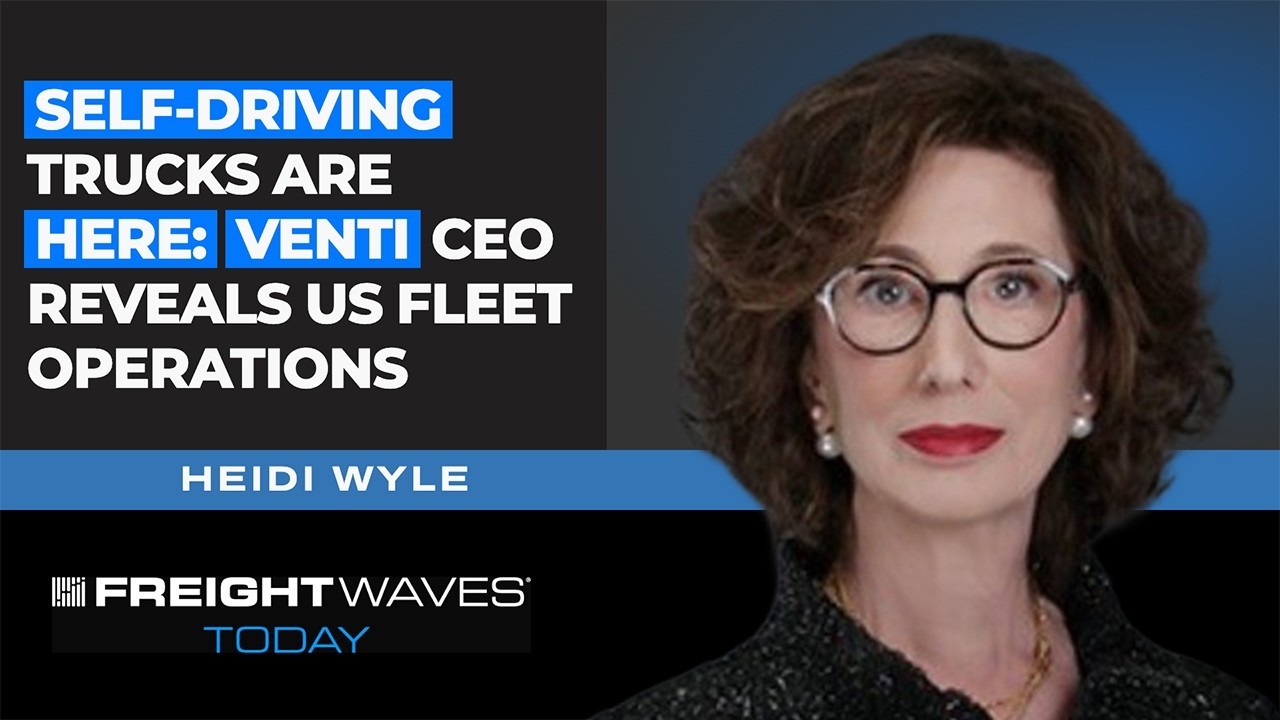
According to FreightWaves, Venti Technologies is operating roughly 60 large container trucks in fully autonomous, round-the-clock service at intermodal yards in California and Texas, a live production deployment the company says has produced a clean safety record and productivity above human benchmarks.
The MIT-founded software company’s deployment stands out because it is running in active freight environments rather than closed pilots, a distinction that matters to carriers, shippers and rail operators evaluating yard automation. Heidi Wyle, Venti’s founder and CEO, told FreightWaves the fleets run every day without interruption.
“We are running, every day, 24/7, in full production operations, exceeding human productivity.” — Heidi Wyle, founder and CEO, Venti Technologies
Wyle said Venti holds existing agreements with several Class I railroads and is in discussions with the rest of the industry. She expects significant rail-yard volume across the railroad sector to materialize within 2 years as the technology scales.
Software stack priced at $70M-$80M
Venti positions itself primarily as a software platform. Wyle characterized the deployed system as roughly $70 million to $80 million of software running on vehicles owned by customers, who retain the trucks while Venti supplies the end-to-end autonomy stack, including yard mapping and mission-specific functions.
The platform is sensor-agnostic: it uses LiDAR as its foundation but adds cameras and, in some applications, ultrasound depending on the job. That flexibility lets Venti adapt the same core system across different vehicle types and sites without rebuilding from scratch.
On cost, Wyle framed yard automation as a direct financial calculation against mission-critical trucking needs in controlled spaces. She said the addressable spend is substantial.
“It’s anywhere from 40% to 70% of transportation costs — and we think that that’s a big win in the right environments.” — Heidi Wyle, founder and CEO, Venti Technologies
Singapore roots, two-month rail adaptation
Venti launched its first fleet in Singapore, which Wyle described as home to the second-largest container port in the world, and has operated there for nearly three years. A second Singapore fleet of 30 vehicles is scheduled to launch this year.
Moving between applications is relatively quick. Wyle said roughly 85% to 90% of the core software carries over across deployments, so shifting from port operations to rail yards required only about 2 months of additional development to handle train detection, signal recognition and rail-specific functions.
Venti is concentrating on the supply chain yard segment, which Wyle said moves $55 billion of goods every day. That figure underpins the company’s case for automating container handling inside intermodal facilities before pursuing public-road autonomy.
Public-road autonomy still years away
Wyle drew a sharp line between enclosed logistics environments and urban last-mile delivery. Yard and port applications, she said, are financially straightforward because they involve a direct cost calculation in controlled spaces. Inner-city autonomous trucking, by contrast, is “probably 7 to 10 years out.”
The distinction helps explain Venti’s sequencing: prove autonomy where routes are mapped, speeds are managed and human traffic is limited, then scale as rail operators adopt. The company’s current footprint covers intermodal yards in two U.S. states, with expansion tied to railroad agreements already in place or under discussion.
Source: FreightWaves
Compiled from international media by the SCI.AI editorial team.