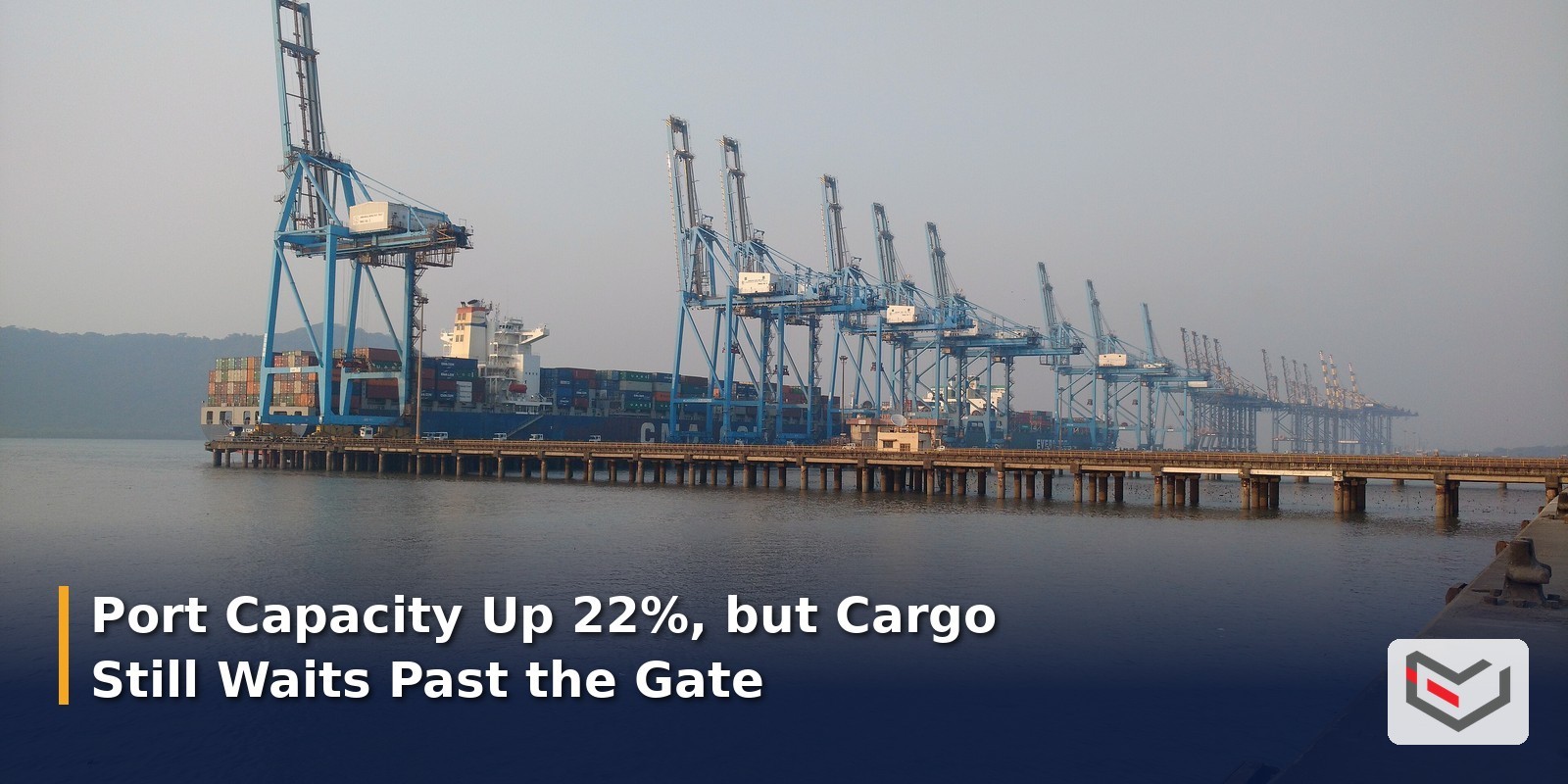
India's port capacity has reached 2.8 billion tonnes a year, up 22 per cent from 2.3 billion tonnes in 2017-18, yet a new FICCI-Kearney report argues the binding constraint on trade has shifted inland. Cargo volumes rose 38 per cent to 1,668 million tonnes, lifting utilisation from 52 per cent to 59 per cent, while average vessel turnaround at major ports fell 18 per cent to about 49 hours. The report finds export clearance averaged 30 hours but the gap to vessel departure stretched to 158 hours, or 84 per cent of total time, and notes foreign hubs still handled around 75 per cent of transhipment containers as of May 2025.
India has added roughly half a billion tonnes of annual cargo-handling capacity at its ports since 2017-18, but the bigger drag on trade now sits outside the terminal gate, according to a new report by industry chamber FICCI and consultancy Kearney, as reported by logisticsinsider.in.
The report, titled Trade, Logistics and Global Connectivity: Hinterland Connectivity, Modal Shift and Cargo Evacuation, was released at FICCI’s Maritime India Conference & Expo 2026 in Mumbai. It places national port capacity at 2.8 billion tonnes a year, up 22 per cent from 2.3 billion tonnes in 2017-18.
Traffic grew faster than capacity. Cargo handled at major and non-major ports rose 38 per cent over the period, from 1,209 million tonnes to 1,668 million tonnes, lifting capacity utilisation from 52 per cent to 59 per cent. That still leaves considerable headroom at the quayside.
Efficiency improves at the berth
Terminal performance has also improved. Average vessel turnaround time at major ports has fallen 18 per cent to about 49 hours, according to the report.
JNPA, Mundra and Pipavav were placed in the top 30 of the World Bank‘s Container Port Performance Index 2025, the report notes, a signal that India’s leading container gateways can compete on berth productivity.
The authors nonetheless argue that quayside gains are being offset by bottlenecks further inland, where cargo evacuation and modal shift determine how quickly freight actually moves.
Where the time goes after customs
The report’s sharpest finding concerns what happens after customs. Drawing on the 2025 National Time Release Study for four key seaports, it notes that export clearance averaged 30 hours, while the gap between clearance and vessel departure stretched to 158 hours, or 84 per cent of the total time recorded.
At Jawaharlal Nehru Custom House, customs processing averaged two hours and 12 minutes in 2026, but the full export cycle still ran beyond eight days.
The authors caution that much of this is logistics activity and scheduled waiting rather than avoidable delay, and say the data shows where coordination between agencies matters most.
Transhipment still leans on foreign hubs
India remains dependent on foreign hubs, which handled around 75 per cent of the country’s transhipment containers as of May 2025.
Vizhinjam, which began operations that month, has added deep-water capacity, but the report says later changes to shipping-line rotations show the structural difficulty of building domestic transhipment.
Private terminal operators now handle roughly two-thirds of major port traffic under the Major Port Authorities Act, 2021, and the government aims to raise private participation to 85 per cent by 2030.
Land links lag behind
Road and rail connectivity remains the weakest link. Of 294 identified road and rail connectivity projects, 84 had been completed by July 2026.
The 1,506-km Western Dedicated Freight Corridor between Dadri and JNPA became fully operational in March 2026, a milestone the report treats as necessary but not sufficient for hinterland evacuation.
Benchmarking Indian corridors against Shanghai-Ningbo, Rotterdam, Jebel Ali and Singapore, the report calls for separate development plans for container ports, transhipment hubs, energy ports and export corridors.
It urges the Ministry of Ports, Shipping and Waterways and state governments to map industrial clusters and plan connectivity around actual freight flows, and recommends dedicated gateway coordinators to track projects and resolve operational bottlenecks.
Source: logisticsinsider.in
Compiled from international media by the SCI.AI editorial team.