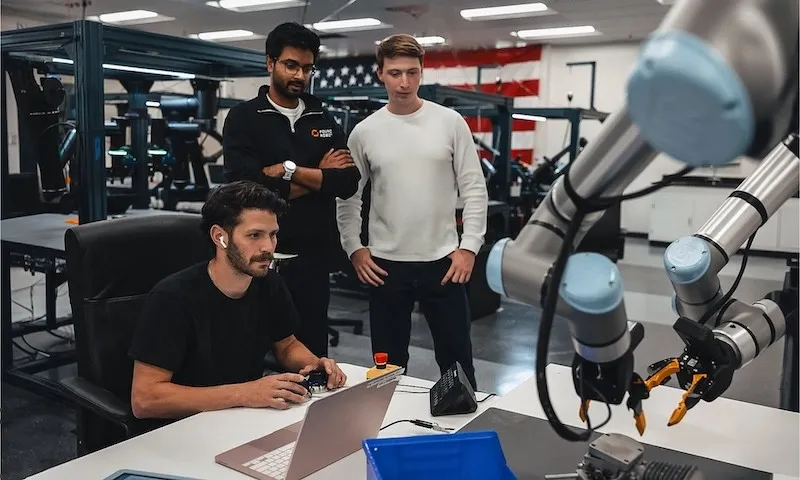
Foundry Robotics has raised an oversubscribed $100 million Series A led by Marlinspike Partners, with backing from Khosla Ventures, Red Glass Ventures, SE Ventures, Wing VC, Axiom Ventures, Hanabi and Zero Shot Fund. The company builds and operates autonomous factories for complex assembly, combining AI-powered robotic cells with manufacturing experts. The funding will build out its Emeryville site, accelerate deployment of AI models into production and grow its research, engineering and factory operations teams. Foundry has expanded its footprint twentyfold to a 130,000-square-foot facility and serves defense and commercial customers building drones, autonomous vehicle subassemblies, wire harnesses, satellites and other complex electro-mechanical products.
According to Robotics & Automation News, Foundry Robotics has closed an oversubscribed $100 million Series A funding round led by Marlinspike Partners, capital the company will use to build out what it describes as America’s first autonomous factory for complex assembly.
The round drew participation from early backers Khosla Ventures and Red Glass Ventures, alongside new investors SE Ventures, Wing VC and Axiom Ventures, plus existing investors Hanabi and Zero Shot Fund. The source states the raise was oversubscribed.
Foundry builds and operates autonomous factories for complex assembly, pairing AI-powered robotic cells with experienced manufacturing specialists. The company said the new capital will fund construction of its Emeryville facility, speed the deployment of AI models into real-world manufacturing, and expand its robotics research, engineering and factory operations teams.
Footprint grows twentyfold to 130,000 square feet
Foundry has expanded its manufacturing footprint twentyfold to a 130,000-square-foot facility in Emeryville. The company currently serves defense and commercial industries, concentrating on high-value, complex electro-mechanical products where production is constrained.
Target applications span drones, autonomous vehicle subassemblies, wire harnesses, underwater vehicles, telecom and data center infrastructure, ground robots, rugged computers, robot compute boxes and satellites, according to the report.
Foundry has also grown its multidisciplinary team, combining robotics researchers, AI and software engineers, and experienced manufacturing experts who develop, deploy and continuously refine the technology directly on the factory floor.
Owning the entire final assembly stack
Founder and CEO Adarsh Kulkarni said the company’s premise is that reviving US manufacturing requires factories designed for robotics from the outset rather than retrofitting a single element of an existing plant.
“We believe the factories that revive America’s manufacturing sector will need to be rethought from the ground up rather than retrofitting one aspect in an existing factory.”
Kulkarni added that Foundry intends to own the entire final assembly stack and embed intelligence at every layer, owning the buildings that manufacture for customers while orienting them for robotics deployment. He framed the mission as revitalizing US manufacturing and creating more capacity to build and scale critical product assembly.
The company argues that defense and industrial firms can now design new hardware faster than ever, but manufacturing remains a critical bottleneck. Traditional assembly lines are built around a single product, take months to deploy and are costly to reconfigure.
Manufacturing-as-a-service model
Foundry instead applies physical AI to build flexible assembly capacity that deploys quickly, adapts to different products and scales with demand. Under its manufacturing-as-a-service model, Foundry owns and operates the factory, taking customers from design to production in weeks without new production line investments or expensive retooling.
The company trains AI models on the building blocks of assembly and deploys them across a grid of robotic “cells” with manufacturing-grade precision. FoundryOS acts as a single agentic system linking the robots, the factory floor and the cloud.
Every production run feeds back into the models, so the same cell that assembles a drone today can learn to build a satellite component tomorrow, and improves at both with each run, according to the report.
Defense customer HII Unmanned Systems endorsed the approach. Its president, Duane Fotheringham, said: “Production capacity is a national constraint on getting unmanned systems to the fleet. Foundry’s approach to autonomous assembly is exactly the kind of capability the defense industrial base needs right now.”
Investor cites domestic assembly gap
Mislav Tolusic, managing partner at Marlinspike, said the next era of industrial strength will belong to nations that can turn new designs into finished hardware fastest, and that defense and industrial equipment manufacturers urgently need more domestic assembly capacity.
“Defense and industrial equipment manufacturers urgently need more domestic assembly capacity, and Foundry is delivering. Their AI-powered factory offers scalable and flexible assembly capacity.”
Tolusic said the firm was impressed with the speed at which Kulkarni and co-founder Emmanuel Lamacchia are executing, citing the assembly of a strong team, the commissioning of the first factory and the rapid signing of customers.
Kulkarni co-founded Foundry with Lamacchia, the former program manager for the Tesla Model Y program. Kulkarni brings robotics and defense experience as employee number 4 at Ghost Robotics, where he built legged robots for the US military, and later served as Scale AI’s inaugural Head of Robotics; he built partnerships with companies including Generalist AI and Physical Intelligence.
Lamacchia was the single-threaded owner for Tesla’s Model Y, described in the source as the best-selling car in the world, responsible for manufacturing approximately 1.5 million cars a year. The leadership team also includes former Tesla software leader Anup Karmakar and former Marine, Army and Air Force veterans who worked at Raytheon and Northrop Grumman.
Source: Robotics & Automation News
Compiled from international media by the SCI.AI editorial team.