Covenant Logistics Group posted a 19.2% year-over-year rise in third-quarter revenue to $353.9 million, powered by a 68.4% surge in its Managed Freight segment to $121.6 million. Freight revenue excluding fuel surcharges climbed 17.2% to $315.1 million, and adjusted earnings per diluted share rose 13.6% to 50 cents. Net income reached $10.7 million, or 40 cents per share. The truckload fleet shrank 8.9% to 2,186 tractors even as revenue per total mile jumped 19.8% to $3.03. Expedited revenue fell 12% as the carrier shifted tractors into committed capacity agreements.
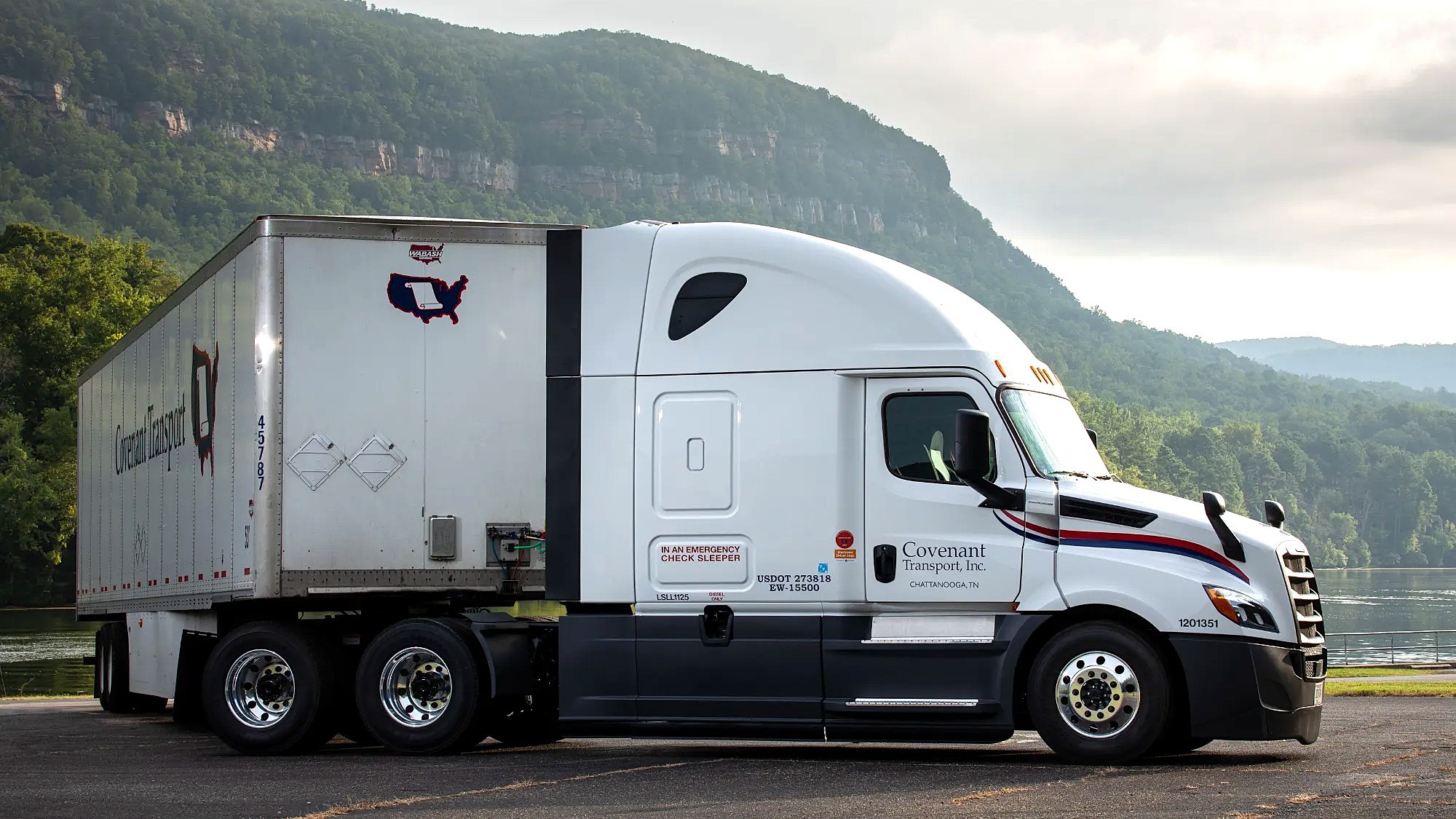
Covenant Logistics Group reported a 19.2% year-over-year increase in third-quarter revenue Thursday, driven by strong growth in its managed freight segment.
Freight revenue excluding fuel surcharges rose 17.2% to $315.1 million from $268.8 million.
Net income increased to $10.7 million, or 40 cents share, compared with $9.1 million, or 35 cents in the third quarter of 2025.
On an adjusted basis, Covenant earned 50 cents share, up 13.6% from 44 cents a year earlier.
Chairman and CEO David R. Parker said the results marked the first time since the second quarter of 2022 that adjusted earnings increased both sequentially and year over year.
“We were pleased with our third-quarter earnings of $0.40 share, or $0.50 share on a non-GAAP adjusted basis,” Parker said in a news release.
The company’s operating income increased to $12.5 million from $7.9 million a year earlier. However, its adjusted operating ratio deteriorated to 95% from 94.4%, reflecting continued pressure from operating expenses.
Covenant will hold a conference call to discuss results with analysts at 10 a.m. Friday.
Covenant Logistics Q3 2026 financial and operating performance
The following table summarizes Covenant’s key third-quarter performance indicators.
- Total revenue: $353.9M vs. $296.9M, up 19.2%
- Truckload total revenue: $204.6M vs. $199.7M, up 2.5%
- Freight revenue excluding fuel (companywide): $315.1M vs. $268.8M, up 17.2%
- Truckload revenue mile: $3.03 vs. $2.53, up 19.8%
- Truckload revenue $5,778 vs. $5,445, up 6.1%
- Managed Freight revenue: $121.6M vs. $72.2M, up 68.4%
- Managed Freight adjusted operating income: $7.08M vs. $3.04M, up 133.3%
- Expedited freight revenue excluding fuel: $70.6M vs. $80.2M, down 12.0%
- Expedited adjusted operating income: $4.16M vs. $5.14M, down 19.0%
- Adjusted earnings $0.50 vs. $0.44, up 13.6%
Managed Freight drives revenue growth
Covenant’s Managed Freight segment was the primary driver of the company’s third-quarter revenue growth, generating $121.6 million compared with $72.2 million in the same period last year, an increase of 68.4%.
Adjusted segment operating income more than doubled to $7.1 million from $3 million, while its adjusted operating ratio improved to 94.2% from 95.8%.
The company attributed the gains primarily to the integration of brokerage operations acquired during the fourth quarter of 2025, along with customer rate increases and lower purchased transportation costs.
Parker said the acquired brokerage operations delivered their strongest quarterly performance since joining Covenant.
The company’s existing brokerage business also benefited from sourcing additional carrier capacity to handle overflow expedited freight.
Covenant cautioned that sourcing qualified carrier capacity at prices below contractual freight rates remains challenging as trucking capacity exits the market. Rising insurance and claims expenses also pose risks to Managed Freight profitability.
Truckload fleet shrinks as revenue climbs
Covenant’s combined Truckload operations generated $204.6 million in total revenue, up 2.5% from $199.7 million a year earlier.
However, Truckload freight revenue excluding fuel surcharges declined 3.4% to $166 million from $171.8 million.
The decline was largely attributable to an 8.9% reduction in the company’s average tractor fleet, which fell to 2,186 tractors from 2,400 a year earlier.
Despite operating fewer trucks, Covenant reported improved pricing and revenue productivity.
Average freight revenue mile climbed 19.8% to $3.03 from $2.53, while average freight revenue increased 6.1% to $5,778 from $5,445.
Average miles during the quarter declined 11.4% to 25,081 from 28,306.
President Paul Bunn said higher rates and an improved freight mix helped offset the impact of operating fewer tractors.
However, inflation and costs associated with repositioning equipment and drivers weighed on profitability.
Truckload adjusted operating income declined to $7.9 million from $10 million, while the segment’s adjusted operating ratio deteriorated to 95.3% from 94.2%.
Bunn said truckload operating expenses increased approximately 20.8% year over year on an adjusted basis, compared with a roughly 19.7% increase in freight revenue mile.
The company cited rising wages, employee benefits, equipment depreciation, maintenance and technology costs, along with temporary expenses related to starting new customer contracts.
Expedited revenue falls as Dedicated business expands
Covenant’s Expedited segment continued transitioning toward multiyear capacity agreements.
Expedited freight revenue excluding fuel surcharges declined 12% to $70.6 million from $80.2 million a year earlier.
The segment’s average tractor fleet fell 21.4% to 677 units from 861, while adjusted operating income declined 19% to $4.2 million.
Despite the reduction in fleet size, average freight revenue increased 12% to $7,934.
By the end of September, approximately 58% of Covenant’s Expedited tractors were operating under committed capacity agreements, compared with about 40% at the end of the second quarter.
Dedicated freight revenue excluding fuel surcharges increased 4.2% to $95.4 million from $91.6 million.
Dedicated revenue climbed 6.2% to $4,810, supported by expansion in the company’s agricultural protein-related transportation business and its decision to exit less profitable dedicated contracts.
Across its entire asset-based fleet, Covenant said approximately 80% of tractors were operating under long-term contracts at the end of the quarter.
Parker said the company’s longer-term goal is to place substantially all of its asset-based business under dedicated or other committed freight contracts by the end of the current freight market upcycle.
Freight demand holds steady, but costs remain elevated
Parker described freight demand as adequate across most sectors and strong in certain markets tied to U.S. economic growth.
However, he said tightening driver capacity and inflation continue to create significant operating challenges.
“Driver capacity is tight, and the cost of recruiting, retaining, and compensating drivers is increasing significantly,” Parker said.
He added that higher expenses for wages, equipment ownership, maintenance and technology have largely offset the benefits of freight rate increases.
Covenant expects its transition toward committed capacity contracts to reduce earnings volatility and improve profitability as the freight market strengthens.
The company’s Warehousing segment also faced profitability challenges during the quarter.
Warehousing freight revenue increased 7.8% to $26.7 million, but adjusted operating income declined to $888,000 from approximately $2 million a year earlier.
The company attributed the decline to operational inefficiencies at new customer locations and labor inflation.
Covenant forecasts further earnings improvement
Covenant expects a modest sequential increase in earnings during the fourth quarter as it continues shifting equipment into higher-margin committed contracts and reduces repositioning expenses.
The company also anticipates growth in its Dedicated fleet and a stable Expedited fleet, with a greater percentage of tractors operating under long-term agreements.
Its 49% ownership stake in Transport Enterprise Leasing contributed $5.7 million in pretax income during the quarter, compared with $3.6 million a year earlier. Covenant expects a lower contribution from the leasing business in the fourth quarter.
As of Sept. 30, Covenant reported approximately $283.9 million in net indebtedness, down $12.4 million from the end of 2025.
The company also reported $75.2 million in immediately available borrowing capacity under its asset-based lending facility.
For the remainder of 2026, Covenant expects net capital equipment expenditures of $35 million to $40 million.
Why it matters: Covenant’s earnings improvement highlights how trucking companies are using higher contract rates, smaller fleets and asset-light brokerage operations to offset persistent cost inflation and uneven freight demand.
Source: FreightWaves
Compiled from international media by the SCI.AI editorial team.