Brad Jacobs, the founder who spun RXO out of XPO Logistics, publicly endorsed C.H. Robinson's roughly $6 billion acquisition of the 3PL at FreightWaves' Future of Freight Festival in Chattanooga, arguing that brokerage success now demands "scale and density." Jacobs, who said the deal was struck by RXO CEO Drew Wilkerson and C.H. Robinson CEO Dave Bozeman, praised its mixed cash-and-stock structure: RXO holders get $17.25 per share in cash plus 0.0856 CHRW shares, valued at $30.25 per share at announcement. He also discussed XPO's breakup, autonomous trucking's shift toward spot freight, QXO's three acquisitions and just under $5 billion in first-half revenue, and why smaller brokers keep surviving consolidation.
Chattanooga—The man who created RXO gave his public support to the 3PL’s acquisition by C.H. Robinson, saying you need “scale and density” to make it in the brokerage world.
Brad Jacobs, who as CEO of XPO Logistics spun off RXO into a standalone publicly-traded 3PL, told the FreightWaves Future of Freight Festival here that he had nothing to do with the C.H. Robinson acquisition of RXO for approximately $6 billion.
“This is not my deal,” Jacobs said. “That was (RXO CEO) Drew Wilkerson’s deal and (C.H. Robinson CEO) Dave Bozeman’s deal.”
But in one sense, it is Jacobs’ deal. It was Jacobs who made the decision to split up the XPO conglomerate, leaving XPO as a stand-alone LTL carrier and creating two separate companies: RXO in 2022 and GXO, a contract logistics company in 2021.
But in discussing the scale and density argument, Jacobs said “you’ve got to be able to find a truck faster than the other guy. You’ve got to find freight to get that backhaul right this second. So bigger is definitely better there.”
Jacobs supported the structure of the deal, which involves RXO (NYSE: RXO) shareholders being able to be paid in some combination of stock and/or cash. Under the terms, RXO shareholders will receive $17.25 in cash and 0.0856 shares of C.H. Robinson (NASDAQ: CHRW) stock share of RXO. At the time of the deal, C.H. Robinson said that amounted to $30.25 But there are also options to take an all-cash payout of $30.25 or an all stock payout of 0.1992 shares of C.H. Robinson stock.
“I like the part that it was a big chunk in stock,” Jacobs said. “That way the people can share in the synergies.”
Warm words for Wilkerson
Jacobs’ other comments on the RXO deal involved Drew Wilkerson, the company’s CEO who is selling the company.
Jacobs described him as a “really nice guy.”
“You know what I like about him?” Jacobs said. “I’ve known him for awhile. He’s totally honest. He never once told a lie. Never told a fib. Never exaggerated. This is a humble thing. It a really beautiful quality of human being. I look for people like that.”
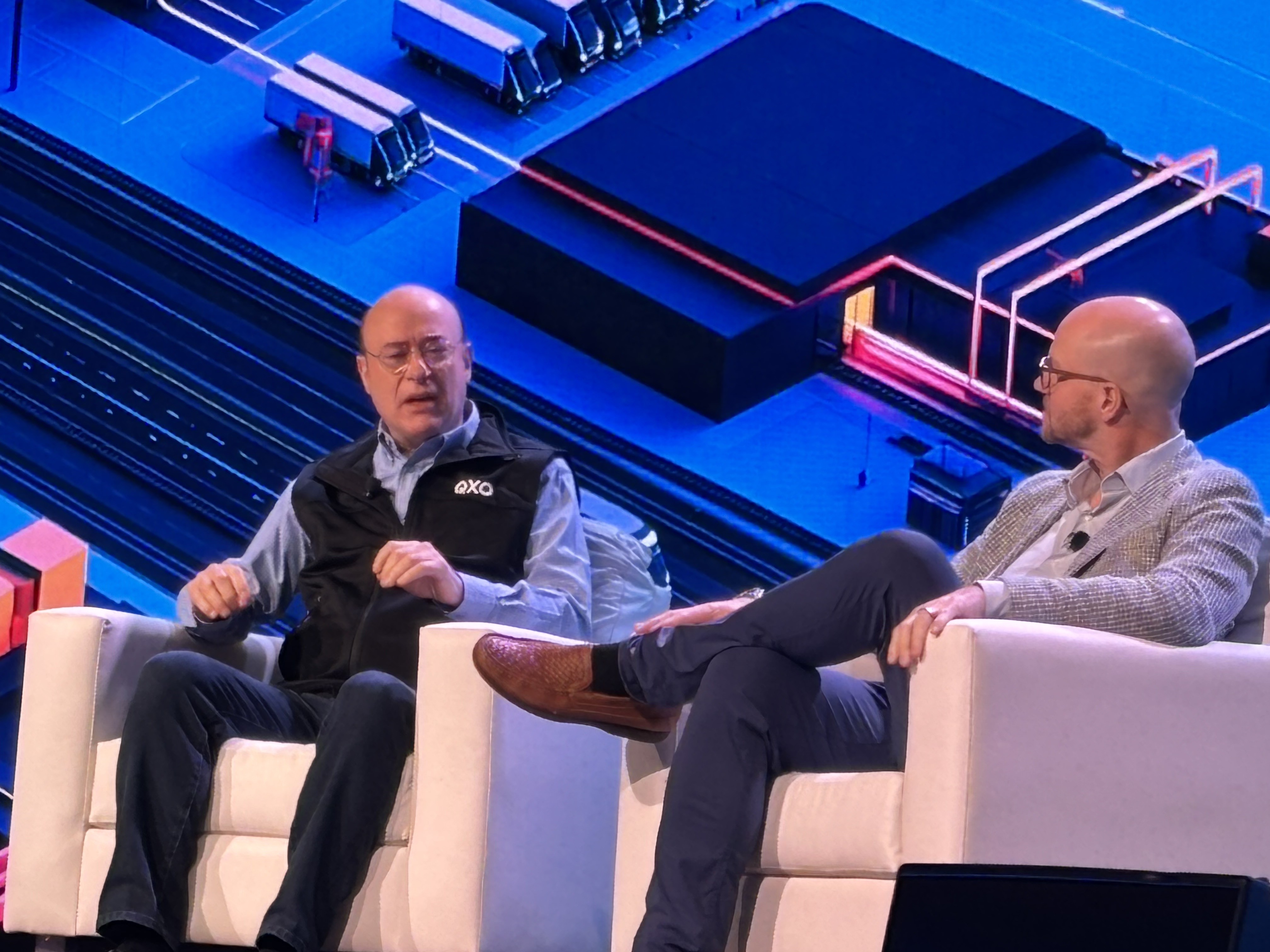
After a relatively brief interview between Jacobs and FreightWaves CEO and founder Craig Fuller, Jacobs took to the stage and answered questions from the audience on a wide variety of topics.
Among them:
The formation of XPO
Jacobs said his original plan in forming the conglomerate that became XPO (NYSE: XPO) was “to form the biggest trucking company that’s ever existed, and just go buy a bunch of trucking companies, form a relationship with OEMs and hire a bunch of drivers.”
But he concluded that having a large number of trucks as a truckload carrier has limited upside. If you’re a shipper, he said, “do you really care if the company has more than one truck or 10,000? Like all you need is that one truck.”
He shifted his attention to buying brokerages, but “they weren’t cheap. They were fairly expensive.” His plan was then modified to buy the various companies that became XPO, but he found that “the multiple wasn’t there.”
“We didn’t get a good multiple because investors didn’t want to buy a conglomerate,” Jacobs said. “They wanted to buy something that was more simple to understand. So we broke it up…at a huge value.”
The prospects of autonomous trucking
Jacobs said a trucking sector that is mostly powered by autonomous vehicles is “going to be more efficient because it’s going to be more Uber-like in terms of spot business.”
He said the percentage of linehaul that will be done by spot business will rise, replacing a market that now has “still a lot of deadhaul, still a lot of empty freight.”
But Jacobs said there was a lot he didn’t know. With efficiency growing at asset-light companies, Jacobs said, “who’s going to own all these trucks? Is it going to be the government? Is it going to be just the network? Is it going to be individual people? Is it going to be big, huge corporations? I don’t think that’s figured out.”
QXO
Jacobs last year stepped down as chairman of both XPO and GXO to focus on QXO (NYSE: QXO), his plan to roll up what he has said was an inefficient building supplies market with logistics as a key to success. The company has made three acquisitions and for the first six months of the year, it had revenue just under $5 billion. Jacobs is chairman and CEO.
“I looked at 55 different industries before I picked building products,” Jacobs said. And in a tip of the hat to the F3 audience, Jacobs said “most of them are way behind the supply chain world in terms of technology and efficiency, in terms of real basic stuff like scanning and having a TMS.” The supply chain is “more advanced than you think. When you look at other industries, they’re behind in the game.”
QXO has not yet caught fire on Wall Street. Its stock is down about 41% in the last year and 14.4% in the last month.
But Jacobs expressed no reservations about the model for QXO. Building products “are not going away. Ten years from now, we’re still going to meet in a building, and if it’s raining we’re still going to have a proof and sleep in a real bed with real windows and real doors and real plumbing.”
That marks building products as “real and durable,” Jacobs said. “You can come into the industry and consolidate it. You can buy a bunch of companies, take out a lot of unnecessary costs, run them more profitably, run them more customer-centric in a more tech-enabled way…and then make yourself the best provider of what they want to pay for.”
Broker consolidation
Jacobs joked that he had been asked about broker consolidation at an earlier F3 conference. The question then, and at this year’s meeting, was about consolidation that would find smaller brokerages disappearing.
But after seeing RXO about to disappear into C.H. Robinson, and Echo Global buy ITS earlier this year, he noted that “the smaller brokers still do just fine.”
“If you talk to the bigger brokers, they all say the little brokers are going out of business,” Jacobs said. “They’ve been saying that forever, and they’re still there.”
Source: FreightWaves
Compiled from international media by the SCI.AI editorial team.