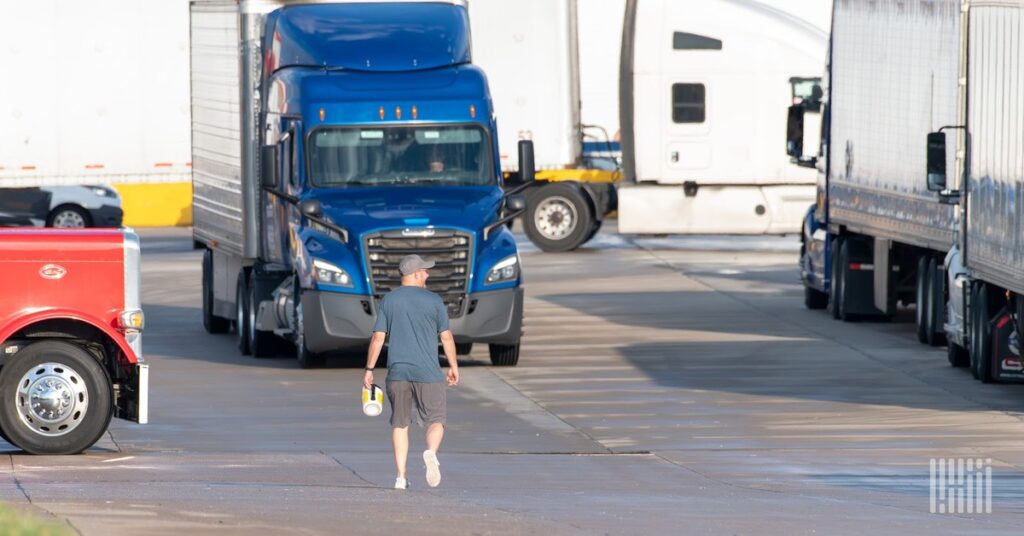
A FedEx driver arriving at a Professional Sports Authenticator facility in Santa Ana, California, on Oct. 13 found his trailer's rear-door lock missing and roughly $963,000 in Pokémon and sports trading cards gone, according to Santa Ana police. Two pallets had vanished and a third was ransacked. The case sits in one of the country's densest cargo theft corridors: an Overhaul report cited by FreightWaves found 37% of nationwide cargo thefts occur within 200 miles of Torrance, California, about 30 miles from Santa Ana. Highway's Brennan Bailey said 87% of direct theft incidents involve carriers whose drivers presented limited-term or non-domiciled CDL designations.
According to www.freightwaves.com, a FedEx truck carrying nearly $1 million in Pokémon and sports trading cards was robbed in Southern California, with investigators putting the confirmed loss at roughly $963,000.
Trailer lock missing at PSA facility
A FedEx driver arriving at a Professional Sports Authenticator (PSA) facility in Santa Ana, California, on Oct. 13 found the lock securing his trailer’s rear door missing, according to Santa Ana police. Approximately $963,000 worth of Pokémon and sports trading cards were gone.
Two full pallets had vanished, and a third pallet had been visibly ransacked. Investigators told Phil Brink, FreightWaves head of fraud media and education, who reported the story, that the actual loss could be even higher as authorities were still conducting on-site inventory to determine what was in the truck and whether the cards were inbound or outbound.
Investigators have not confirmed a precise timeline. Earlier media reports suggested the driver had been away from the vehicle for 60 to 90 minutes, but Santa Ana police told Brink that was inaccurate and that the driver was gone for only a short period. Key questions — including whether the theft was targeted, a crime of opportunity, or potentially an inside job — remain unanswered.
A theft corridor 30 miles from Torrance
The case matters to carriers and shippers because it sits squarely in one of the country’s densest cargo theft corridors. Santa Ana is roughly 30 miles from Torrance, California — a city that serves as a benchmark for regional theft data.
Brink cited an Overhaul report he covered in August showing that 37% of reported cargo thefts nationwide occurred within a 200-mile radius of Torrance, and nearly 70% of those regional incidents happened within a 50-mile radius of the city.
“Southern California has a lot going on in that region — think the Port of Los Angeles, Long Beach — they’re all right next to each other. Those are 12 miles from Torrance. We have major warehouses, distribution centers, and then just thousands of trucks moving freight every single day. So that really creates opportunities for criminals.” — Phil Brink, Head of Fraud Media and Education, FreightWaves
Direct theft vs. strategic theft
Brennan Bailey, chief product officer at Highway, framed the incident as “straight theft,” distinguishing it from two other fraud categories his company tracks. Direct theft, he explained, is when the legal custodian of freight absconds with it, while strategic theft involves a bad actor fraudulently assuming custodianship — the mechanism behind most double-brokering schemes.
Bailey said strategic theft is by far the most dominant form, noting that 87% of all direct theft incidents involved motor carriers where a driver presented a limited-term or non-domiciled designation on their CDL.
“The vast majority of [strategic theft] occurs when a legitimate motor carrier’s inbox is compromised. A freight broker is sending a rate confirmation directly to a motor carrier’s inbox as an attachment — you’re attaching extremely sensitive load details, arguably the most sensitive document that a freight broker has, into an email and sticking it into the inbox of a motor carrier’s Gmail and relying on their data hygiene to keep that protected.” — Brennan Bailey, Chief Product Officer, Highway
Secure rate confirmation delivery
Highway’s response mirrors the approach used by retail banks: rather than emailing rate confirmations as attachments, the platform sends carriers a notification prompting them to log in and retrieve the document through an authenticated portal — a process Bailey called “secure rate confirmation delivery.”
The system logs who accessed the document, from where, and at what time, creating a digital audit trail. For the FedEx case specifically, Bailey noted that whether insurance coverage applies may hinge on whether the carrier followed required protocols for hauling high-value cargo in an unattended vehicle.
Source: FreightWaves
Compiled from international media by the SCI.AI editorial team.