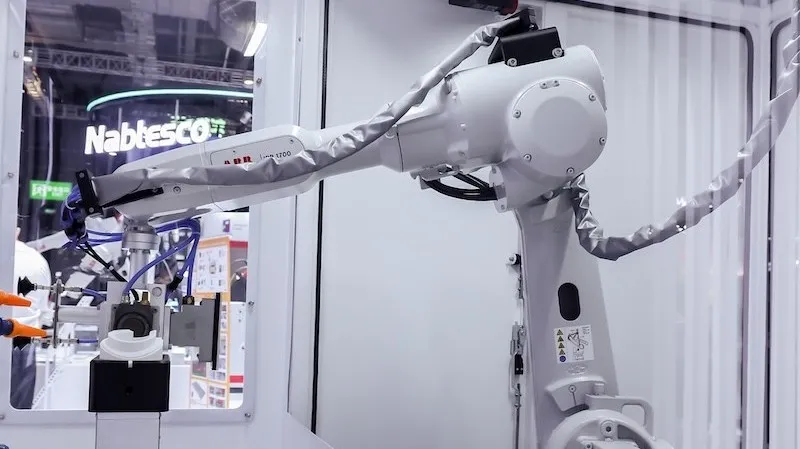
ABB Robotics launched the IRB 1700 and IRB 1700ID robots on October 20, 2026, delivering up to 20 percent shorter cycle times and 15 percent lower power consumption. With payloads from 6 kg to 12 kg, 0.03 mm path repeatability, and 700 degrees/second joint speeds, they target high-precision tasks including AI server rack assembly. The compact design reduces footprint by 50 percent; the ID variant integrates cabling internally. Debuted at CIIF Shanghai, the robots support ABB’s autonomous and versatile robotics strategy.
According to Robotics & Automation News, ABB Robotics introduced two new high-performance industrial robots—the IRB 1700 and IRB 1700ID—on October 20, 2026, delivering up to 20 percent shorter cycle times than comparable models on the market.
Performance and efficiency gains
The IRB 1700 family offers payloads from 6 kg to 12 kg across five variants and is powered by OmniCore controllers. According to the report, it enables up to 20 percent shorter cycle times, up to 15 percent lower power consumption, and service intervals of up to 20,000 hours between oil changes—significantly extending maintenance cycles and reducing operating costs.
The robots achieve precise path repeatability of down to 0.03 mm and joint speeds of up to 700 degrees per second, making them suitable for high-speed precision applications including arc welding, sanding, deburring, material handling, and machine tending.
These performance metrics support manufacturers’ dual objectives: increasing output while maintaining quality and cutting energy use—pressures Craig McDonnell, managing director, business line industries, ABB Robotics, explicitly cited in the source.
Design innovation and application scope
The IRB 1700 features a footprint 50 percent smaller than its predecessor. The IRB 1700ID variant incorporates ABB Robotics’ Integrated Dressing (ID) design, routing cables and hoses inside the robot arm to simplify installation and improve packaging efficiency across industrial applications.
The new robots are also tailored for emerging electronics demands, including AI server rack assembly—a direct response to surging global demand for AI infrastructure, as stated in the source.
The IRB 1700 family extends ABB Robotics’ mechatronics portfolio and supports its development of autonomous and versatile robotics (AVR), with integration into software tools such as RobotStudio, AI Robot Trainer, OmniCore EyeMotion, and automatic collision-free path planning.
Market debut and strategic context
The IRB 1700 and IRB 1700ID made their public debut at the China International Industry Fair (CIIF) in Shanghai, where a live demonstration featured fully functional arc welding and sanding applications.
This launch follows other recent expansions by ABB Robotics, including updates to the IRB 1200 family in 2025 and the introduction of three new robot ranges for China’s advanced manufacturing sector—also in 2025.
According to the source, the new robots reinforce ABB’s focus on precision manufacturing across electronics, automotive, and general industries—sectors facing intensifying pressure to scale production without compromising quality or energy efficiency.
“Precision manufacturing across sectors from electronics, automotive, to general industries is facing the pressure to produce more, while maintaining quality and reducing operating costs. The IRB 1700 family addresses these challenges with a new level of speed, accuracy, reliability and energy efficiency.” — Craig McDonnell, managing director, business line industries, ABB Robotics
Source: Robotics & Automation News
Compiled from international media by the SCI.AI editorial team.