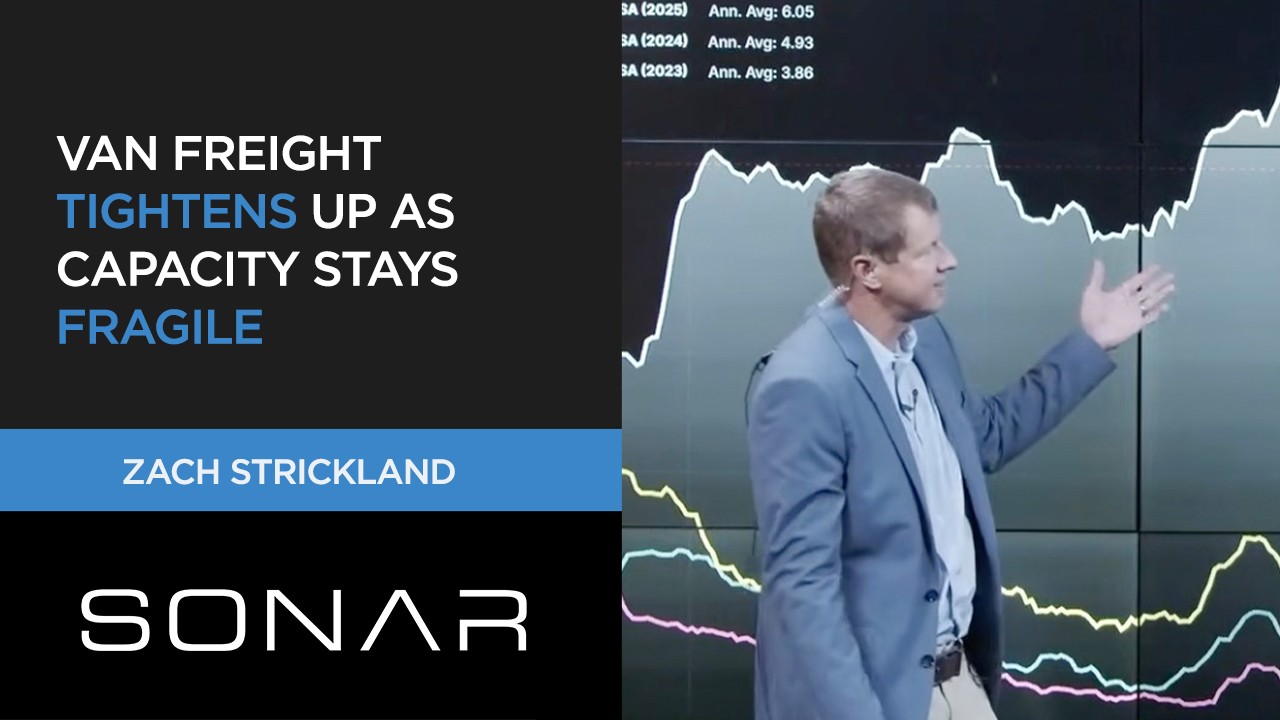
According to www.freightwaves.com, the national Tender Rejection Index climbed to 14% and is holding near a secondary peak comparable to Labor Day levels — driven primarily by van freight, which accounts for 60% to 70% of all U.S. freight tendered.
Capacity Fragility, Not Demand Surge, Driving Rejections
Zach Strickland of FreightWaves’ SONAR team emphasized that rising rejections reflect ongoing market fragility rather than increased demand. Although the National Sonar Tender Volume Index rose slightly post-holiday, total tender volumes remain below April levels.
“This is really just, like I said, more of a sensitivity and a fragility that still exists in the market.” — Zach Strickland, FreightWaves SONAR analyst
Strickland underscored that carriers cannot rely on automatic capacity influx as seen in late 2022, when post-pandemic stabilization occurred. He noted that current conditions differ fundamentally: “We are not in a market that you can sit back and rely on capacity coming into it like we saw towards the end of COVID at the, you know, in 2022.”
Refrigerated freight rejection rates stand at 20%, supported by the ongoing harvest season — a factor expected to sustain elevated reefer rejections for the next few months. Flatbed rejections sit near 19%, though flatbed represents less than 10% of total freight volume, limiting its systemic impact.
Midwest Corridor Under Pressure
Geographically, the Midwest is the epicenter of tightening conditions. Strickland flagged Columbus, Joliet, Allentown, and Elizabeth, New Jersey as critical markets. Joliet — a major rail hub — was singled out as a primary driver of rejection-rate stickiness.
Nationally, van spot rates show predominantly upward movement, with only isolated softening observed in Atlanta and Greenville, South Carolina. The timing adds complexity: pressure is emerging earlier and more intensely than typical seasonal patterns would predict, as the final week of the quarter usually triggers a freight push — yet October has historically softened after quarter-end before late-month recovery.
Diesel costs are contributing to spot rate increases, but Strickland cautioned that fuel surcharges require market support: “You can’t pass along that diesel cost without a market that will allow it.” For now, the fragile capacity backdrop appears to be enabling such pass-through — particularly in van freight.
Source: FreightWaves
Compiled from international media by the SCI.AI editorial team.