Intermodal spot rates haven’t kept pace with trucking’s spot market surge — but that’s about to change in 2026

Craig Fuller, CEO at FreightWaves · Sunday, February 15, 2026
The freight market has been sending mixed signals for months, but one trend stands out clearly as we move deeper into 2026: trucking spot rates have staged a meaningful recovery, while intermodal rates remain stubbornly anchored near cycle lows.
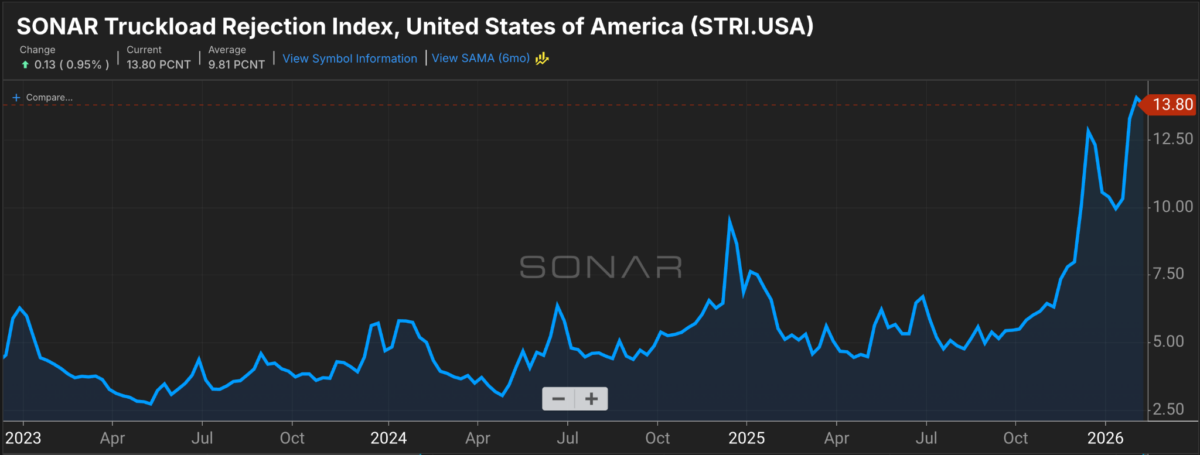
Look at the data. Truckload spot rates (inclusive of fuel) are holding elevated around $2.80 per mile nationally, per recent SONAR readings, up 23% from a year ago where it was at $2.33 per mile. Tender rejections are hovering near 14% — levels not seen consistently since the post-COVID unwind in 2022, and higher than anything in 2023, 2024, and 2025. Carriers are rejecting loads, pushing spot pricing higher, and creating real headaches for shippers’ routing guides.
Intermodal, meanwhile, tells a different story. Domestic intermodal spot rates (excluding fuel) sit at $1.39 per mile, down from $1.48 per mile a year ago, a decline of 5% — basically the same levels of where intermodal spot rates were during the COVID shutdowns in March 2020.
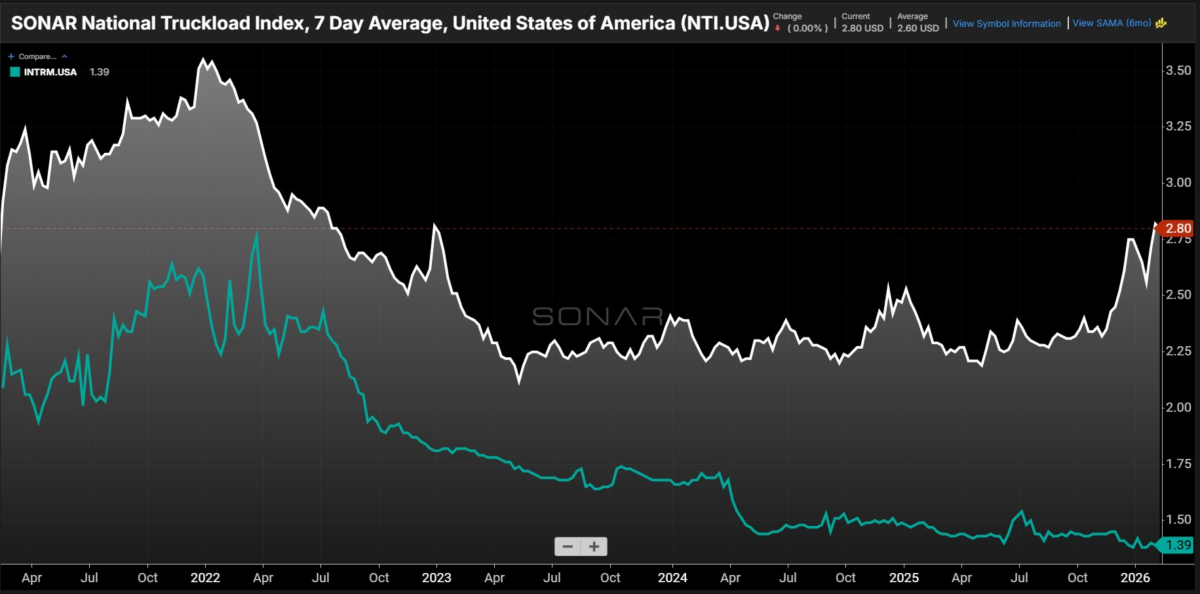
That’s despite strong intermodal volume performance, with slight Q4 year-over-year gains fueled by reliable rail service and a significant rate spread versus truckload (often 20–30% savings on key long-haul lanes). Intermodal spot rates are running at half of their trucking counterparts.
This divergence isn’t new. For much of the past couple of years, shippers chased cost savings by shifting longer-haul freight to intermodal, especially as truckload capacity was abundant and spot rates soft. Railroads capitalized with excellent service reliability entering its second year of strong performance, excess container availability, and aggressive pricing to capture share. Intermodal volumes grew even as truckload volumes dipped negative in spots.
But the market is shifting under our feet. Trucking capacity continues to tighten — driven by ongoing carrier exits, regulatory pressures on drivers (English proficiency rules, non-domiciled CDL restrictions, ELD enforcement), winter weather disruptions, and early signs that domestic freight demand, particularly in the Rust Belt is returning. T
Sign up free to read the full article
Create a free account to unlock full access to all articles.
Sign Up FreeAlready have an account? Sign in