Skip to content

Warehousing & Transport

Analysis

India’s Western Freight Corridor Cuts Logistics Costs to 7%

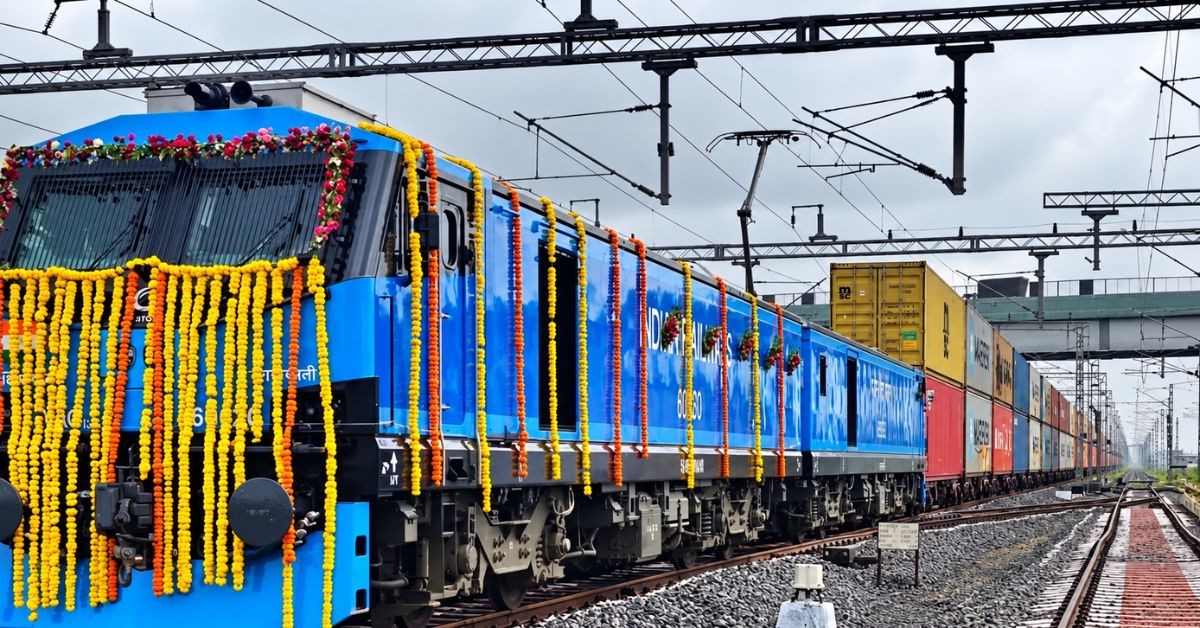
India’s Western Dedicated Freight Corridor (WDFC) is now fully operational after Prime Minister Narendra Modi inaugurated its final 326 km section, completing the rail link from Dadri, Uttar Pradesh, to JNPT in Maharashtra. Built at a cost of over Rs 20,700 crore as part of the Rs 1.3 lakh crore, 1,500 km corridor, it will cut national logistics costs to ~7% from ~14%. Maharashtra CM Devendra Fadnavis highlighted double-decker trains carrying cargo equal to 250 trucks each and noted 70–80% of capacity is reserved for ISO container traffic between North India and western ports like JNPT, Mundra, and Pipavav.

Original source: Source information pending

India’s Western Freight Corridor Cuts Logistics Costs to 7%

According to maritimegateway.com, Prime Minister Narendra Modi dedicated three key sections of the Western Dedicated Freight Corridor (WDFC) on Tuesday, completing the final port-end link between Dadri, Uttar Pradesh, and Jawaharlal Nehru Port Trust (JNPT) in Maharashtra.

Corridor Completion and Scale

The newly inaugurated sections span 326 route kilometres and were constructed at a cost of over Rs 20,700 crore. They form part of the full 1,500 km Western Dedicated Freight Corridor, which traverses five states — Maharashtra, Gujarat, Rajasthan, Haryana and Uttar Pradesh — at a total project cost of Rs 1.3 lakh crore.

The Japan International Cooperation Agency (JICA) provided financing and technical support for the corridor over nearly two decades, extending cumulative official development assistance amounting to thousands of crores of rupees. JICA characterized the milestone as a landmark outcome of India-Japan infrastructure cooperation.

With the New Saphale–JNPA stretch now operational, the corridor achieves end-to-end rail connectivity from North India’s inland container depots directly to western ports — primarily JNPT, but also Mundra and Pipavav.

Logistics Impact and Capacity Design

Maharashtra Chief Minister Devendra Fadnavis called the corridor a “revolution” in Indian logistics, stating it would enable faster movement of cargo from Uttar Pradesh to JNPT entirely by rail. He emphasized that newly deployed double-decker freight trains can carry cargo equivalent to 250 trucks per train.

Fadnavis projected the corridor would reduce India’s logistics costs to 7% from the current level of approximately 14%, bringing them on par with China’s benchmark. This improvement is expected to sharpen the competitiveness of Indian businesses in global supply chains.

About 70–80% of the corridor’s capacity is allocated for ISO import-export container traffic, with the remainder supporting movement of fertilisers, food grains, salt, coal, petroleum products, cement and industrial goods.

Strategic Integration and Regional Benefits

The WDFC serves as the primary logistics backbone for the Delhi-Mumbai Industrial Corridor, supporting multi-modal logistics parks and industrial nodes along its route. Its termination at JNPT — one of India’s largest ports — confers significant economic advantages for Maharashtra, including anticipated employment generation across port-adjacent zones.

The corridor strengthens integrated freight movement across northern and western India, reducing dependency on road transport and lowering emissions per tonne-kilometre. Its design supports high-frequency, high-capacity operations essential for time-sensitive export-import flows.

By linking inland container depots in Uttar Pradesh and Haryana directly to JNPT and other western ports, the WDFC enables seamless intermodal transfers and shortens transit times for manufacturers in the National Capital Region and beyond.

Source: maritimegateway.com

Compiled from international media by the SCI.AI editorial team.
Ask SCI.AI Finished reading? Continue with SCI.AI. Explore the related policy, route, company and historical context. Continue asking
Global Air Cargo Demand Rises 6% in August Amid Rate Slowdown
Warehousing & Transport

Global Air Cargo Demand Rises 6% in August Amid Rate Slowdown

Global air cargo demand rose 6% year on year in August 2026, extending strong summer performance after a 5% gain in July. Spot rates averaged $3.13/kg — 24% above 2025 — though annual growth has eased from 41% in May to 28% in July and further in August. China’s e-commerce exports to Europe fell 25% YoY following the EU’s 1 July removal of the €150 duty-free threshold. China-to-Western Europe spot rates dropped another 6% MoM to $3.85/kg. Transpacific lanes strengthened, with Northeast Asia to North America averaging $5.76/kg (+2% MoM). Xeneta forecasts 4% global air cargo growth for 2026.

Flexport launches fulfillment hubs in Canada, UK
ESG & Regulation

Flexport launches fulfillment hubs in Canada, UK

Flexport has expanded its fulfillment network internationally with new hubs in Mississauga, Canada (50,000 sq ft, August 2026) and Coventry, UK (40,000 sq ft, September 2026). The facilities reduce delivery times by 37% to Canada and 28% to the UK versus U.S.-only fulfillment. Integrated with Flexport’s Fulfillment Operating System, they support multi-channel retail, cold-chain storage (Coventry), USMCA customs entry (Mississauga), and UKCA compliance. Head of Fulfillment Will O'Donnell emphasized localized execution backed by global infrastructure. Expansion continues with planned hubs in Germany and Japan in Q4 2026, targeting 12 total hubs by end-2027.

Descartes acquires Extensiv for $120M, fourth 2026 deal
AI & Automation

Descartes acquires Extensiv for $120M, fourth 2026 deal

Descartes Systems Group acquired Extensiv for $120 million on September 1, marking its fourth acquisition of 2026. The deal follows its August 24 agreement to buy Tai for $100 million, and earlier 2026 purchases of Idelic ($28 million) and Drivin ($30 million). Descartes reported $193.6 million in revenue and $48.5 million in profit for the quarter ending April 30 — up 15% and 35%, respectively. It will release fiscal 2027 Q2 earnings on September 10. Extensiv, based in El Segundo, California, strengthens Descartes’ warehouse, inventory, and e-commerce fulfillment offerings for third-party logistics providers.

Welcome Back!

Login to your account below

Create New Account!

Fill the forms below to register

Retrieve your password

Please enter your username or email address to reset your password.

Scan to share via WeChat

Open WeChat and scan the QR code to share

QR Code

Add New Playlist