Skip to content

Last Mile · Supply Chain

Analysis

U.S. Last-Mile Costs Rise Faster Than Revenue for 45% of Operators

A FarEye report reveals intensifying financial strain on U.S. last-mile delivery: 45% of operators say costs are outpacing revenue in 2026, while fuel, driver availability, and vehicle operations rank as top cost pressures. Organizations with greater network control achieve 95% on-time performance and 8.3% median cost inflation—well below the 14.5% seen among low-control peers. Hybrid networks now span 57% of respondents, with 47% planning deeper outsourcing. Predictability trumps speed for 55.7%, and AI adoption has jumped to 66.3% from 46.2% in 2025.

Original source: dcvelocity.com

U.S. Last-Mile Costs Rise Faster Than Revenue for 45% of Operators

Ask SCI.AI about this story

📋 本文要点

A FarEye report reveals intensifying financial strain on U.S. last-mile delivery: 45% of operators say costs are outpacing revenue in 2026, while fuel, driver availability, and vehicle operations rank as top cost pressures. Organizations with greater network control achieve 95% on-time performance and 8.3% median cost inflation—well below the 14.5% seen among low-control peers. Hybrid networks now span 57% of respondents, with 47% planning deeper outsourcing. Predictability trumps speed for 55.7%, and AI adoption has jumped to 66.3% from 46.2% in 2025.

According to www.dcvelocity.com, escalating delivery costs are pressuring U.S. operators, with 45% reporting that costs are rising faster than revenues in 2026, per FarEye’s Eye on the Last Mile America 2026 report.

Cost Pressures Mount Across Core Operational Areas

Fuel emerged as the top cost pressure for 7 in 10 operators surveyed, while driver-related expenses—including cost and availability—were cited by more than half. Vehicle operation costs ranked third, named by 40% of respondents. The data underscores how tightly compressed margins have become: 42% said delivery costs and revenues are growing at roughly the same pace, leaving little room for reinvestment or resilience planning.

Network Control Drives Performance and Cost Discipline

Organizations with greater control over their delivery networks achieved 95% on-time performance—versus just 65.5% among low-control peers. Crucially, higher-control operators also reported significantly lower median cost inflation: 8.3% compared to 14.5%—despite similar median investment levels, according to the report.

Fragmentation, Predictability, and AI Adoption Accelerate

Delivery networks are growing more hybrid and fragmented: 57% operate hybrid models (combining owned and outsourced capacity), and 47% of those plan to increase outsourcing. Prioritization is shifting from speed to reliability—55.7% prioritize predictability or first-attempt success, versus only 11.4% emphasizing maximum speed. Meanwhile, AI implementation is surging: 66.3% are now using or implementing AI, up from 46.2% in 2025.

“Delivery operators are being squeezed from both sides—core operating costs remain high while networks themselves are becoming more complex. What is particularly significant is that higher-control organizations are reporting 95% on-time performance and lower cost inflation without materially higher investment.” — Kushal Nahata, CEO and co-founder of FarEye

Source: DC Velocity

Compiled from international media by the SCI.AI editorial team.
Ask SCI.AI Finished reading? Continue with SCI.AI. Explore the related policy, route, company and historical context. Continue asking
Stay ahead of supply chain shifts

One email a week: the stories that matter and new risk events — in English, free.

Prefer RSS? Articles Risk events

M&S backs £340M warehouse automation with TGW
Last Mile

M&S backs £340M warehouse automation with TGW

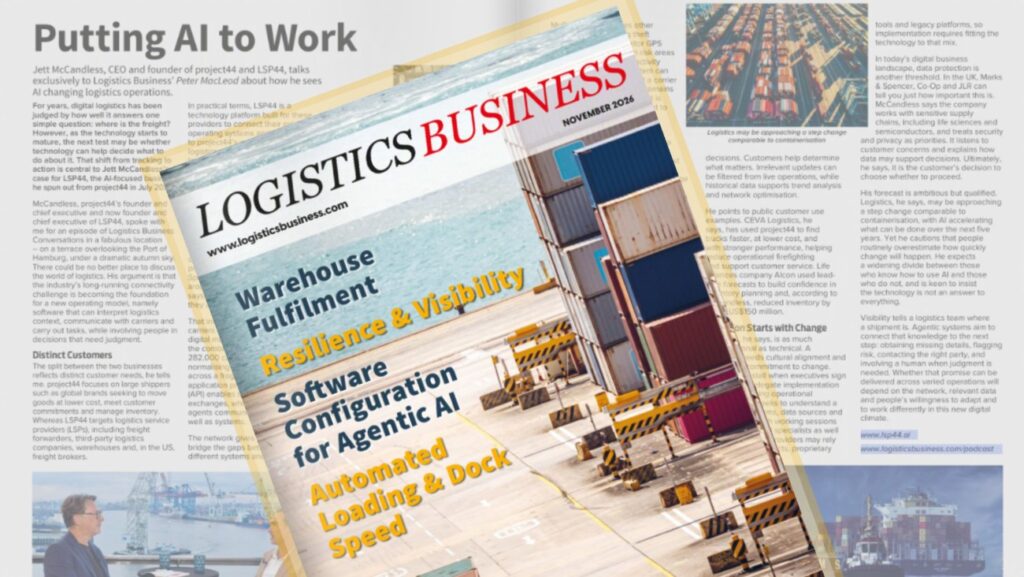
The November 2026 issue of Logistics Business Magazine, published on November 6, 2026, leads with an interview with project44 and LSP44 founder Jett McCandless on the shift from shipment visibility to AI-powered decision-making. TGW Logistics details its £340 million automation project for Marks & Spencer's new Daventry grocery fulfilment centre, while a THG Fulfil and Footasylum project has introduced 85 robots and 96,000 storage locations. Joloda Hydraroll discusses automated trailer loading in under 10 minutes, and UPS Europe, Middle East and Africa President Daniel Carrera explains why resilience now matters as much as efficiency.

Amazon lifts 2026 capex to $220B as warehouse automation hits $30B
Last Mile

Amazon lifts 2026 capex to $220B as warehouse automation hits $30B

Apparel supply chain investment is pivoting from volume growth to yield and efficiency, with warehouse automation spending reaching an estimated $30 billion this year. Amazon raised its 2026 capex forecast to about $220 billion from $131 billion in 2025, UPS has automated 63 percent of hub volume and invested over $100 million in RFID, and FedEx is pushing capex down toward 4 percent of revenue while returning $4.1 billion in spin-off proceeds to debt reduction. Maersk has earmarked $10 billion to $11 billion for ports and integrated logistics, and Gartner sees global IT spending rising 14.2 percent to $6.37 trillion.

India quick commerce to need 75M sq ft logistics space by 2030
Last Mile

India quick commerce to need 75M sq ft logistics space by 2030

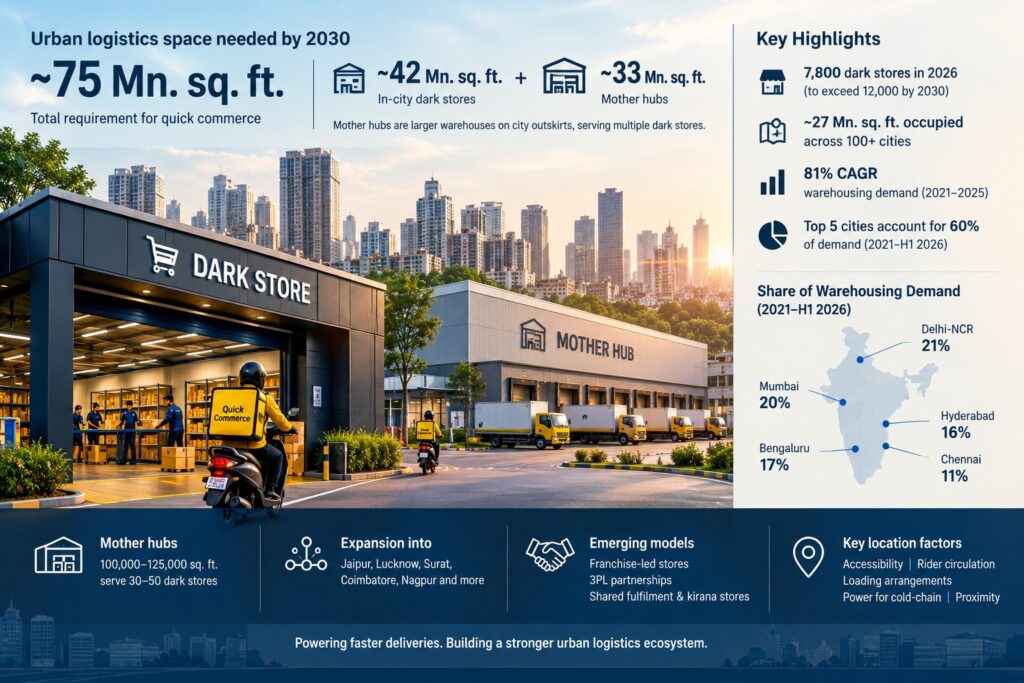
India's quick commerce sector is projected to require about 75 million sq. ft. of urban logistics space by 2030, including 42 million sq. ft. of in-city dark stores and 33 million sq. ft. of mother hubs, according to a CBRE South Asia report. The ecosystem has scaled to 7,800 dark stores in 2026 across more than 100 cities and is expected to exceed 12,000 stores by 2030. Quick-commerce warehousing demand grew at an 81% CAGR between 2021 and 2025, with annual take-up rising from 3.1 million sq. ft. in 2024 to 4.3 million sq. ft. in 2025. Delhi-NCR, Mumbai and Bengaluru accounted for nearly 60% of demand.

Welcome Back!

Login to your account below

Create New Account!

Fill the forms below to register

Retrieve your password

Please enter your username or email address to reset your password.

Scan to share via WeChat

Open WeChat and scan the QR code to share

QR Code

Add New Playlist