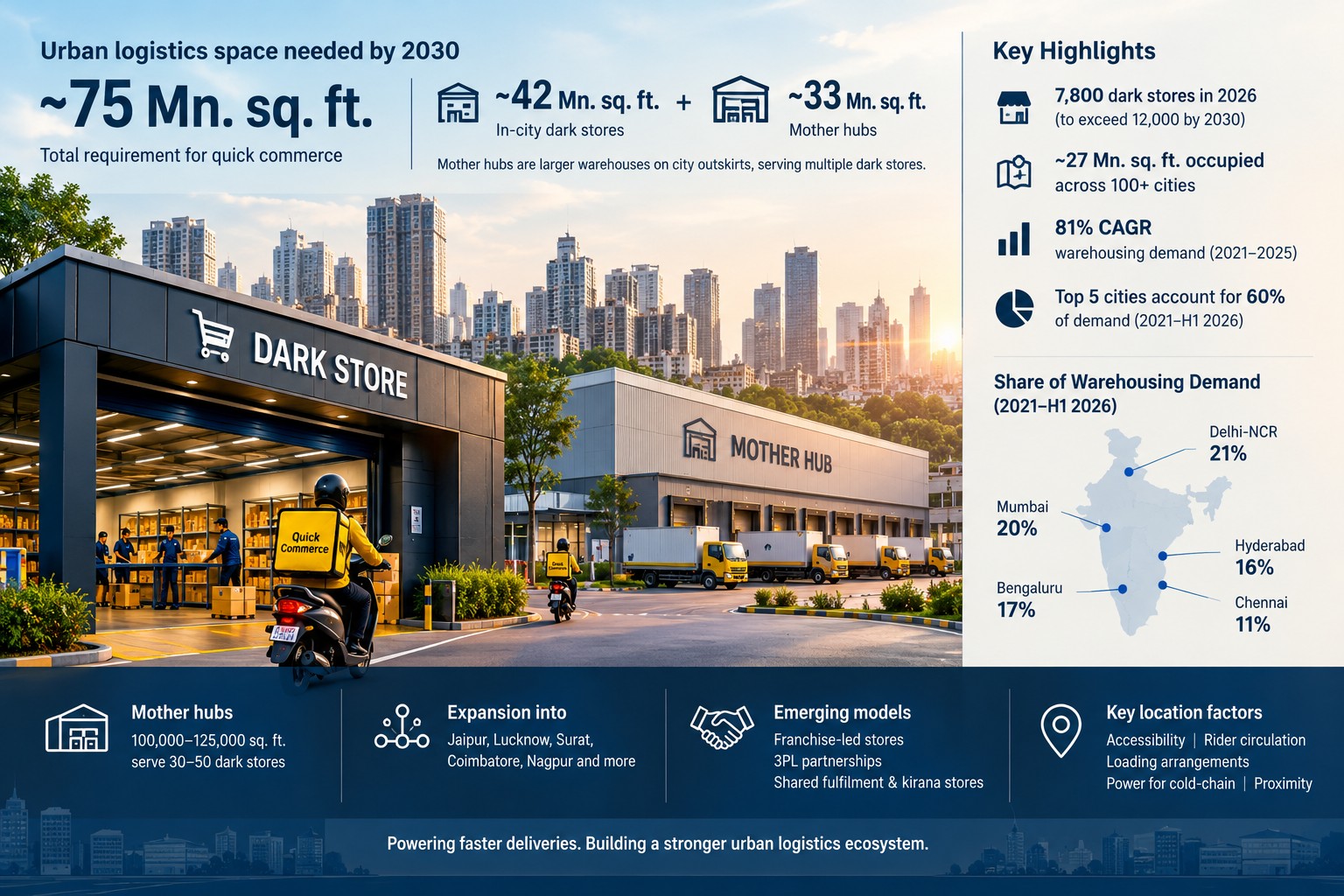
India's quick commerce sector is projected to require about 75 million sq. ft. of urban logistics space by 2030, including 42 million sq. ft. of in-city dark stores and 33 million sq. ft. of mother hubs, according to a CBRE South Asia report. The ecosystem has scaled to 7,800 dark stores in 2026 across more than 100 cities and is expected to exceed 12,000 stores by 2030. Quick-commerce warehousing demand grew at an 81% CAGR between 2021 and 2025, with annual take-up rising from 3.1 million sq. ft. in 2024 to 4.3 million sq. ft. in 2025. Delhi-NCR, Mumbai and Bengaluru accounted for nearly 60% of demand.
India’s quick commerce sector will require a cumulative 75 million sq. ft. of urban logistics space by 2030, according to a new report from CBRE South Asia Pvt. Ltd. titled “India’s Quick Commerce Scale-up: Decoding Dark Stores and Urban Logistics Demand,” as reported by infashionbusiness.com.
The projected footprint splits into roughly 42 million sq. ft. of in-city dark stores and 33 million sq. ft. of mother hubs — larger warehouses on city outskirts that stock and replenish multiple dark stores. The sector already occupies about 27 million sq. ft. across more than 100 cities.
India’s quick-commerce ecosystem has scaled to 7,800 dark stores in 2026, and the network is expected to exceed 12,000 stores by 2030. The network remains metro-centric, with 65-70% of stores concentrated in the top eight cities, though expansion into tier-II and III markets is gathering pace.
Warehousing demand grew at 81% CAGR
Quick-commerce-related warehousing demand grew at a compound annual growth rate of 81% between 2021 and 2025, accounting for 4-5% of pan-India logistics leasing during the period, according to the report.
Annual space take-up rose from 3.1 million sq. ft. in 2024 to 4.3 million sq. ft. in 2025. To replenish expanding dark-store networks, operators have been leasing mother hubs on city outskirts, serving multiple stores through a hub-and-spoke model.
Demand stayed concentrated in major markets during 2021 to the first half of 2026:
- Delhi-NCR: 21%
- Mumbai: 20%
- Bengaluru: 17%
- Hyderabad: 16%
- Chennai: 11%
The top three cities together accounted for nearly 60% of total demand. Anshuman Magazine, Chairman and CEO for India, South-East Asia, Middle East and Africa at CBRE, said real estate sits at the heart of the shift as platforms move from capital-heavy expansion to a more disciplined growth cycle.
“As platforms move from capital-heavy expansion to a more disciplined growth cycle, the focus is moving from simply adding stores to building dense, efficient and well-located fulfilment networks.”
— Anshuman Magazine, Chairman and CEO, India, South-East Asia, Middle East and Africa, CBRE
Mother hubs anchor hub-and-spoke model
Mother hubs of 100,000-125,000 sq. ft. are becoming central to the hub-and-spoke model, with each hub typically serving 30-50 dark stores depending on store density in the city, the report states.
These hubs also absorb spillover SKUs that cannot be stocked in compact urban formats. As the sector matures, mother hubs are expected to drive sustained Grade A leasing demand in logistics parks.
Operators are deepening their presence in markets such as Jaipur, Lucknow, Surat, Coimbatore and Nagpur, where relatively cost-effective real estate can support expansion. The report also flags partner-led models expected to influence leasing patterns through 2030, including franchise-led dark stores, third-party logistics providers taking on warehousing and last-mile functions, and partnerships with neighbourhood kirana stores serving as micro-warehouses.
Ram Chandnani, Managing Director of Leasing Services in India at CBRE, said operators will increasingly judge sites on their ability to support high-throughput fulfilment rather than floor area alone.
“Ground-floor access, rider circulation, loading arrangements, power for cold-chain infrastructure and proximity to the relevant catchment will be critical determinants of a location’s viability.”
— Ram Chandnani, Managing Director, Leasing Services, India, CBRE
Chandnani added that availability constraints, high rents and zoning considerations in established urban markets could make purpose-built and shared fulfilment infrastructure important enablers of capital-efficient expansion, particularly in tier-II and III cities.
Source: infashionbusiness.com
Compiled from international media by the SCI.AI editorial team.