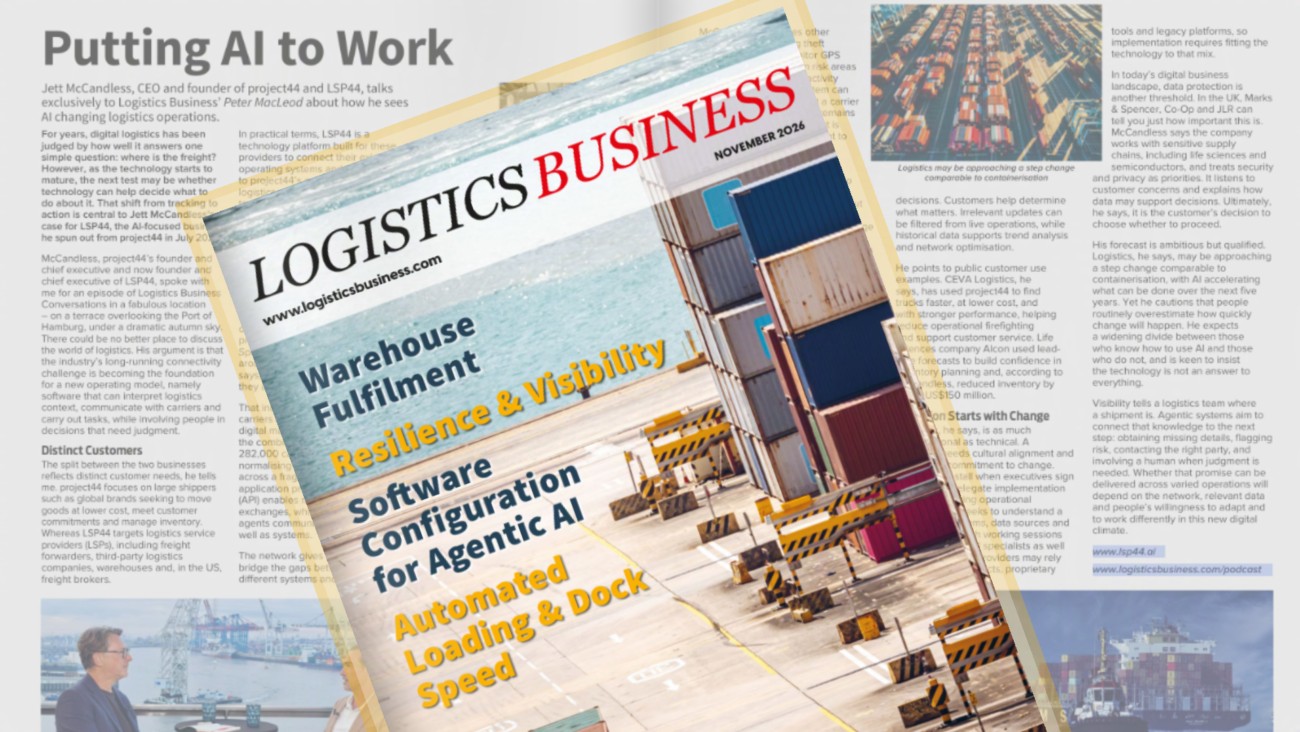
The November 2026 issue of Logistics Business Magazine, published on November 6, 2026, leads with an interview with project44 and LSP44 founder Jett McCandless on the shift from shipment visibility to AI-powered decision-making. TGW Logistics details its £340 million automation project for Marks & Spencer's new Daventry grocery fulfilment centre, while a THG Fulfil and Footasylum project has introduced 85 robots and 96,000 storage locations. Joloda Hydraroll discusses automated trailer loading in under 10 minutes, and UPS Europe, Middle East and Africa President Daniel Carrera explains why resilience now matters as much as efficiency.
According to logisticsbusiness.com, the November 2026 edition of Logistics Business Magazine is now available, featuring interviews and analysis on warehouse automation, artificial intelligence, supply chain resilience and transport. The issue, published on November 6, 2026, examines how logistics businesses are responding to pressure to improve efficiency and manage disruption.
AI and the containerisation comparison
Jett McCandless, founder of project44 and LSP44, speaks to Editor Peter MacLeod about the shift from shipment visibility to AI-powered decision-making. In the interview, published on page 6, McCandless argues the industry could be approaching a transformation comparable to containerisation.
The magazine frames the discussion around the growing pressure on logistics businesses to adopt new technologies while managing disruption. The interview is positioned as one of the issue’s lead features, opening the edition’s coverage of artificial intelligence in logistics.
M&S and the £340 million Daventry project
TGW Logistics reveals details of its automation project for Marks & Spencer‘s new Daventry grocery fulfilment centre, valued at £340 million. The feature, on page 42, covers the challenges of designing a facility for an unpredictable future.
The Daventry project is presented as a major warehouse automation undertaking for the retailer’s grocery fulfilment operations. According to the source, TGW Logistics outlines both the technology involved and the design questions raised by planning a site whose future requirements are difficult to forecast.
Footasylum adds 85 robots
A major automation project involving THG Fulfil and Footasylum has introduced 85 robots and 96,000 storage locations. The magazine examines the technology, investment and reported productivity improvements behind the transformation on page 40.
The Footasylum project is one of two warehouse automation case studies highlighted in the issue, alongside the M&S Daventry facility. The source states that the feature covers the reported productivity gains attributed to the deployment.
Automated loading and supply chain resilience
Joloda Hydraroll discusses the future of automated trailer loading on page 36, including technology designed to load non-modified trailers in under 10 minutes. The feature addresses what the magazine describes as a major warehouse bottleneck.
Separately, Daniel Carrera, President of UPS Europe, Middle East and Africa, explains why resilience is becoming as important as efficiency, in a feature on page 8. Blue Yonder, meanwhile, explores how better freight emissions data could influence everyday transport decisions on page 22.
“Resilience is becoming as important as efficiency.” — Daniel Carrera, President of UPS Europe, Middle East and Africa
The issue also covers autonomous mobile robots, warehouse safety, software integration, sustainable packaging and the latest innovations in materials handling, according to the source.
Source: logisticsbusiness.com
Compiled from international media by the SCI.AI editorial team.