Skip to content

Strategy & Planning · Supply Chain

Analysis

Maersk shifts pricing to track market, avoids $15.8bn loss

Maersk has shifted its container freight pricing strategy to closely track market rates — a reversal from its pandemic-era approach, which delayed passing on surges and cost an estimated $15.8bn in lost revenue. Using Q4 23 as a baseline, Sea-Intelligence found Maersk’s rates now mirror the Container Trade Statistics global average, especially during the Red Sea disruption cycle beginning in late 2023. The consultancy confirmed the change is structural, not transient, enabling Maersk to capture revenue upside during sudden rate spikes without sacrificing downside protection.

Original source: theloadstar.com

Maersk shifts pricing to track market, avoids $15.8bn loss

Ask SCI.AI about this story

📋 本文要点

Maersk has shifted its container freight pricing strategy to closely track market rates — a reversal from its pandemic-era approach, which delayed passing on surges and cost an estimated $15.8bn in lost revenue. Using Q4 23 as a baseline, Sea-Intelligence found Maersk’s rates now mirror the Container Trade Statistics global average, especially during the Red Sea disruption cycle beginning in late 2023. The consultancy confirmed the change is structural, not transient, enabling Maersk to capture revenue upside during sudden rate spikes without sacrificing downside protection.

According to The Loadstar, Maersk has overhauled its container freight pricing strategy to align more closely with real-time market movements — a marked departure from its pandemic-era approach, which delayed passing on rate increases to customers.

Pandemic-era caution cost Maersk revenue

Sea-Intelligence’s analysis, using Q4 23 as a baseline, found that during the pandemic freight surge, Maersk consistently priced below the Container Trade Statistics (CTS) global average. The Danish carrier adopted a cautious stance, apparently hoping slower rate adoption would soften the subsequent decline. But rates fell just as rapidly for Maersk as for the broader market. As Sea-Intelligence stated:

“In other words, the data showed Maersk gave away some revenue upside when rates went up, but got nothing in return when rates went down.”

The consultancy estimated that this strategy cost Maersk approximately $15.8bn in foregone revenue compared with a hypothetical scenario where its pricing had tracked the market. This figure reflects cumulative revenue loss across multiple quarters during the pandemic cycle, with Q4 23 serving as the fixed index reference point.

Sea-Intelligence emphasized that Maersk’s deviation from the CTS average was not temporary or tactical — it represented a sustained strategic choice during a period defined by extreme volatility, including sharp spikes and collapses in spot rates between Q4 2023 and mid-2024.

New discipline during the Red Sea cycle

A decisive shift occurred during what Sea-Intelligence termed the “Red Sea cycle”. Again anchoring analysis to Q4 23 as the baseline, the firm observed that Maersk’s quarterly freight rates have since moved in near-lockstep with the CTS global average amid disruption-driven market adjustments.

“Figure A4 (below) shows the deviation in Maersk’s rate from the CTS average. As can be seen, the deviation is so tiny, as to more likely constitute minor fluctuations with no discernible trend,” Sea-Intelligence noted. This tight tracking began in earnest following the escalation of Red Sea hostilities in late 2023, persisting through early 2024.

Sea-Intelligence concluded:

“What the data shows very clearly is that Maersk has changed its approach to pricing, compared to what it was doing during the pandemic.”

The firm added that Maersk now “very closely follow[s] average market developments and hence avoid[s] the loss in revenue opportunity when the rates suddenly surge.”

Source: The Loadstar

Compiled from international media by the SCI.AI editorial team.

Ask SCI.AI Finished reading? Continue with SCI.AI. Explore the related policy, route, company and historical context. Continue asking
Stay ahead of supply chain shifts

One email a week: the stories that matter and new risk events — in English, free.

Prefer RSS? Articles Risk events

India weighs telecom PLI 2.0 with design-led focus
Strategy & Planning

India weighs telecom PLI 2.0 with design-led focus

India is preparing a second edition of its telecom production-linked incentive scheme, with the Ministry of Communications shifting the emphasis toward design-led manufacturing and deeper domestic value addition. The first scheme, backed by an outlay of Rs 12,195 crore, closed in March 2026 after approving 42 companies, including 28 MSMEs, and drawing Rs 6,073 crore in investment against an initial target of Rs 4,115 crore. Seventeen firms claimed the extra 1 per cent incentive for design-led manufacturing. The new proposal must clear inter-ministerial talks and consultation before reaching the Union Cabinet.

UAE delivers 136,000 tonnes of Gaza aid via 15,529 transport assets
Strategy & Planning

UAE delivers 136,000 tonnes of Gaza aid via 15,529 transport assets

The UAE has delivered more than 136,000 tonnes of aid to Gaza under Operation Chivalrous Knight 3, valued at over $4.3 billion and equal to about 46 per cent of total international assistance to the territory. Hamoud Al Afari, director of UAE relief operations, said 15,529 transport assets were used, including 26 vessels, 218 aircraft in 81 airdrop missions and thousands of trucks. Three round-the-clock centres in Abu Dhabi, Al Arish and inside Gaza coordinate the effort, backed by 22 charitable institutions, 500 volunteers and 130 medical personnel.

M&S backs £340M warehouse automation with TGW
Last Mile

M&S backs £340M warehouse automation with TGW

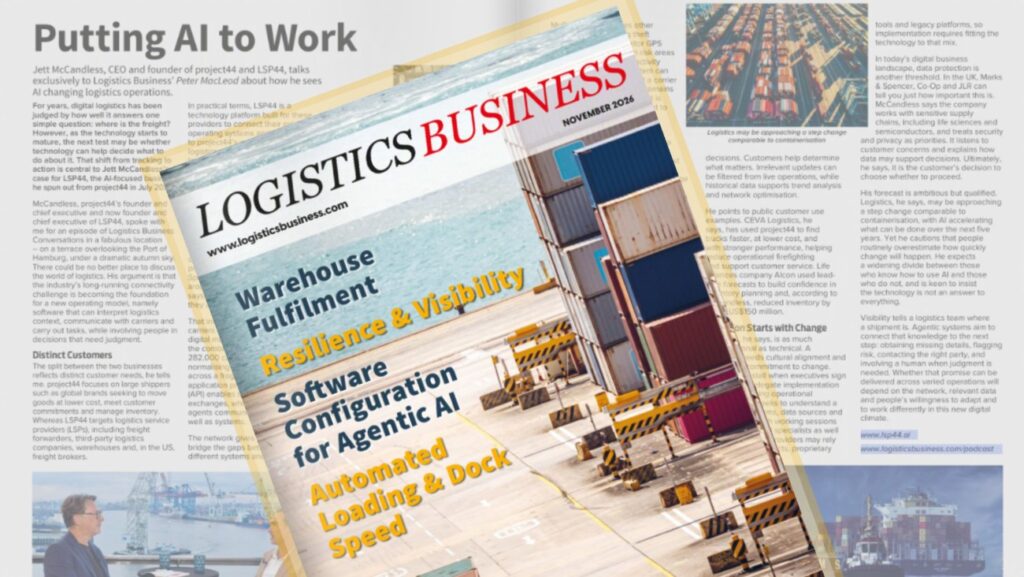
The November 2026 issue of Logistics Business Magazine, published on November 6, 2026, leads with an interview with project44 and LSP44 founder Jett McCandless on the shift from shipment visibility to AI-powered decision-making. TGW Logistics details its £340 million automation project for Marks & Spencer's new Daventry grocery fulfilment centre, while a THG Fulfil and Footasylum project has introduced 85 robots and 96,000 storage locations. Joloda Hydraroll discusses automated trailer loading in under 10 minutes, and UPS Europe, Middle East and Africa President Daniel Carrera explains why resilience now matters as much as efficiency.

Welcome Back!

Login to your account below

Create New Account!

Fill the forms below to register

Retrieve your password

Please enter your username or email address to reset your password.

Scan to share via WeChat

Open WeChat and scan the QR code to share

QR Code

Add New Playlist