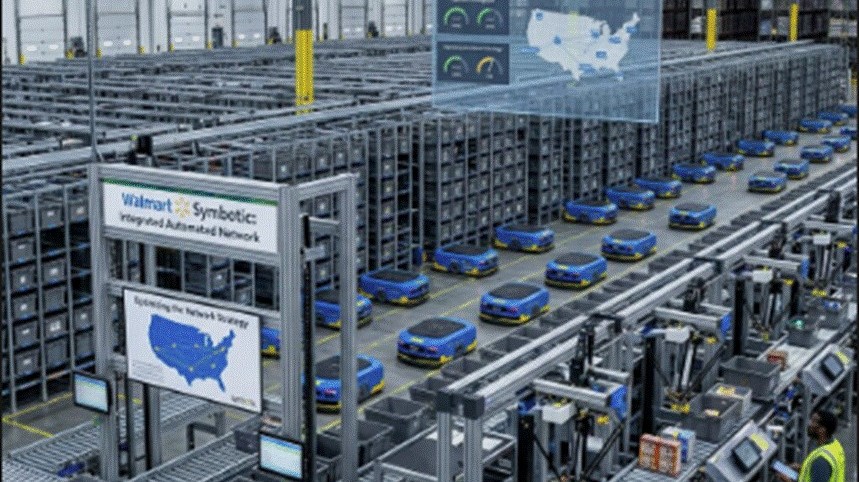
Walmart and Symbotic announced an expanded agreement on October 29 to bring additional automation to 25 U.S. regional distribution centers, with an initial commitment of roughly $6 billion over several years. Symbotic has worked with Walmart since 2017, and Walmart added $125 million for R&D on racking, picking and inventory-management technology. The deal signals a shift from single-facility projects to network-level automation strategy, echoed by Amazon's deployment of more than one million robots and DHL Supply Chain's one billion picks with Locus Robotics.
According to logisticsviewpoints.com, Walmart and warehouse automation specialist Symbotic announced an expanded commercial agreement on October 29 that will extend additional automation capabilities to 25 U.S. regional distribution centers, backed by an initial commitment of approximately $6 billion covering work over several years and multiple locations.
A shift from single-site projects to network-level strategy
Warehouse automation has traditionally been evaluated one facility at a time, with business cases measured against improvements inside a single building. The scale of the Walmart-Symbotic commitment suggests a different framing: automation assessed against the performance of an interconnected distribution network serving stores, pickup and home delivery.
Walmart says the initiative is intended to support upstream e-commerce inventory management, increase storage capacity and improve the movement of products through its supply chain. The company also expects the expansion to support broader assortment, greater speed and more reliable replenishment.
Rob Montgomery, executive vice president for Walmart U.S. Supply Chain Operations, tied the expanded agreement to improving service, growing capacity, simplifying work for associates and lowering costs.
“The question is not simply how much faster a facility can pick, but what the investment changes across the supply chain.” — Rob Montgomery, Executive Vice President, Walmart U.S. Supply Chain Operations
An existing partnership, not a new pilot
The relationship behind the announcement is long-running. According to Reuters, Symbotic has been helping automate Walmart’s supply chain since 2017, and the latest agreement extends automation to another 25 regional distribution centers.
Supply Chain Dive reported that Walmart committed an additional $125 million toward research and development of racking technology and related picking, process-flow and inventory-management capabilities. That commitment points to a competitive discussion moving beyond individual pieces of robotic hardware toward how storage, picking, inventory, material movement and software operate together.
Symbotic says its integrated portfolio includes BreakPack for each-picking and SymMicro for e-commerce micro-fulfillment, supported by proprietary software that uses AI to orchestrate product movement. For operators, the question becomes how multiple automation layers combine into a repeatable operating system rather than which robot performs an individual task.
Other operators signal the same direction
Developments elsewhere reinforce the trend toward network-scale deployment. Amazon reported in 2026 that it has deployed more than one million robots across its operations network, spanning inventory handling, mobile robotics, robotic arms and packaging automation.
Amazon also says its Sequoia system can identify and store inventory up to 75 percent faster at fulfillment centers. Separately, DHL Supply Chain and Locus Robotics reached another measure of scale in 2026: one billion warehouse picks using Locus autonomous mobile robots.
Locus says thousands of its robots now operate across more than 40 DHL-managed sites worldwide. These are different applications with different economics, but the common thread is that leading operators are confronting where automation should be deployed, how quickly it can scale and whether benefits survive replication across a network.
The metrics that matter after go-live
The risk in covering a $6 billion automation agreement is treating announced spending as demonstrated return. The more valuable story will develop as the systems go live across the 25 facilities.
Measures worth watching include throughput, storage utilization, replenishment performance, labor productivity, system availability, fulfillment speed, implementation cost and the ability to maintain performance during demand peaks, according to the report.
A compelling demonstration can show what automation can do. A network-scale deployment begins to show whether the technology can generate similar value repeatedly under different facility and operating conditions. For Walmart, that makes the 25 distribution centers as important as the $6 billion headline.
The announced objectives are ambitious: more capacity, faster product movement, better replenishment, broader assortment, simpler work and lower costs. The harder task now is measuring what changes when those systems operate across the network — and for other warehouse operators, evaluating what automation changes in the economics and performance of the supply chain around it, not the robot alone.
Source: logisticsviewpoints.com
Compiled from international media by the SCI.AI editorial team.