Container rates on major trade lanes are climbing even as demand cools after peak season, according to FreightWaves, as carriers return to the Red Sea, port congestion lingers in Asia and a potential labor strike at Los Angeles-Long Beach adds fresh uncertainty for cargo owners.
Red Sea return reshapes schedules
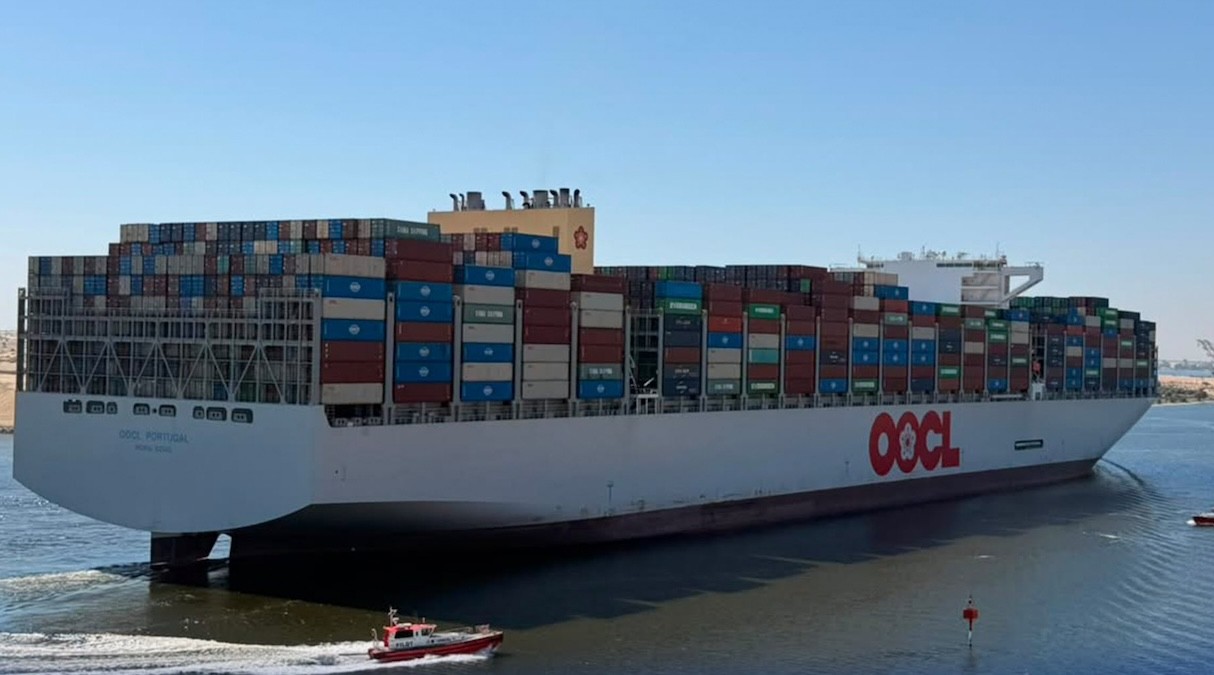
Israeli carrier Zim announced a return to the Red Sea for its joint Asia-U.S. East Coast service with Mediterranean Shipping Co., per the Freightos update. The move is notable because Yemen-based Houthi rebels declared the Bab el-Mandeb Strait closed to Israel-linked vessels as recently as August.
The return remains uneven. Some services are using the Suez Canal on voyages toward Europe while continuing to sail around Africa on return journeys, underscoring carriers’ continued caution about the route, according to the report.
Ships arriving ahead of schedules built around longer Africa voyages can bunch together at destination ports, adding pressure to terminals already working through backlogs. That congestion has helped support freight rates even as demand eases after the peak shipping season, the update said.
Asia-Europe prices rise since mid-October
The Freightos Baltic Index put last week’s Asia-North Europe rate at $3,551 per 40-foot equivalent unit, or FEU, up 3%. Prices to the Mediterranean rose 8% to $4,252 per FEU.
Carriers are pairing their November pricing plans with additional sailing cancellations. Drewry reported eight blank sailings scheduled on Asia-Europe routes for the following week, compared with two in the current week.
European forwarders nevertheless said carriers had discounted their published rates during October and expected similar concessions in November, raising questions over whether the higher prices will hold.
Trans-Pacific rates defy post-holiday slowdown
Trans-Pacific prices also rose, defying expectations of a slowdown after China’s Golden Week holiday. Asia-U.S. West Coast rates increased 3% to $8,368 per FEU, while East Coast rates jumped 9% to $10,565, a high for the year.
Daily East Coast prices have since retreated but remained about $200 per FEU above the previous week’s level, Freightos said. The analyst noted forwarders are seeing signs that demand is cooling and space is becoming easier to secure.
Typhoon Champi brought fresh disruption to East Asia last week, closing Taiwanese container ports, including Kaohsiung, Keelung and Taipei, on Friday. The storm largely spared East China port operations before weakening as it moved toward Japan, though major Chinese hubs are still recovering from earlier summer storms.
LA-Long Beach strike threat looms
At LA-Long Beach, approximately 250 port watchmen have authorized a strike that could begin Nov. 1 if contract negotiations fail. Although the workers account for only about 2% of the ports’ International Longshore and Warehouse Union workforce, their role could give a walkout a much wider impact.
The Pacific Maritime Association said terminals employing the watchmen handle roughly 85% of Long Beach’s cargo and 33% of Los Angeles’ cargo. The employers’ association warned that other ILWU members were not expected to cross Local 26 picket lines, potentially stopping vessel, yard and gate operations at affected terminals.
Negotiations remain underway and a strike has not been confirmed. Any work stoppage would add to existing delays affecting rail-bound containers at the port complex, according to the update.
Trade deadlines add to uncertainty
U.S. trade policy presents another approaching deadline. The White House extended its trade truce with China in late September, preserving current arrangements on tariffs until early January, according to the update. However, U.S. port fees on China-linked vessels remain formally scheduled to resume Nov. 10.
Although much of the shipping industry expected those charges to be deferred alongside the broader truce, the U.S. Trade Representative instead opened a request for comments on postponing them until January. That step points toward a possible delay but does not itself suspend the fees.
The update also said USTR expects to complete Section 301 investigations into excess manufacturing capacity in China and 15 other countries by year-end. Those investigations could provide a basis for restoring tariffs to levels previously imposed under the International Emergency Economic Powers Act.
Source: FreightWaves
Compiled from international media by the SCI.AI editorial team.