According to uai.com.br, a 2026 study by Live University and Inbrasc reveals that only 14% of Brazilian supply chain organizations have reached an advanced stage in deploying Agentic AI for predictive or analytical applications — despite widespread use of generative AI for basic tasks.
Technology Adoption vs. Strategic Maturity
The first edition of the Índice de Maturidade Tecnológica em Supply Chain 2026 (IMTS) surveyed 456 respondents from 328 companies, with 76% reporting annual revenues above R$ 300 million and 50% exceeding R$ 1 billion. While 98% confirmed ERP system deployment — signaling strong foundational infrastructure — the report identifies a sharp disconnect between operational technology use and strategic data utilization. As Alex Leite, director of Live University, stated at a June 2026 industry event:
“Although basic infrastructure is consolidated, the index highlights a clear contrast between operational technology adoption and the capacity to use it strategically — to predict risks and integrate partners.” — Alex Leite, Director, Live University
Investment Priorities Reflect Immature AI Integration
Companies plan to invest an average of R$ 1.8 million annually in supply chain technologies. However, spending priorities underscore early-stage development: data cleansing accounts for the largest share at R$ 680,000, followed by platform investments at R$ 577,000, while AI-specific allocations stand at R$ 517,000. This distribution reflects limited maturity — with AI still treated as a component rather than a core driver. The report further notes that 88% of firms use generative AI for routine functions, but fewer than one in seven leverage autonomous agents for decision support or forecasting.
Prestex Case Study: Agentic AI in Ultraexpress B2B Logistics
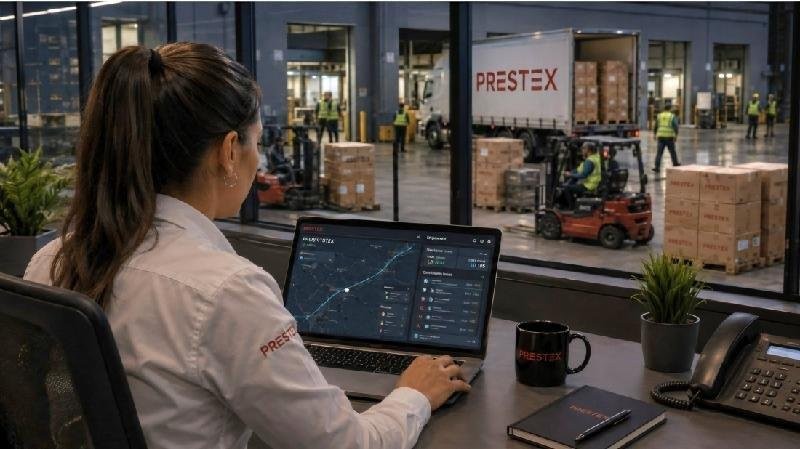
Prestex Logística Ultraexpressa, a national 24/7 B2B logistics provider handling everything from pharmaceuticals to industrial machinery, exemplifies advanced implementation. The company integrated HubSpot’s Agentic AI directly with its ERP and Transport Management System (TMS), enabling autonomous access to systems and real-time decision-making — distinct from rule-based chatbots. Within six months, the solution resolved 30% of customer service requests without human intervention and cut internal operational overload by nearly one-third. Urgent tracking queries now receive responses in under 10 minutes, and real-time invoice lookups automatically route complex cases to commercial, operational, or finance teams.
Rastreabilidade vs. Monitoramento: Predictive Visibility Gains
The IMTS identifies resilience and risk management (21%) and partner oversight (14%) as the most fragile points in Brazil’s supply chains. Prestex’s proprietary Sisprestex platform — launched in 2009 — embodies a shift from passive monitoring to active traceability. As Marcelo Zeferino, Chief Commercial Officer of Prestex, explained:
“Monitoring shows where the cargo is. Traceability explains everything that happened along the way — if there’s a delay, monitoring displays current location; predictive traceability pinpoints the rupture point, quantifies lost time, and assesses operational impact.” — Marcelo Zeferino, CCO, Prestex
Integration with IoT sensors enables proactive alerts — such as immediate temperature excursions for pharmaceutical shipments — turning visibility into actionable foresight.
Human Capacity Remains the Critical Constraint
The Live University study identifies workforce capability as the top barrier to AI adoption, cited by 54% of respondents. Leadership engagement is credited for success in 49% of cases. Prestex addresses this through dual-layer AI tools: Léo, a generative AI for client-facing support, and Max, designed for partner communication and training. According to Zeferino:
“Technology delivers speed and precision, but ethical, contextual decisions remain uniquely human. Critical situations demand human judgment to balance urgency, safety, and responsibility. Automation frees our operational team to focus precisely where human intelligence is irreplaceable.” — Marcelo Zeferino, CCO, Prestex
Source: uai.com.br
Compiled from international media by the SCI.AI editorial team.